
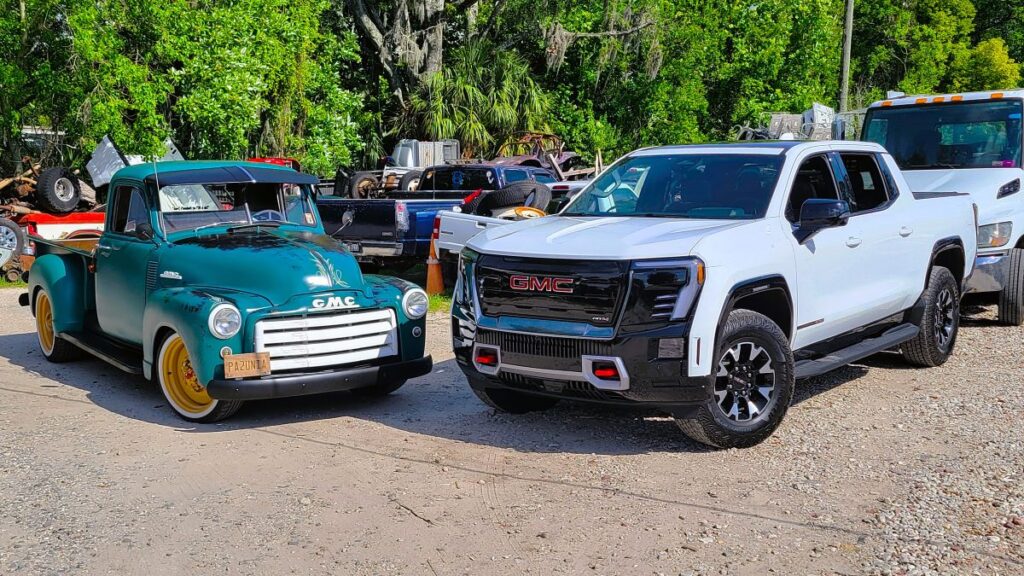


Artist Diana Brewer’s 1952 GMC pickup truck, nicknamed Pa2unia, is a stunning shapely classic design with some handcrafted touches by her.
But as we united this classic, artfully patinated 196-inch-long green pickup with its way bigger great-great grandson, one thing was for sure – it was dwarfed by this high-tech 64-year-old descendant – which does not use petrol as its motivation.
Standing a good foot taller was the 231-inch-long, 75-inch tall 2026 GMC Sierra AT4 EV, as in electric vehicle. And while Pa2unia’s 100-hp inline 6 was a sturdy workhorse then and now, it’s no match for our Summit White Sierra AT4’s 725 horsepower and 775 lb-ft of torque. But gosh, did they look happy together among some amazing stuff in the Brewer’s Towing Service yard, as family cats wandered over to check it all out.
Then we decided to leave Pa2unia and play with our EV Sierra on Northeast Florida’s roads. After all, Pa2unia looks best in the sun, not shaded by a grandchild.
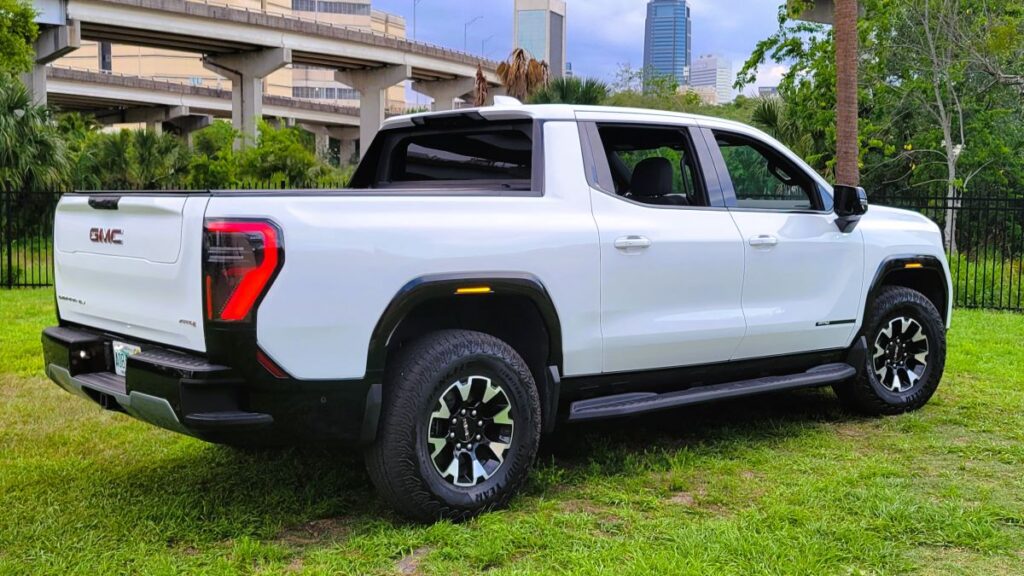
OK, both the GMC Sierra AT4 EV and Chevrolet Silverado Trail Boss EV that we just tested share GM’s Ultium battery platform. So they match each other within an inch or so. There’s also basically the same silhouette.
But the Sierra EV has one thing the Silverado EV does not – a grille, or at least a neat black panel that looks like one. And that black panel makes this EV look more GMC, plus it’s got a cool backlit GMC badge dead center, framed by a lit LED accent.
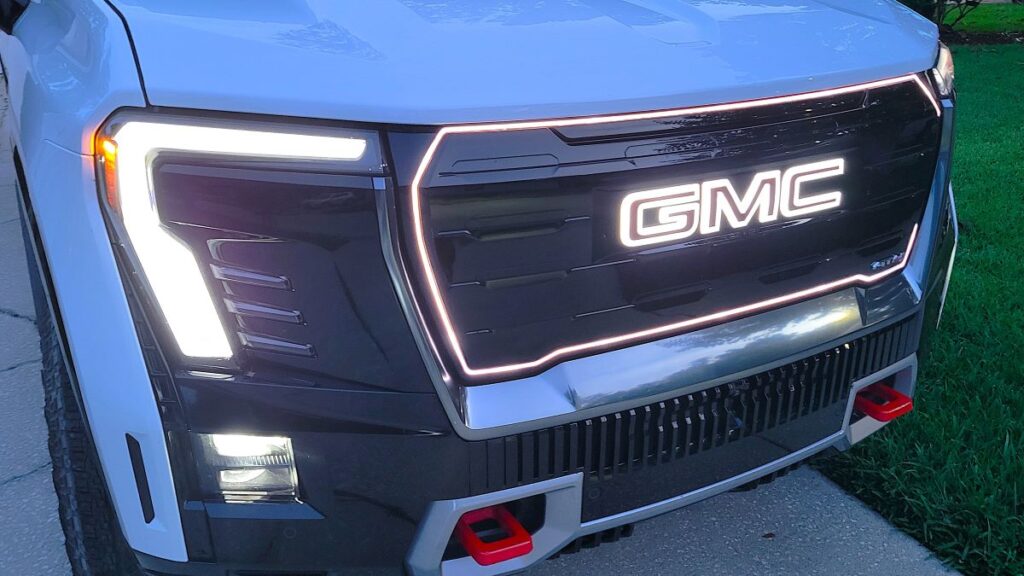
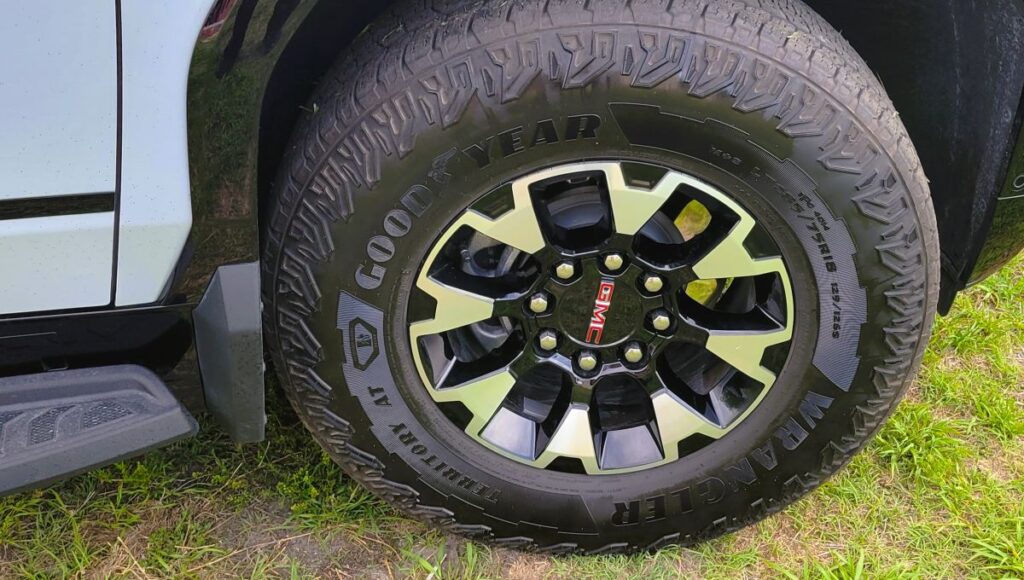
Outer corners are framed by angular DRLs, while the AT4’s red tow hooks are flaked by LED headlights under a ribbed bumper with the only vent, flanked by fog lights – and over a lower skid plate. Squared-off fenders edged in black frame 18-inch AT4 wheels wearing meaty, knobby off-road Goodyear Wrangler rubber with seven inches of clearance between tread and fender flare edge.AT4’s get a 2-inch factory lift.
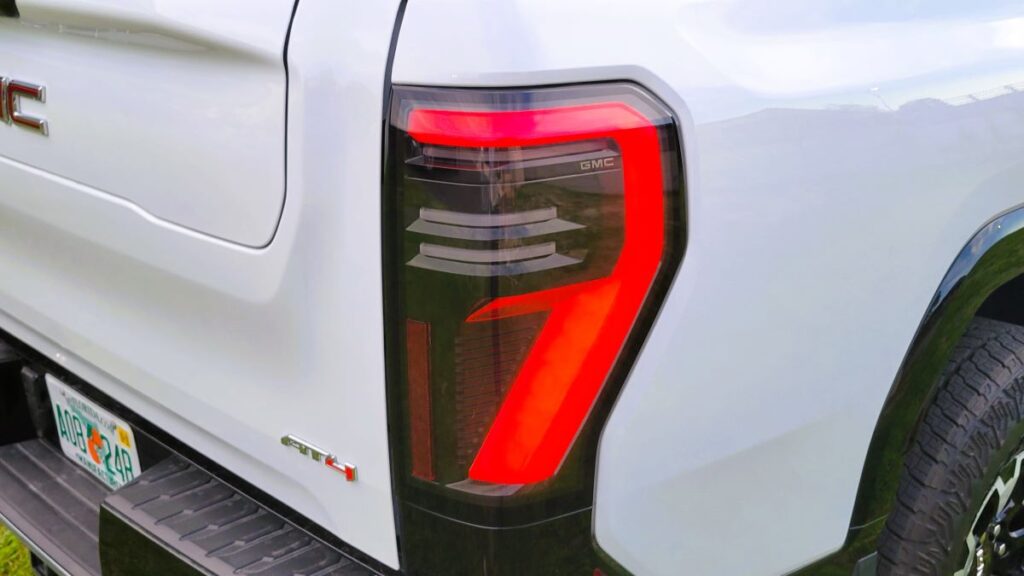
There are running boards under smooth doorskins. The roofline is low, with higher sills for a streamlined look aided by the sloping C-pillars flowing into cargo bed sides. LED taillights flank a multi-purpose tailgate over a meaty bumper and more silver skid plates. There’s a folding solid tonneau cover to protect what’s in the bed.
Cool fact – this Sierra EV is about 11 inches shorter than the gas Crew Cab version – it’s big but short overhangs and a cleaner body shape help visually shrink it. I also like the GMC heritage in its look.
The running board does not deploy, and there’s no grab handle for the driver. All other doors get them – so you grab the steering wheel and hoist up and into black leather seats with white piping and stitched accents. Only what’s below that looks like basic GM plastic.
Our seats were 16-way power-adjustable, the driver’s getting dual memory presets, although the lumbar control on the driver’s seat cushion did not work on our 5,100-mile-old truck.
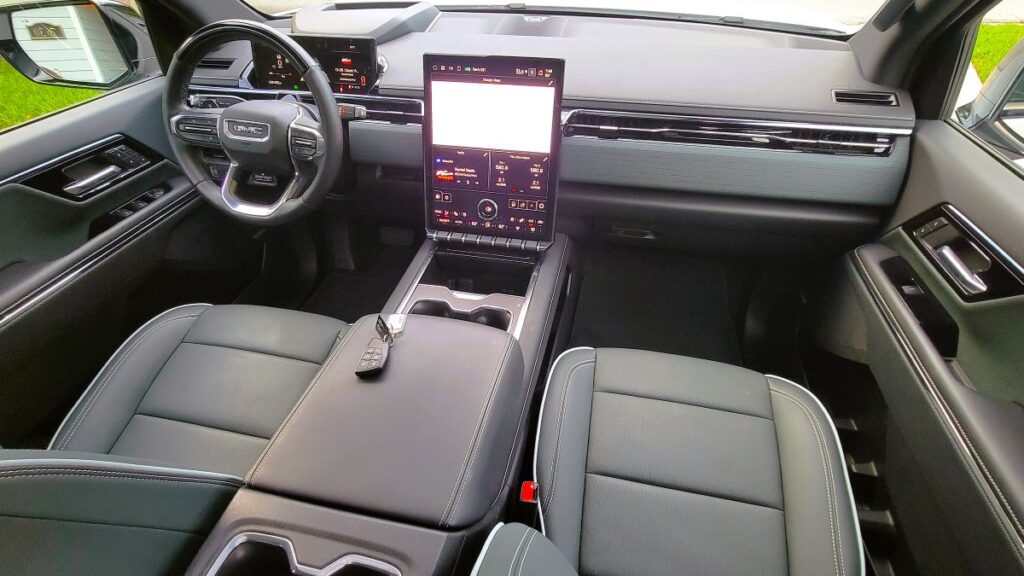
While the Silverado EV gets a sweeping, almost one-piece digital gauge and infotainment display, our Sierra EV starts with a standalone 11-inch screen ahead of the driver. It offers everything from a simplified digital mph readout, to a navigation map with speed, or various gauges. Almost all add a small info screen.
The thick leather-clad steering wheel gets standard cruise and screen selection controls in front, and audio buttons in back, plus a small regenerative braking paddle. It’s adjustable too.
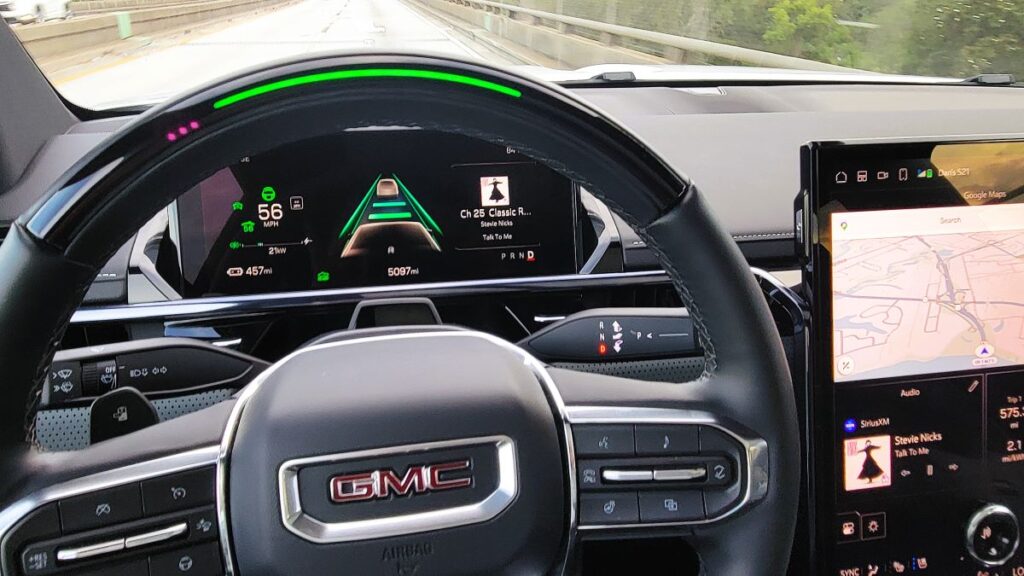
Stacked vertically center-stage, versus the Silverado EV’s horizontal one, is a 16.8-inch touchscreen that shows navigation, EV info and more, with a big volume knob low and center. A main menu screen handily accesses settings, Wi-Fi hotspot, phone and most other controls.
There’s a separate icon to access headlights, as well as a menu for trailering, activating the Wi-Fi hotspot, or sensitivity for regen braking/one-pedal driving. I liked the simulated overhead camera images to help back neatly into spots, plus focused nose and tail camera – great for tight spots, or just centering on a trailer hitch.
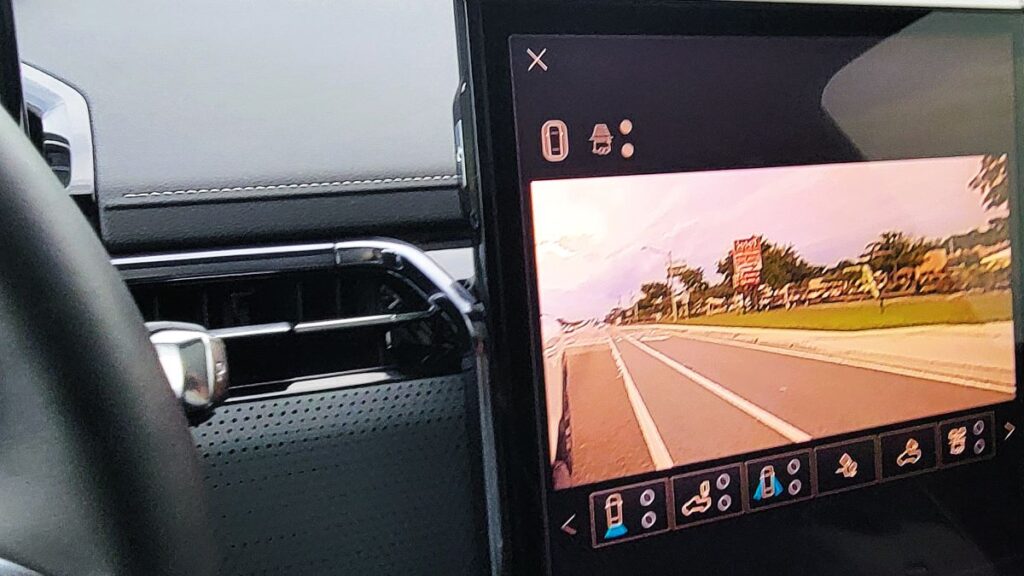
The center screen also shows big left and right blind spot camera views when you activate turn signals. Below are more touchscreen icons for climate control along with 8 physical buttons for those that would prefer to skip the touchscreen.
The wide center console is framed in more perforated leatherette, with a neat inductive phone charger atop the storage area’s sliding door. There is additional space and USB ports underneath along with storage under the padded armrest.
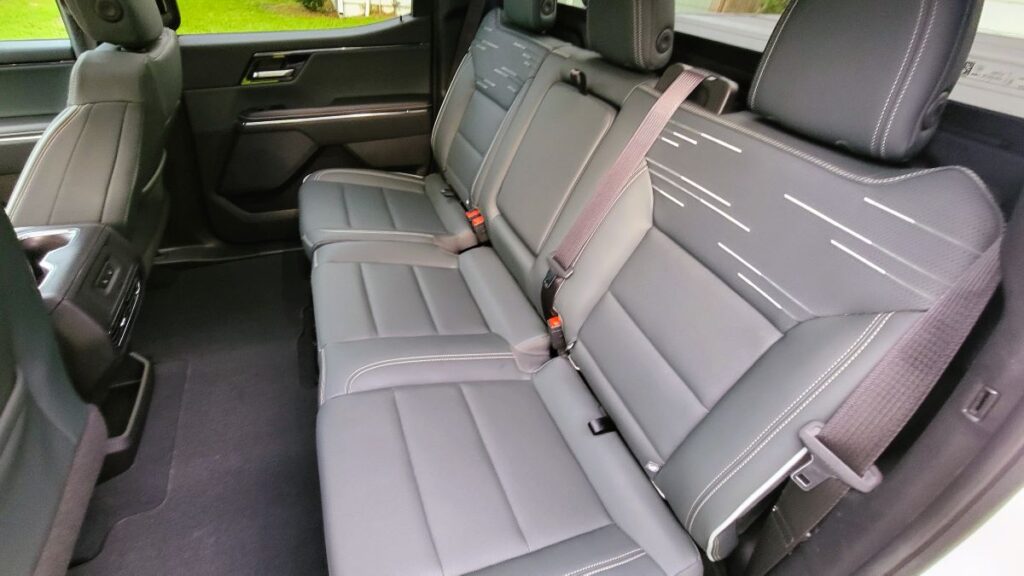
Back seats offer serious head and leg room for two, even three adults, with a/c vents and heated outboard positions. Seat bottoms fold up 60/40 to reveal storage options. The seatbacks flip forward to offer a platform.
GMC Sierra AT4 EV Offers Tons Of Cargo Space
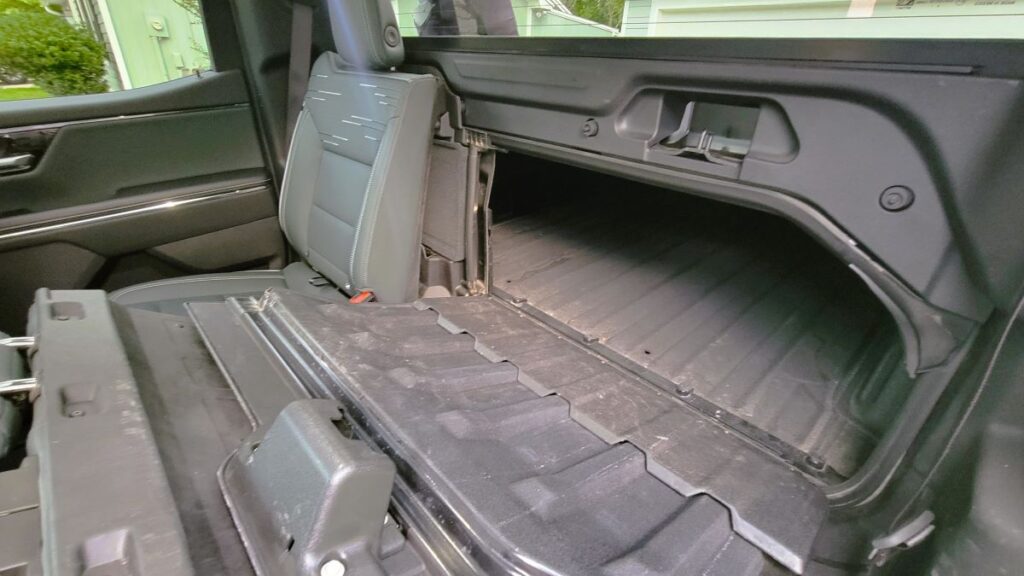
Like the Chevrolet Avalanche of the early 2000’s, there’s a 60/40 midgate behind the seats that folds down to extend storage space into the cargo bed. Even the rear window can be removed for open air driving.
The Sierra EV has a long laminated clear glass roof – no sliding moonroof – tinted to block UV rays. On sunny days, the Sierra did not warm up, but I’d still want that optional $150 sunshade.
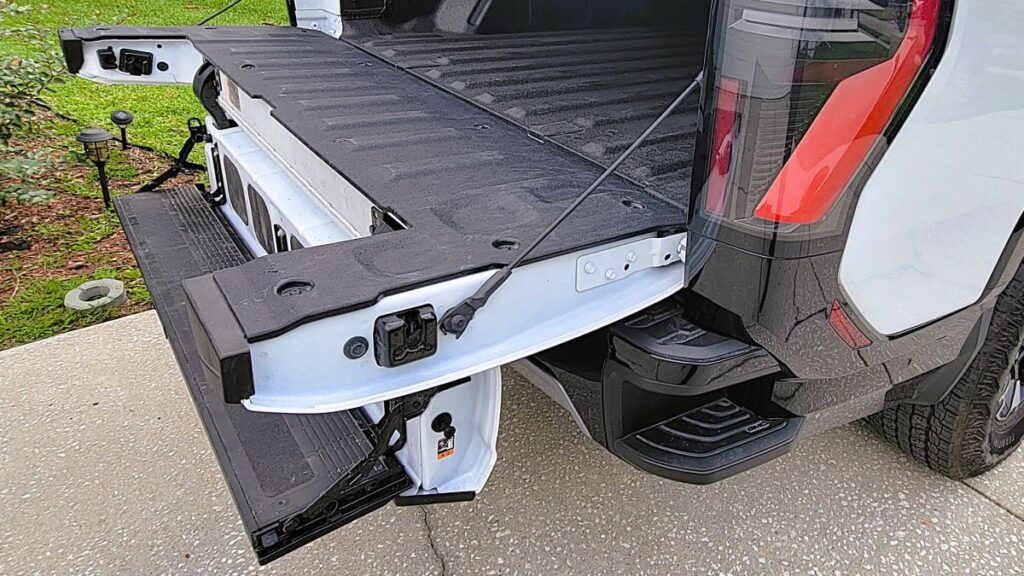
That 57.5-cubic-foot cargo bed has low wheel well intrusion, 115-volt power plugs and a folding metal cover for weatherproof stowage. The MultiPro tailgate has a mini-gate that folds to become a chest-high work table. There’s a step when the tailgate is down;- or a barrier to keep stuff in the bed when it is open. It can handle stuff over 10 feet long. There are steps carved into the outer corners of the rear bumper to ease access to its innards.
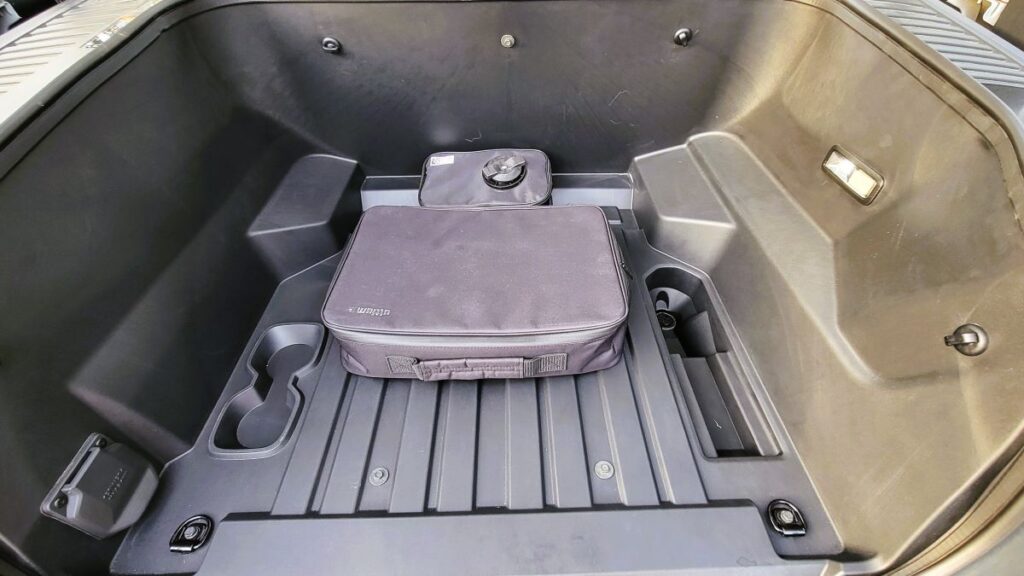
With no gas engine under the hood, there’s a frunk with 11 cubic feet of room, plus cup holders, 120-volt plug and drain plugs for picnic ice to melt away.
GM has done EVs right with its adaptable Ultium platform with lots of room for multiple liquid-cooled lithium-ion battery modules down low between electric motors, one at the front, the other in the rear – with Torque Vectoring e4WD. Tap the right icons to select Max Power, and you access 760 hp and 785 lb-ft of torque from its 205-kWh Max Range battery in the AT4 trim. It has an NACS Tesla Supercharger-style port, allowing you to add up to 120 miles of range in 10 minutes at the fastest Level DC charging stations due to its 800-volt electrical system, or a 10 to 80 percent charge in about 40 minutes. At home it can it can gain 25 to 35 miles of range per hour at a maximum rate of 19.2 kW, assuming you have an 80-amp Level 2 charger.
The result is a real truck with real range. We saw 466 miles of estimated range with a 96% charge. GMC saysits rated for 478 miles with a full charge. After 217 miles of highway and suburban driving, with full regen braking, we still had 49% of the battery left, and an estimated 237 miles of displayed range. This full-size EV truck came close (20 miles) to delivering the real range it promised. We never needed to charge it – and averaged 2.1 miles per kWh. No range anxiety here. That’s not too bad for a pickup truck that happens to be an EV. It can tow more than 12,000 pounds, and retain usable range, we are told.
There are four drive modes – Normal, Off-Road, Tow-Haul and My Mode, accessible via the main screen menu display’s Drive Modes icon. My Mode lets you customize steering, accelerator feel and motor sound, from Normal to Sport.
Oh yes – there’s a Thors Hammer icon on that screen, unleashing all 760-hp. And you can also change your one-pedal regen braking reaction from Normal, to High, or off.
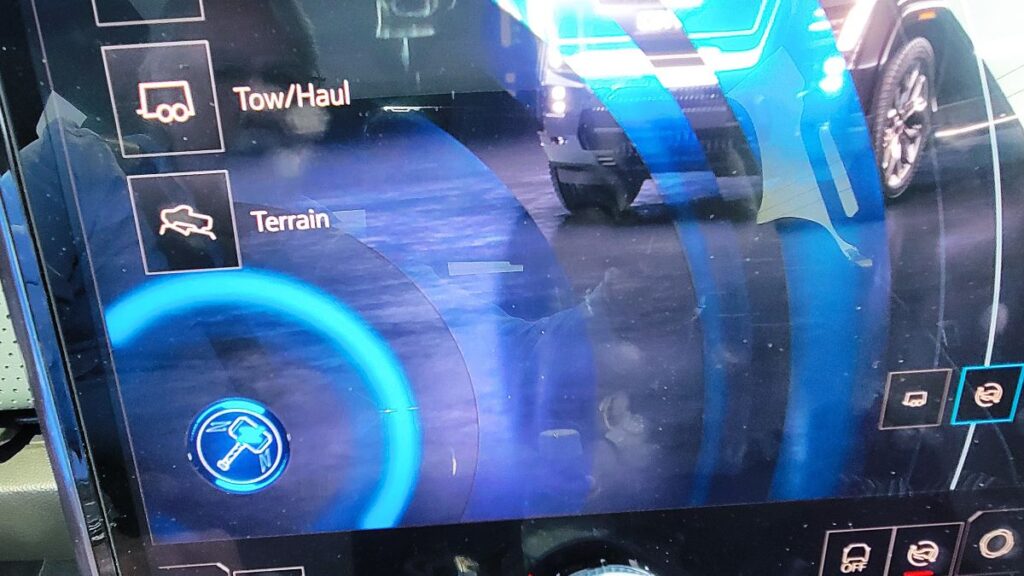
We spent most of our test drive in Normal mode. It’s very responsive, with an immediate launch and 60 mph in 5.6 seconds. Tap Thor’s Hammer – the icon pulses with rippling sound effects – and the Sierra EV launched hard to 60 mph in 4.5 seconds, no drama, no wheelspin. In that mode, motor noise was amplified, a great turbine-like motor noise, while steering really tightens up.
And here’s the fun part. There’s no Sport drive mode, but tap in My Mode, then adjust its settings – Sport steering, Adrenaline in the Acceleration setting, and Sport for motor sound. Tap Thor’s Hammer – this EV rears up and launches, all wheels grabbing, to 60 mph in 3.7 seconds with no drama. There was no diminution of launch torque, or much range loss when we did a succession of quick launches. And acceleration from a stoplight, or to pass, was great due to instant EV torque that stayed online through legal speed.
Chevy Silverado Trail Boss EV Video Road Test (story continues below)
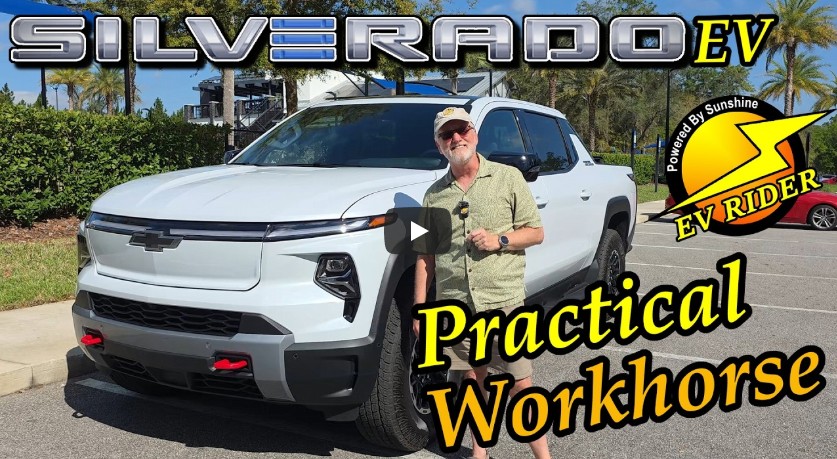
For comparison, the Silverado Trail Boss EV we tested recently hit 60 mph in a quick 5.5 seconds in Normal; MyMode with sport selected did 60 mph in 4.9 seconds. In maximum power mode, 60 mph came in 4 seconds flat.
Our test truck’s fully independent coil suspension with a hydraulic rebound control smooths out rough pavement. Our ride was quite plush yet controlled, probably helped by the weight of the battery pack. Add in tall Goodyear sidewalls and this truck swallowed speed bumps with a one after-bounce. Regen braking allows you to basically “downshift brake” into turns, where this big truck was neutral with a tad of body roll in suburban cornering. Push harder and there’s some understeer, like most pickups.
Like the Silverado Trail Boss we just tested, there’s four-wheel steering. The rear wheels turn a bit opposite from the fronts to tighten turns. We did a U-turn in my neighborhood that a regular gas Sierra can’t handle. There’s also “CrabWalk” – front and rear tires turn the same way to sidestep stuff – novel, with grins from those who saw it.
The 8,844-lb. GMC’s 14.5-inch front/13.5-inch rear disc brakes had a solid pedal feel and decent stopping power with some nose dive at full stop. In daily driving, one-pedal regen invoked right as you let off the accelerator. It was a bit abrupt until I figured it out, then finessing it is easy, to stop this Sierra EV where you want.
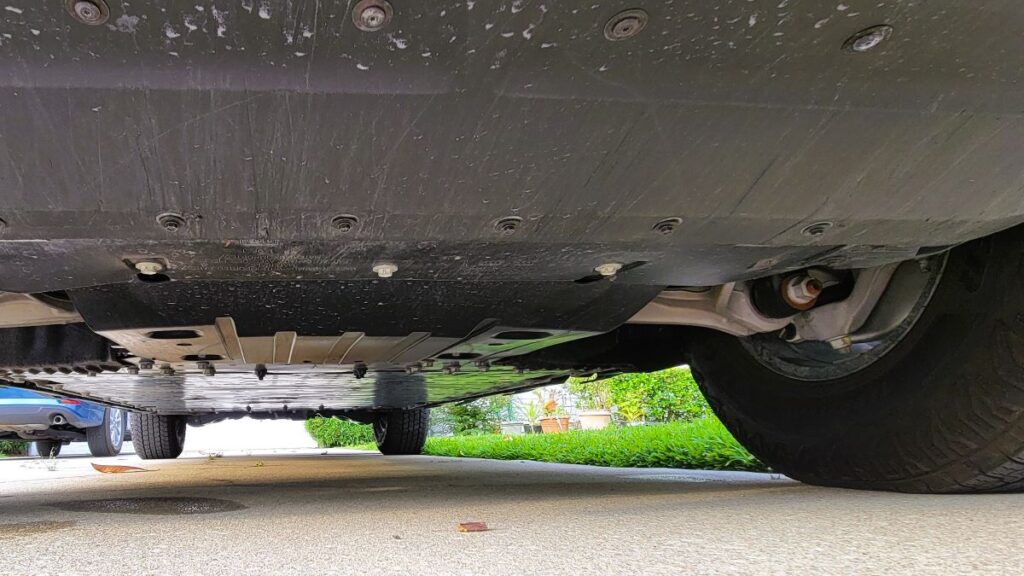
Then we tried this 4-ton EV, with its all-wheel-drive, all-terrain tires, 2-inch off-road lift and underbody protection, on bumpy, dusty Florida woodland roads. Using Terrain mode, which turns off traction control, backs off throttle input and mimics a gas truck’s low range, its easily handled ruts and sandy verges. There was no wheelspin under acceleration.
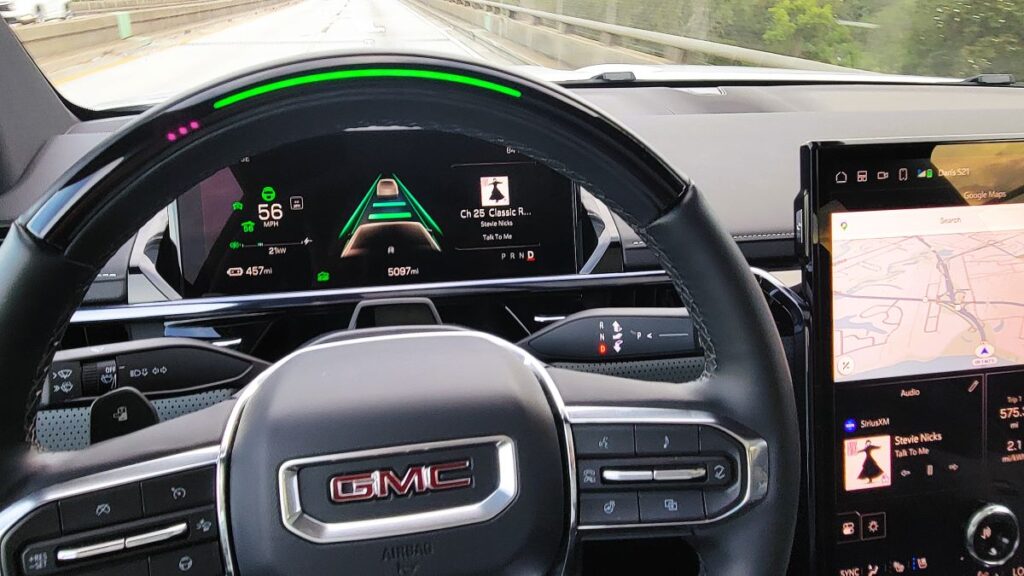
Super Cruise (included in AT4) easily handled autonomous driving on federal and some state highways, staying on and maintaining lanes hands-free. Unlike some other hands-free systems, this one will only change lanes if you tap the stalk. This is also a very quiet truck, nothing other than a hint of wind and tire noise at highway speed.
And after pitting classic and new GMC nose-to-nose, what did the Brewers think of Pa2unia’s great-great? They loved the shape, technology like its crab-walk and rear-steer, and the EV range. But Pa2unia, as Diane’s pride and joy, is still the GMC to have, they say.
The 2026 GMC Sierra EV Elevation with EPA-estimated 283-mile standard battery, starts at $64,995. Our AT4 Max Range starts at $89,600, with the $2,250 folding bed cover – final price of $93,545; a few bucks less than the Silverado EV Trail Boss we just tested with similar gear.
Bottom line: The range, power, relative agility and room for everything makes this a real choice for a real EV truck – and it looks cool, even next to Pa2unia.
2026 GMC Sierra AT4 EV Max Range Specifications
Vehicle type – full-size 5-passenger crew cab all-wheel-drive electric pickup
Base price – $89,600 ($93,545 as tested)
Powertrain type – dual-motor w/electronic 4WD and torque vectoring, and 205 kWh battery pack
Horsepower (net) – 760
Torque – 775
Transmission – 1-speed transmission
Wheelbase – 145.7 inches
Overall length – 233 inches
Overall width – 83.8 inches w/o mirrors
Height – 78.2 inches
Front headroom – 43.9 inches
Front leg room – 44.8 inches
Rear headroom – 38.7 inches
Rear legroom – 44.3 inches
Cargo bed – 5-foot, 11-inches/57.5 cu. ft. volume
Payload/towing – up to 2,100 pounds/12,500 pounds
Weight – 8,844 lbs.
Range – 478 miles (GM-estimated w/Max Range battery)