
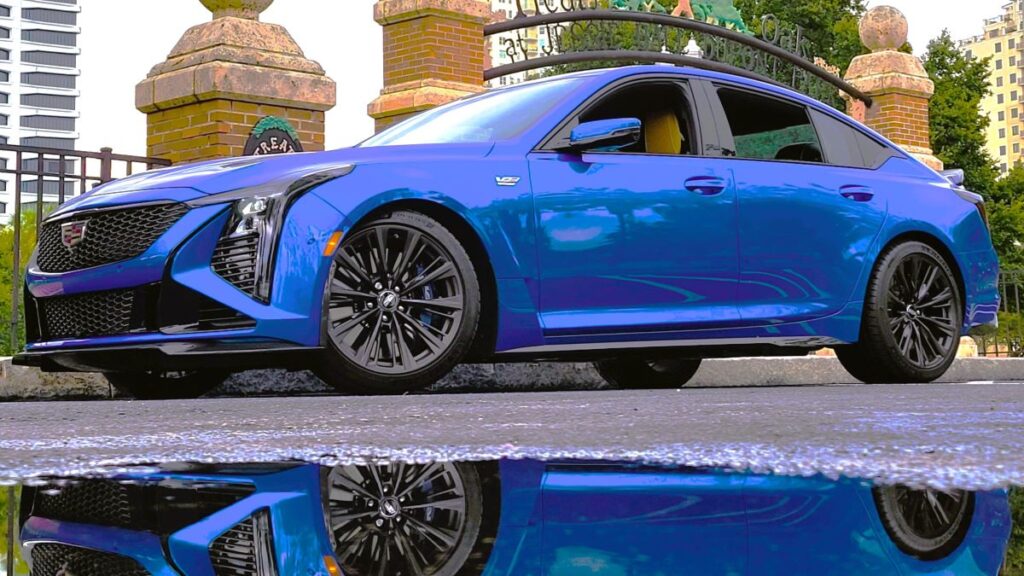


Blame Wayne Cherry. Or….we should probably praise him.
When he was General Motors’ VP of design from 1992 to 2004, he led a Cadillac styling decision to give the cars sharper edges with light blades – vertical lighting elements that harkened back to the cool ‘69 Eldorado’s front and rear light designs.
Now, 57 years later, what was known as the “Art & Science” design language remains a key part of Cadillac design. And with our 2026 Cadillac CT5-V Blackwing, so does performance. Say hello to what I call a 4-door Corvette.
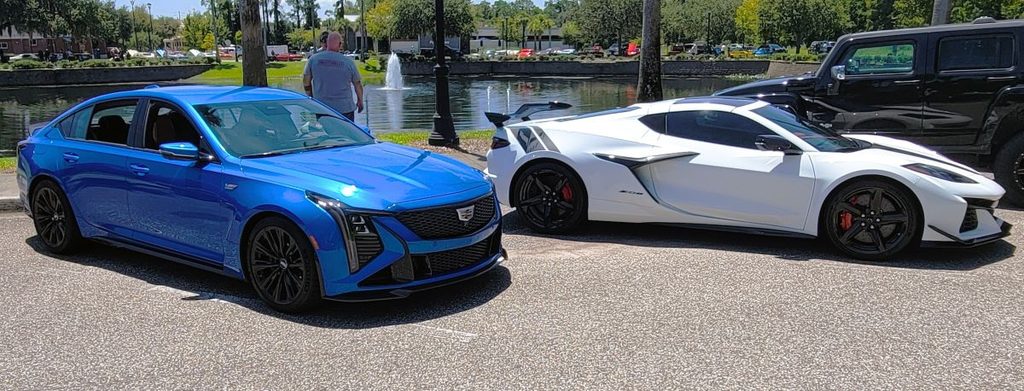
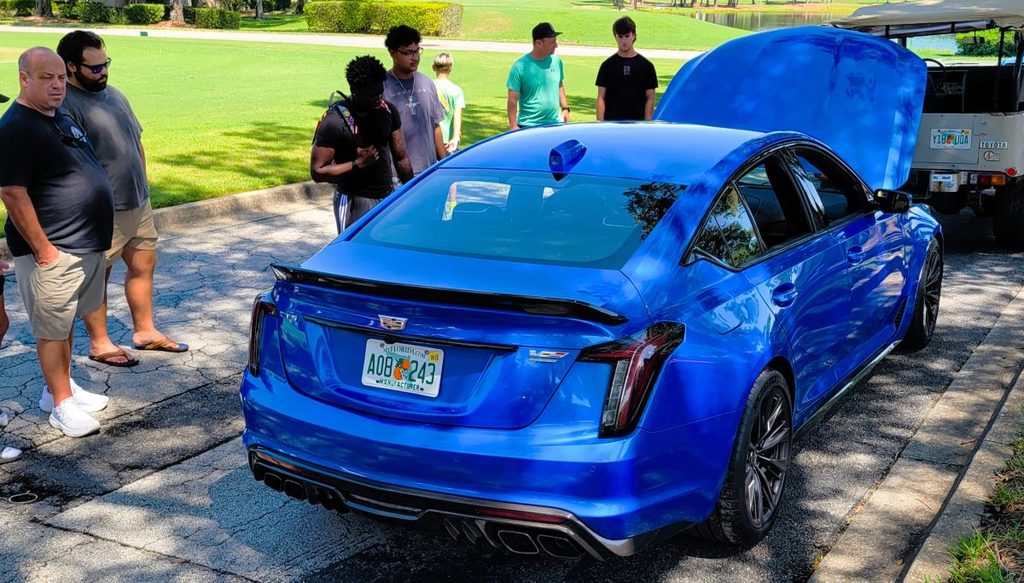
Let’s not mince words – as more than one onlooker said, this is a 4-door Corvette, albeit with the C7 (2014-2019) Z06’s 6.2-liter supercharged V-8, aka LT4. And with Cadillac in Formula 1, and now showing off the V-ONE concept – a slick version of its IMSA Weathertech race car, there’s certainly some trickle-down in tech and attitude from racing to Blackwing.
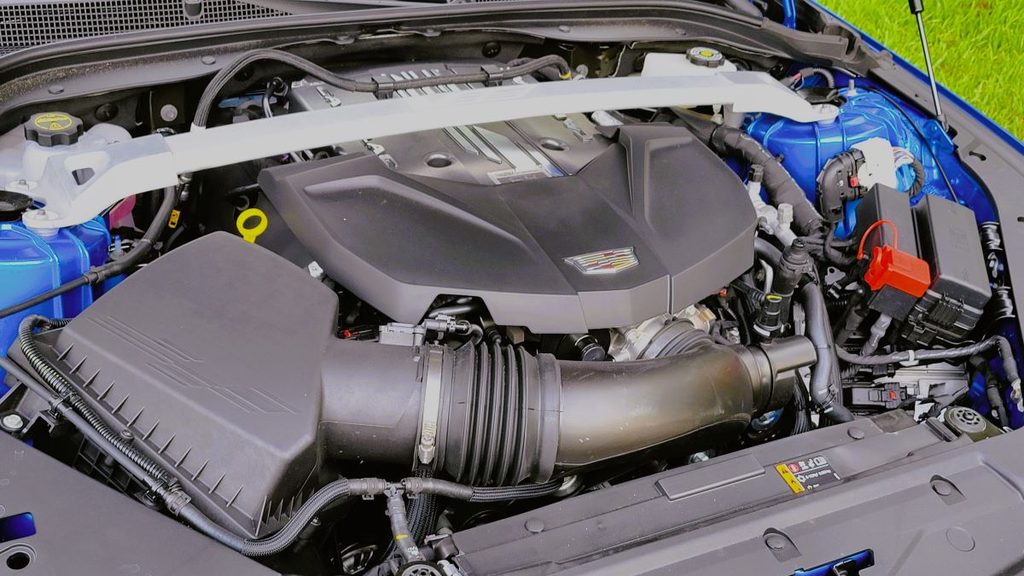
It’s got a supercharged 6.2-liter, cast alloy 16-valve OHV V-8 with 668 hp at 6,500 rpm, and 659 lb-ft of torque at a low 3,600-rpm. You can get it with a Tremec 6-speed manual; alas, ours had a quick-shifting 10-speed paddle-shift automatic. And Jason Neal hand-built this beauty’s engine. His signature is on a build plate atop the V-8, near the cool strut bar, on this newish 1,500-mile-old sedan.
Cadillac CT5-V Blackwing: Sports Car Performance, Sedan Practicality
The result is a very quick 4,142-lb. rear-wheel-drive sedan – 3.7 seconds to get to 60 mph in Tour mode; and 3.5 seconds in V-Mode with Launch Control, which is easy to set up.
You preset V-Mode’s steering, suspension, brake feel, engine sound and shift to Tour, Sport or Track modes, while the PTM (Performance Traction Management) can be set from none to full on.
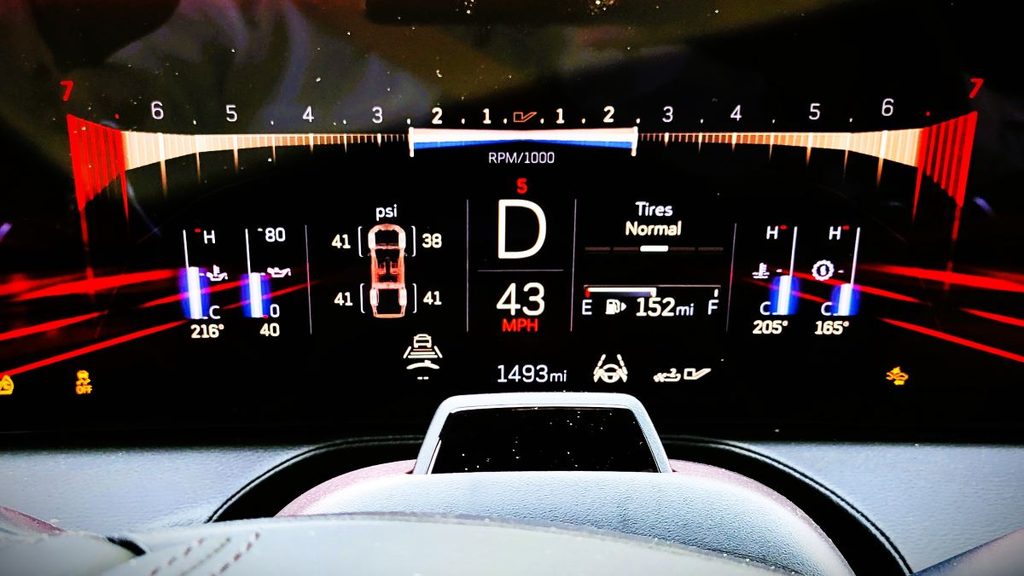
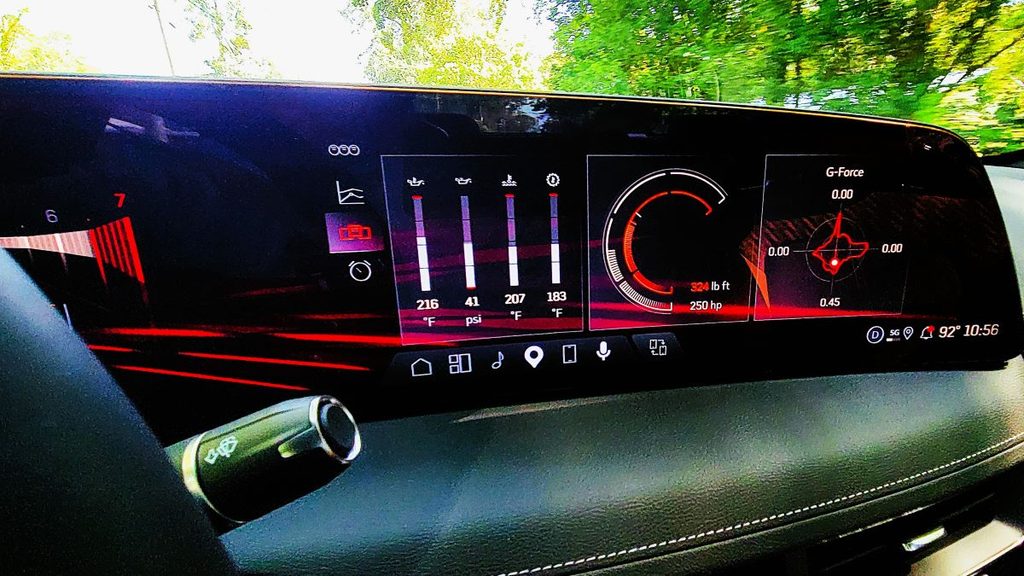
I went with track mode, the gauge display showing strip tach and speedometer, tire condition, many engine gauges, gear, and stability and traction control status. Launch Control is activated by an touchscreen icon on the gauge display, then just left-foot-brake/right-foot-gas.
On a private road, Blackwing says when to release the brake, then we launched with rapid-fire upshifts, a beautiful exhaust note, and a hint of wheelspin in first-to-second, and second-to-third upshifts – it is wicked quick, yet well-mannered.
And launch shoves us into the leather, pulling an impressive .8Gs.
A 2025 Blackwing we tested hit 60 mph in 3.9 seconds in Tour, with a wondrous bellow from the pipes. In Sport mode – 60 mph in a 3.7 seconds. And in Launch Control, 60 mph in 3.5 seconds.
Tour mode is what I used daily, with plenty of power and about 20 mpg in commuting from this test car. The Blackwing requires 91or higher premium with Cadillac recommending 93 octane to achieve its full 668 horsepower.
It’s just fine for every day driving. Push the gas pedal harder and the Cadillac had a hint of wheelspin into first, second and third in all drive modes, but traction control caught it clean and quick. In V-Mode and Sport, downshifts brought a rumbly overrun with exhaust crackling. And traction is so good we pulled Gs on launch, this sedan still quicker than a 2022 Corvette ZL1 I tested with a 495-hp/6.2-liter V-8.
The McPherson-type front suspension is joined with a five-link independent rear with coil springs, all tied together with Cadillac’s fine Magnetic Ride Control. The result is supple yet taut in Tour mode with quick damping of bumps, and a comfortable, quiet ride – we only heard some tire thump on expansion joints at highway speed. Set in Sport, you felt things firm up, but never harsh, with quick bump damping and tight control.
The Track setting for the suspension really firms up the ride, making it stiff enough that some folks may not like it. And the exhaust in Track mode, while delicious in its burbling overrun with exhaust crackles, might not be fine for late night neighborhood runs. So Sport mode is a fun way to drive this Cadillac, making it feel smaller than it is.
In any mode, the CT5-V Blackwing is very agile and responsive, fairly flat and quite neutral in turns, easily pulling .6Gs in neighborhood corners at low speed. In Sport and Track mode, driven harder into a roundabout or ramp, the Blackwing stayed very neutral, pulling a drama-free, neutral 1.04Gs . Steering in Tour mode was direct, with good feel; very direct with serious feedback in Sport and Track.
We did not have the carbon ceramic brake rotor option. But the 15-inch disc brakes with Brembo six-piston calipers (front), and 14.4-inch rear discs with four-piston calipers (rear) were very good – a quick-reacting pedal with serious control and short, straight stops every time. And those stops – negative 1.17Gs on deceleration, with no fade after repeated use. Super Cruise autonomous driving saw it easily stay in lane hands-free, only drifting a bit over bumpy pavement, and changing lanes with just a tap of the stalk – loved the rear-view mirror’s wide-screen rear video image.
With all this power comes serious looks, still hewing to Wayne Cherry’s design mantra.
Edgy shapes with razor-thin lighting elements made the CTS look pretty cool in 2009. Now that midsize sedan has evolved into the CT5-V Blackwing, which we tested as a 2025 model last year. This midsize Cadillac was redesigned for 2020, and refreshed last year. And the first thing we notice is that the light blades remain – how could you miss them, when front and rear blades do a digital dance as door handles glow upon sensing the key fob.
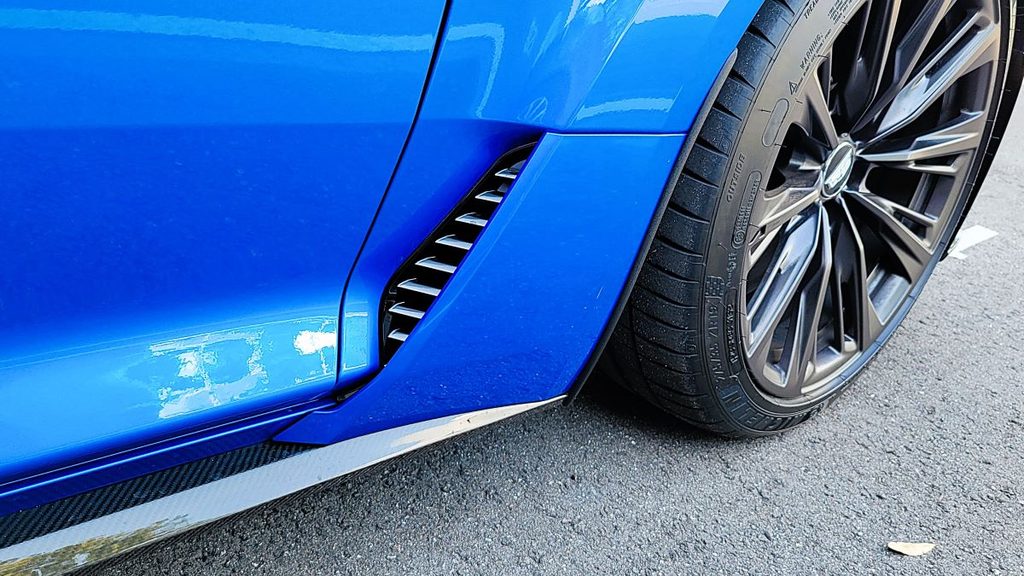
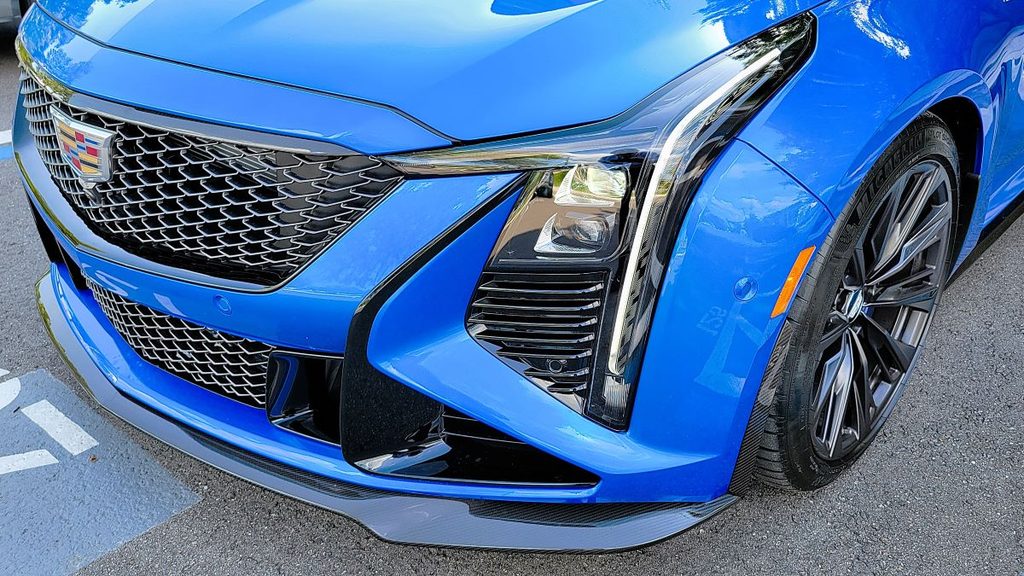
Sitting wide and very low on those 19-inch Michelin Pilot Sport tires, the wheels are wider in back with blue brake calipers visible between gloss black alloy wheel spokes. The grille is gloss black under a carbon fiber spear. The stacked LED headlights’ light blades wrap up into edgy front fenders. The lower air intake is deep and flanked by brake intakes. And there’s a deep carbon fiber lower air dam.
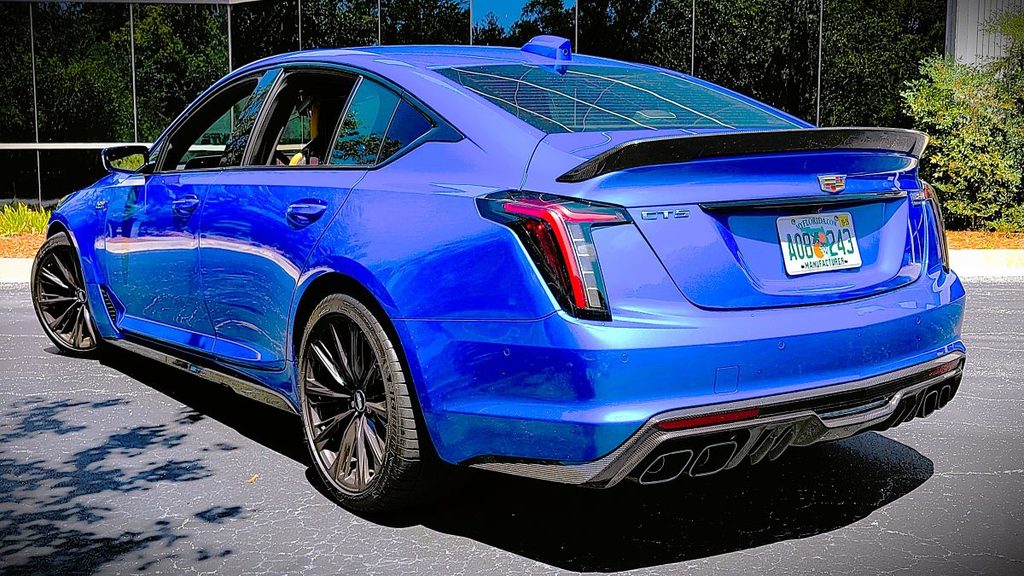
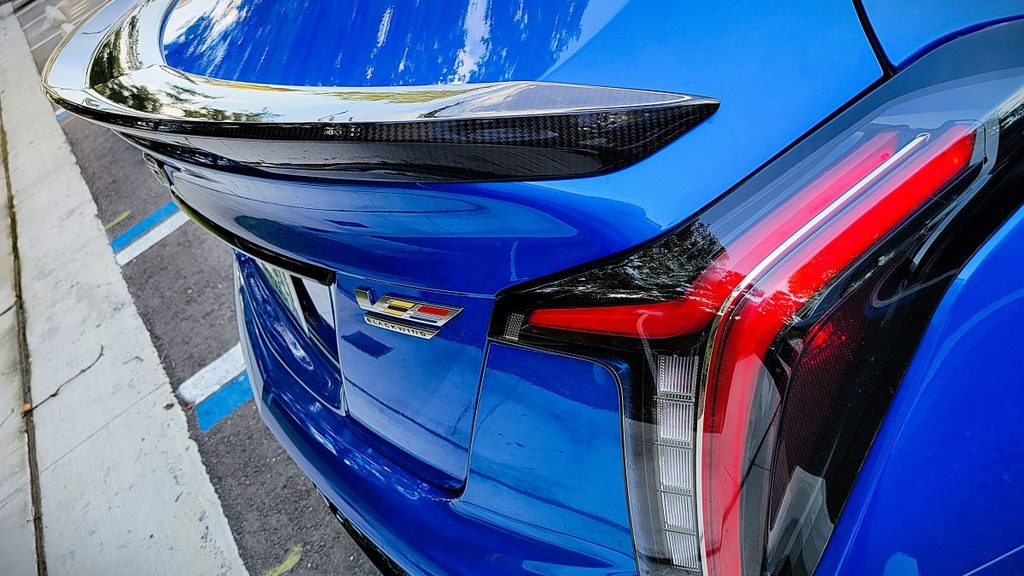
The rubber hugs flared fenders tightly, the 116-inch wheelbase emphasized with black carbon fiber sills that also visually lowers the sedan. The roofline is low atop the gently carved flanks, as the rear window line flows semi-fastback down to a shirt decklid with a tall carbon fiber spoiler. The taillights flow around the outer rear corner. And the lower rear carbon fiber fascia means business, framing squared black chrome exhaust tips.
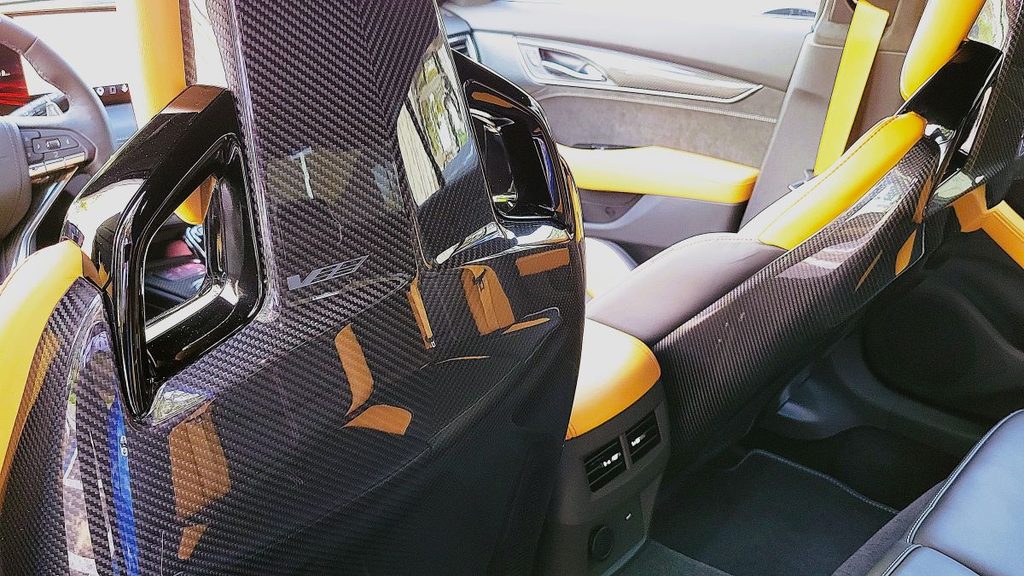
Parked at two area cruise-ins, the Blackwing got lots – and I mean lots – of attention. Corvette owners were transfixed by the supercharged engine, akin to what motivated the C7 ‘Vette. Others loved the carbon fiber-shelled seats, the sweeping digital dash, and the serious performance-oriented rubber and huge disc brakes.
Cadillac CT5-V Blackwing Interior: Firm And Supportive
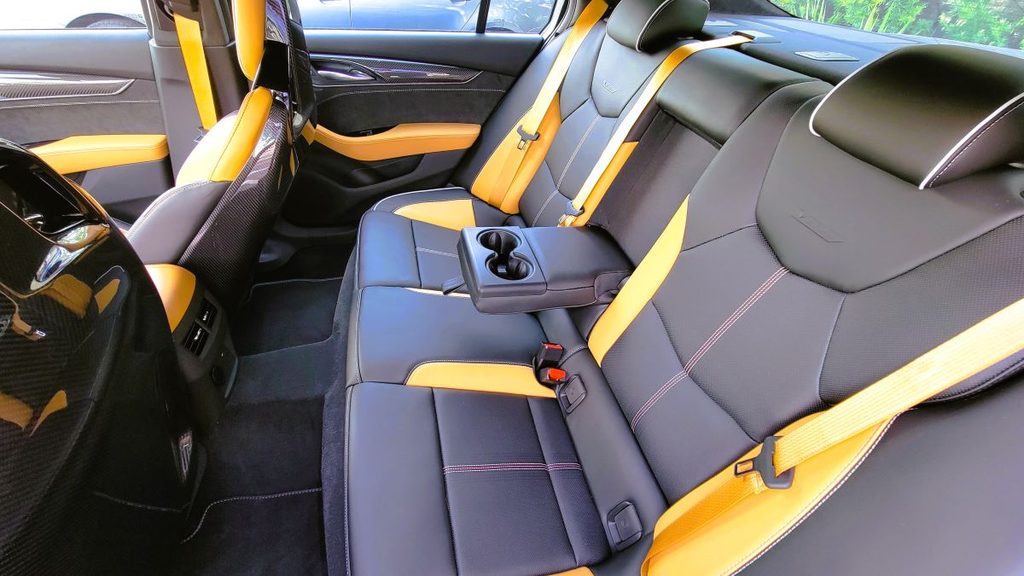
Our test car featured a black over tan leather interior with white piping on the seat’s prominent bolsters, and a neat red and white stitched center accent. While the two-tone interior wasn’t to everyone’s taste, folks wanted to sit in the carbon fiber-shelled buckets. They are very firm, but very supportive and comfortable; with heat, cooling and gentle massage.
The thick padded leather steering wheel has more carbon fiber. Paddle shifters live in back; the usual audio, cruise and screen controls in front, although the etched symbols on metal buttons for things like autonomous diving and volume are tough to see in the daytime.
More Cadillac Coverage (story continues below)
2026 Escalade IQL EV Is Cadillac’s Biggest, Plushest SUV
2026 Cadillac Lyriq-V Rips With 615 HP Of Smoothness
’26 Escalade Platinum Sport: High Tech Interior, V‑8 Punch
2026 Escalade ESV Platinum Sport Review
Cadillac With Corvette Heart: 2025 CT5 V Blackwing
2026 Cadillac Vistiq: Stylish 3-Row Family Hauler
Turn signal and wiper stalks feel more “sturdy Chevrolet” than “precision Cadillac,” unlike the rest of the controls. And new for 2026, a Performance Data Recorder with a memory card slot allows you to record your track times.
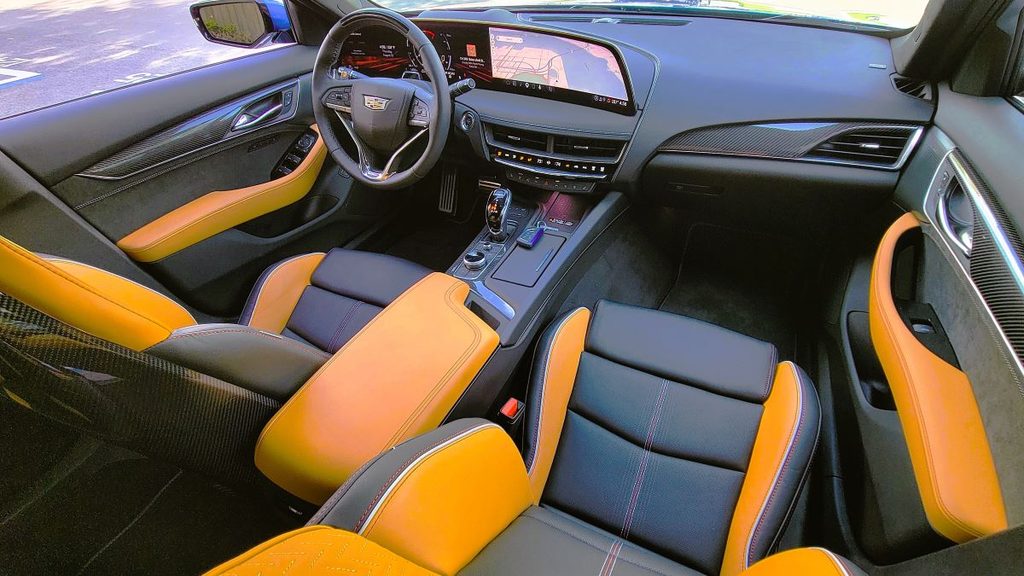
Another wow for onlookers is the 33-inch diagonal advanced curved LED display, added last year. It gets a configurable gauge screen straight ahead with Sports, Touring or simple digital speed readouts.
And it seamlessly flows into a wide-screen navigation map, or performance gauges that include power/torque, engine stats and G-Force.
The black dashboard is done in stitched leatherette with real carbon fiber, more on doors over suede. The headliner is a plush suede as well, with no sunroof, which some folks missed.
The center console is stitched leatherette and carbon fiber with dual smartphone inductive chargers under real buttons for climate control and other stuff. There’s an electronic gearshift with manual shift option, then a handy main screen twist/tap and volume control for a solid 16-speaker AKG audio system. And thanks to those controls, the functions in the main screen were easy to handle for functions which include wireless Apple CarPlay and Android Auto, and HD radio.
The back seats have lots of leg and head room, with rear a/c vents – but the sloping roofline means you have to duck to get in. And your knees may touch that carbon fiber front seat shell. But like a classic Cadillac, there’s also a decent (11.7-cu.ft.) trunk that hands-free opens, expandable with split folding rear seatbacks.
I still love the small number plate at the bottom of the steering wheel. Ours reads 81-1211. That means it’s a limited edition CT5 (8), with 10-speed automatic (1), then the last three numbers show the production number for the car we had in that configuration.
CT5 pricing starts at $49,200 for the RWD Premium with turbocharged 2-liter four, up $110 since 2025; our CT5-V Blackwing is the top tier, starting at $98,900, up $1,300 since our 2025’s base. We had $32,265 in options, including $8,630 carbon fiber exterior trim; $8,090 semi-aniline leather interior with carbon fiber front seats; and $2,600 SuperCruise with alloy shift paddles. A few more options tallied it to $132,960.
Bottom line: This Blackwing is still America’s classiest performance grand tourer, with some serious luxury, tech and racing-bred performance. Plus, four doors when the family wants pace with cornering poise and grace. And that V-8 exhaust growl, tunable from subdued to serious!
2026 Cadillac CT5 V Blackwing Specifications
Vehicle type – 4-door, 5-passenger all-wheel-drive sports sedan
Base price – $98,900 (as tested: $132,960)
Engine type – supercharged OHV 16-valve aluminum V-8
Displacement – 6.2 liters
Horsepower (net) – 668 @ 6,500 rpm
Torque (lb-ft) – 659 @ 3,600 rpm
Transmission – 10-speed automatic w/paddle shifters
Wheelbase – 116 inches
Overall length 194.9 inches
Overall width – 74.1 inches w/out mirrors
Height – 56.5 inches
Front headroom – 39 inches
Front legroom – 42.4 inches
Rear headroom – 36.6 inches
Rear legroom – 37 inches
Cargo capacity – 11.9 cu. ft.
Curb weight – 4,142 lbs.
Fuel capacity – 17.4 gallons
Mileage rating – 13 mpg city/20 mpg highway