


I could make jokes about all the soccer Dads and career Moms who drive a Ford Explorer – I literally drove past dozens as I tested this one.
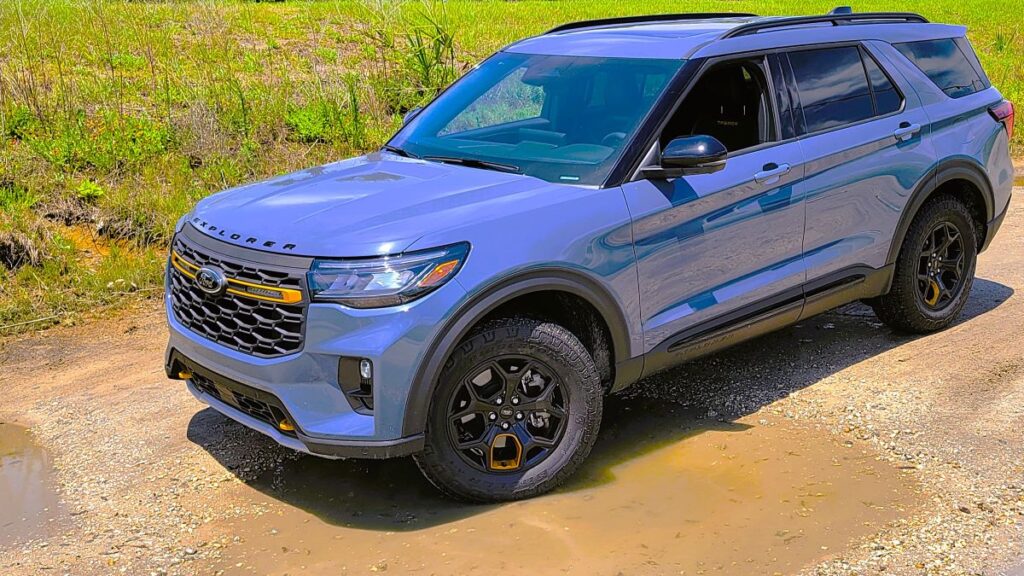
But in my city, and many counties around, a version of the Explorer called the Ford Police Interceptor Utility is the go-to for those in uniform, mostly in Carbonized Gray. Ours have reflective logos that sort of blend in during the daytime, so with the slimline LED light bar and no cargo rails (standard on police Explorers), they are quite invisible – they are quite invisible –civilian‑looking to other drivers. And my Explorer Tremor’s Vapor Blue Metallic – kind of metallic gray – almost looks like my local Sheriff’s Office’s.
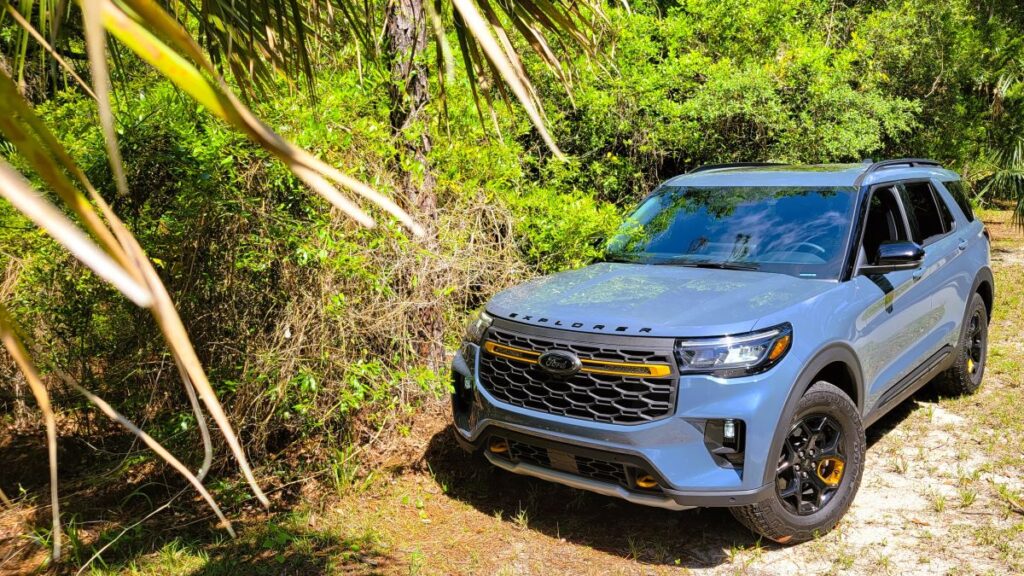
The first Explorer in 1991 looked like what it was – a rear-wheel/four-wheel-drive SUV atop a Ranger pickup. But as of 2011’s fifth-gen, it shifted to a front-wheel/all-wheel-drive platform with turbocharged fours and sixes. Then came the fully revamped sixth-gen atop a new rear-wheel-drive based platform in 2020 – our 2026 Explorer is a 2025 refresh of that model. And one look tells you it’s an Explorer, from its sweptback, almost Range Rover silhouette that’s an evolution of its recent generations. And there’s lots out there – the Explorer has always been a top selling SUV – almost 187,000 in 2023; just over 194,000 in 2024; and almost 223,000 in 2025.
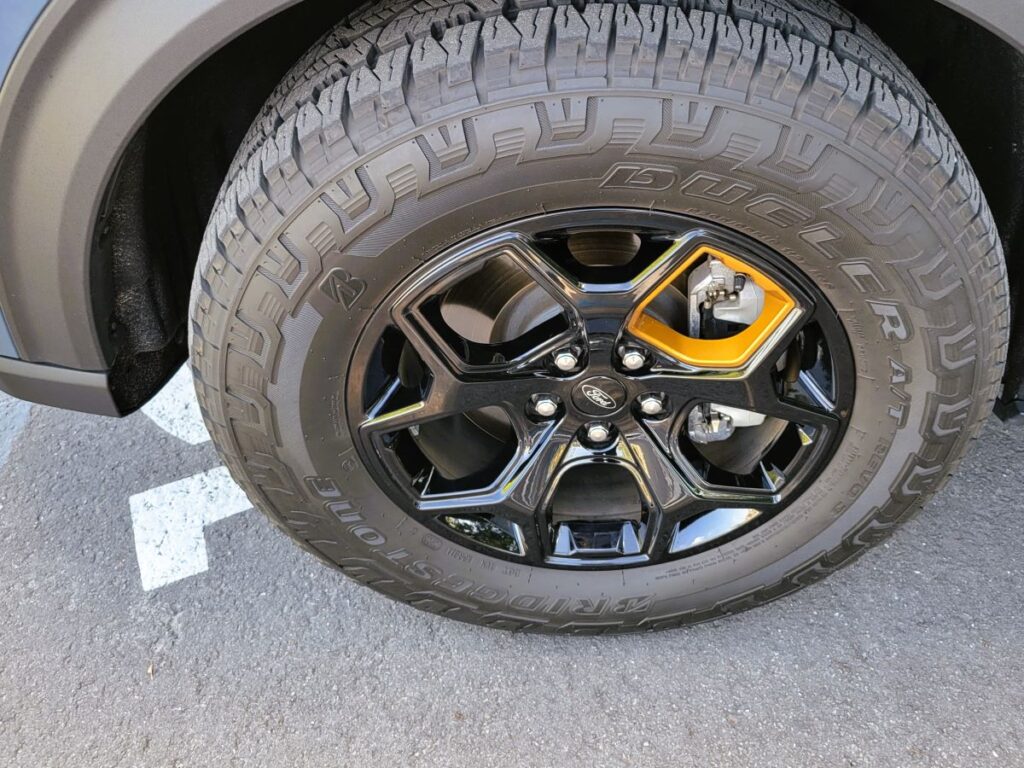
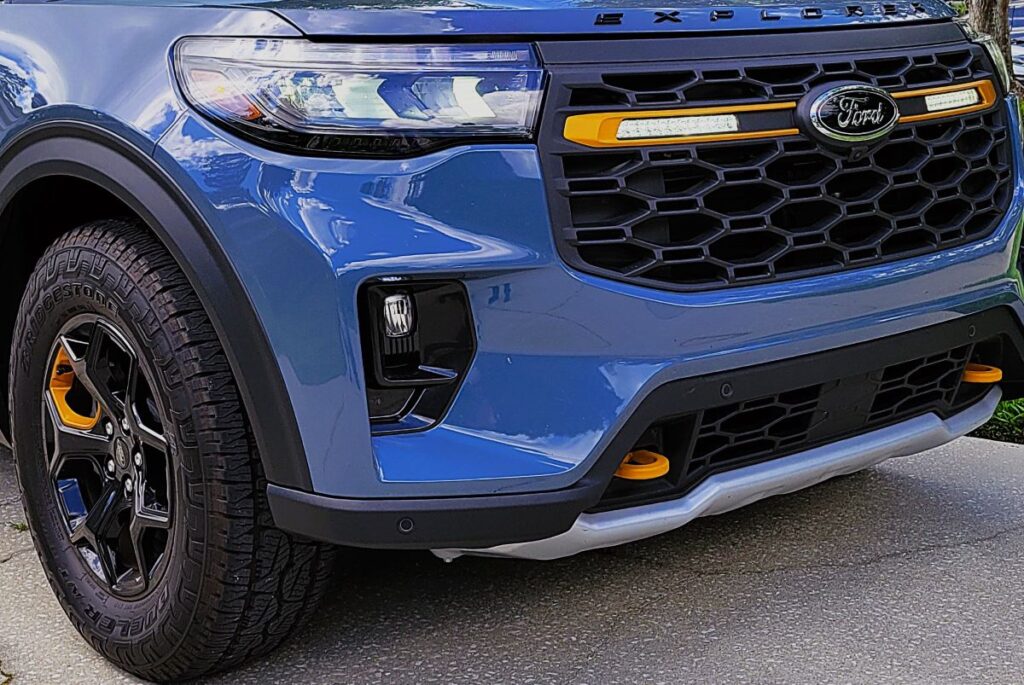
The new grille gets wider, a copper bar accent across the Tremor model’s black honeycomb mesh between LED headlights with strip DRLs. Fog lights live in deep sculpted side vents, while the lower center intake gets copper-colored tow hooks and a silver skid plate. The flanks don’t change from 2020 – gently flared fenders framed in black over gloss black alloy wheels, one spoke done in – yes, copper – wearing off-road oriented 18-inch Bridgestone Dueller A/T rubber.
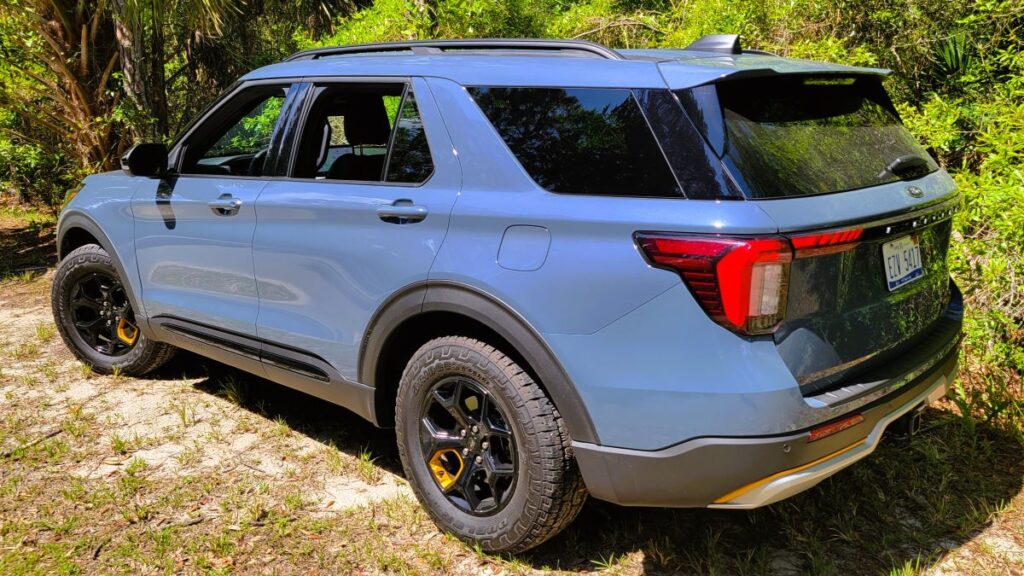
The familiar rising accent line across the doors is there over prominent black sill accents. Slim roof racks are black. In back, large taillights now get a gloss black bar connecting them over a black bumper with silver skid plate-like accents, a hint of copper in there.
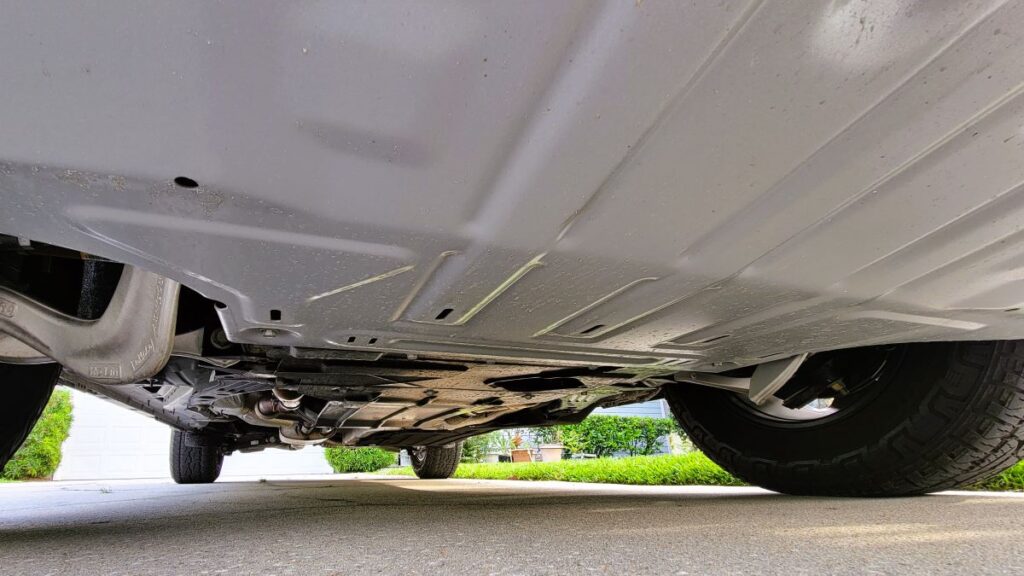
And gaze underneath – there’s a real skid plate behind that bumper, in case you run over a sunken palm tree. And off-road lights flank the Ford emblem – really bright LEDs – but they can only be activated with high beams on, and only after diving two steps into a screen menu.
The 2025 refresh of the Explorer eliminated a lot of physical controls inside, and expanded its digital content. And with our Tremor model, there’s some subtle upscaling going on as well.
Under the padded black dashtop lives a total redesign of what faces the driver and passenger. It does away with the original 2020 model’s multiple buttons. There’s a fine mesh black cloth, then silver trim over textured gray facing the dashboard, with copper thread underneath. Perforated aluminum Bang & Olufsen speaker grills accent doors over more stitched armrests.
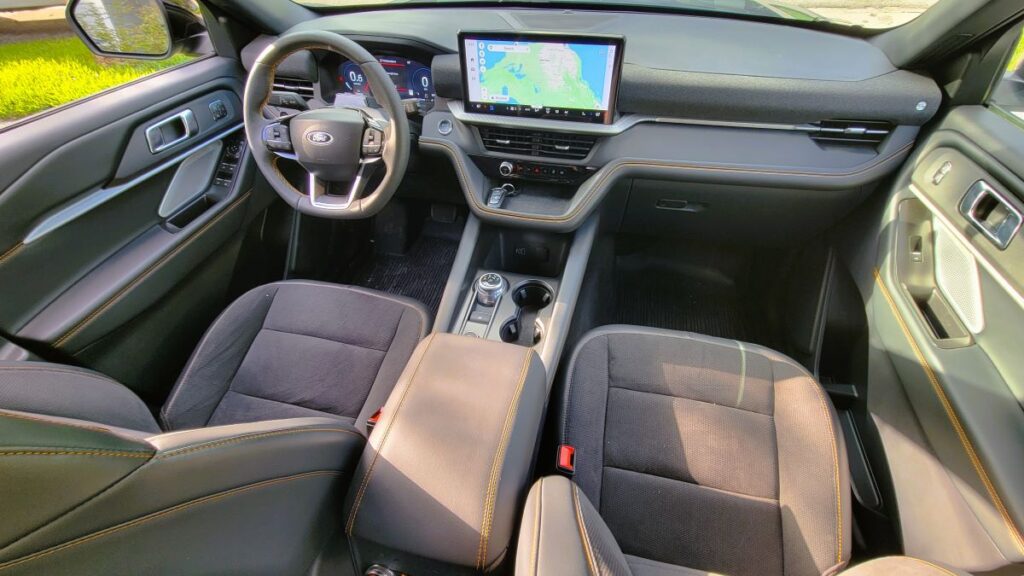
Dash center is a wider touchscreen that handles almost every infotainment function you wish, albeit some a menu tap or two down. Only a volume knob remains under that screen and next to some basic safety system buttons over a very handy mini-shelf. That said, our Tremor did not have what I’d expect right on that shelf – inductive phone chargers.
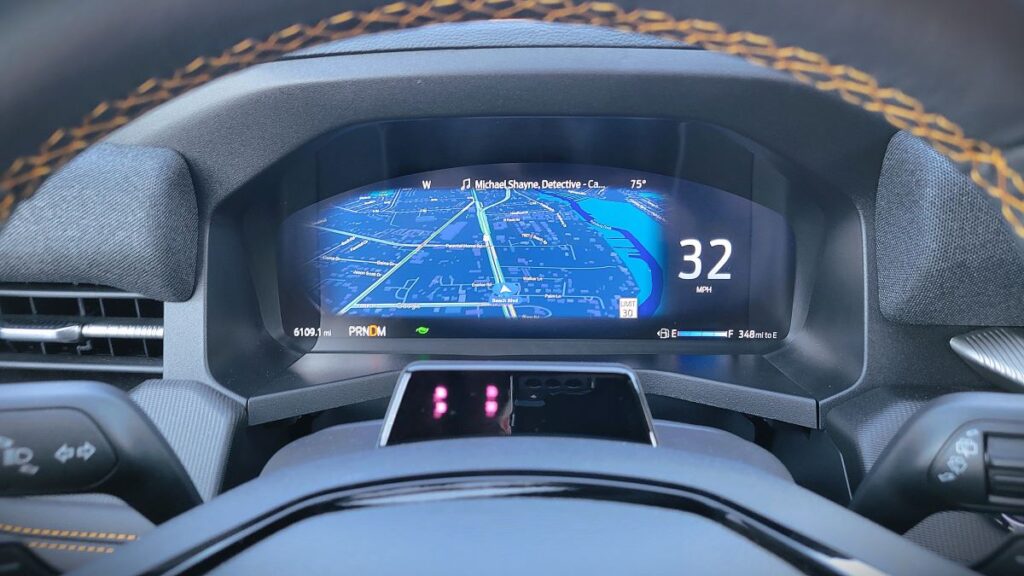
The copper-stitched leather steering wheel rim is thick and grippable, small plastic paddle shifters in back, familiar Ford audio and digital gauge screen controls in front. And that gauge package can go from simple – digital speed – to navigation map, or gauges with info displays that include climb and lean angle, since Tremor models aim for some off-roading.
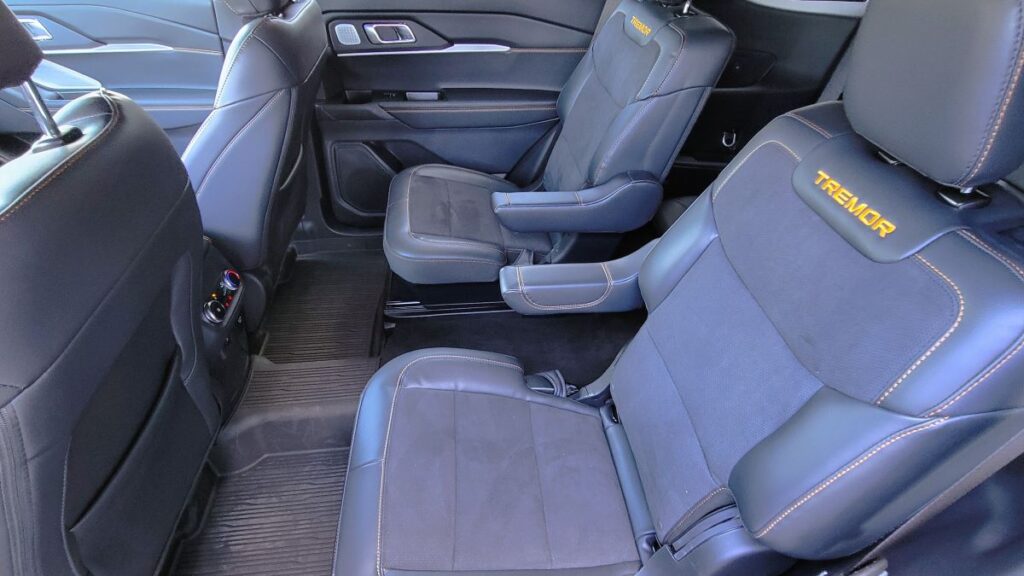
The plush leather and suede seats get heat, cooling and massage, plus more copper stitching and “TREMOR” embroidered in the seat uppers. They were comfortable and supportive on trips on and off-road. There’s good storage room at the head of the wide center console, trimmed in leatherette with copper stitching, with a rotary gear selector and cup holders, with more space under the – you guessed it – copper stitch-accented center armrest.
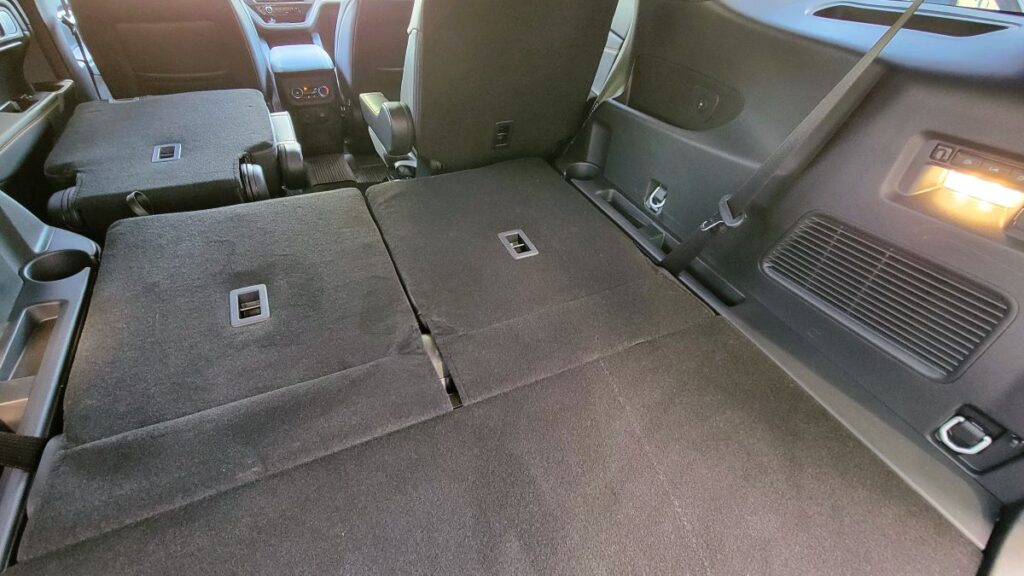
Captain’s chairs in the second row have great head and leg room, living under a fixed-glass moonroof with retractable cover, also with “TREMOR” embroidering, plus heat. There’s rear climate control, and USB/12-volt power ports. And there’s room in between to access a usable if low rear 2-person bench seat. The second and third rows fold flat to really expand space – and the last row power drops or lifts. The power tailgate climbs high to clear my head, as well.
2026 Ford Explorer Tremor 4WD Has 5,000 Pounds Of Towing Muscle
The Tremor, and the Police Interceptor can have one of two engines – a 3.3-liter hybrid with 318 hp, or a 3-liter EcoBoost V-6 with 400 hp. I got lucky – my Tremor has that twin-turbo V-6. And while most civilian Ford Explorers play family SUV and never play with in the rough, I opted to run the Tremor up and down a muddy, pot-holed mud path next to a salt marsh, usually home to folks in 4×4’s going fishing.
The Explorer Tremor gets an off-road suspension with an extra inch of ground clearance over family Explorers – 8.6 inches of it. There’s more steel underbody skid plates, revised bumpers with better approach and departure angles, and those knobbier tires to help. Along with the 400-hp V-6, we had a 10-speed automatic transmission, limited-slip rear differential for improved traction, plus a dedicated off-road drive mode with selectable Rock Crawl, Mud/Ruts, Tow/Haul, and Slippery condition selections.
2026 Ford Explorer Tremor 4WD Handles Light Off Roading Well
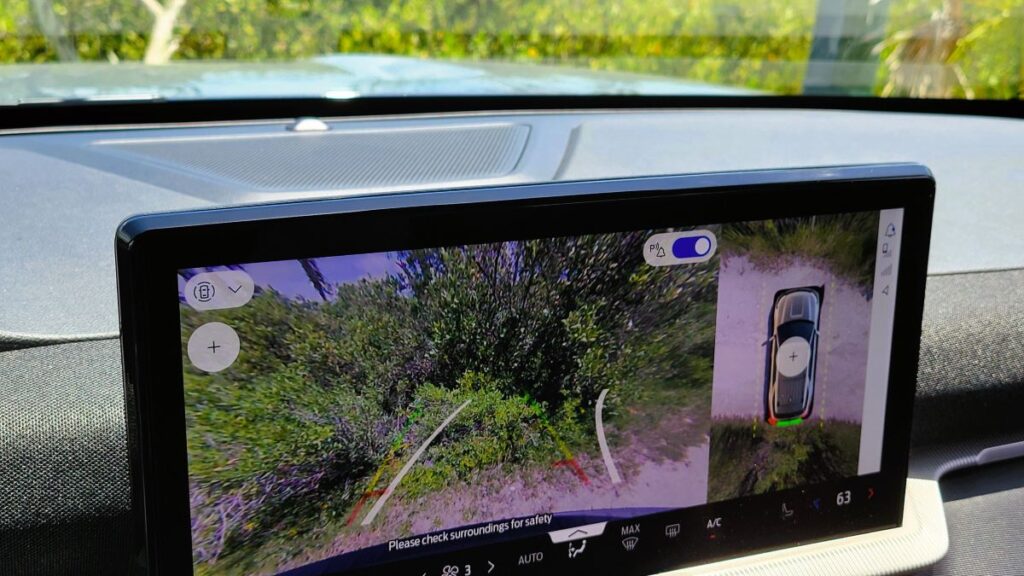
We activated off-road mode, which backs off throttle input to help limit wheelspin, and move out. The mud road heads downhill through deep puddles pocked with coral-based rocks. Our 4,457-lb. SUV’s multi-link suspension with off road-spec dampers just absorbed those splashing dips without any head toss or harshness. And the tires grabbed and pulled us through the slimy route with no issues. In off-road mode, the main screen shows what’s right in front of that new grille, with tire tracks to show where you are headed – and there’s a 360-degree overhead image of what’s around, plus a big screen image of that tree in back as you reverse. FYI – rubber floor mats kept the muddy footprints contained.
The 40-foot turning radius make it somewhat easier to turn around at the end of the trail – didn’t hurt that the Tremor’s rear axle gets brake-based torque vectoring that locks its inside rear wheel during slow off-road maneuvering. That can cut the turning radius by up to 25%.
Call the Tremor a pretty legit off-roader for the basic stuff like a dirt trail, forest road or rainy beach – no mountain roads to test in Florida, though.
Back on the asphalt again and set in rear-wheel-drive, we checked how the Tremor handles commuting and shopping duties.
In Eco mode – you have to select it each time you fire this Explorer up, since it reverts to Normal mode – the 7,000-mile-old SUV moves out well, rearing up a bit as it gains turbo boost to hit 60 mph in a 5.3 seconds with a subtle exhaust growl. Tap in Sport mode, and as the steering loads up with a bit more feel, the Explorer seems to pull out of the hole quicker en route to 60 mph in a quick 4.8 seconds, its exhaust a bit meatier. Paddle shifters respond well, a l’il throttle blip on downshifts.
With the V-6, it can tow up to 5,000 pounds of trailer. Auto-engine shutoff was transparent when it refired – no lurch. And driven mostly in Eco mode, we averaged up to 25 mpg.
Our test of a 2020 Explorer SVT with twin-turbo, DOHC 3-liter V-6 giving 400-hp (w/premium) and 415 lb.-ft. of torque took 6.5 seconds to hit 60 mph in Sport mode. Observed mileage was 20 mpg.
The chassis is designed with rear-wheel-biased all-wheel-drive unless you select Sport or an off-road mode, with MacPherson strut in front, and multi-link rear. Yet even with it being a bit taller in the saddle, and with more offroad-specific rubber, the Explorer Tremor had a taut yet nicely supple ride that handled bumps quickly, good buffering at compression on all but the sharpest potholes, and a fairly quiet ride at speed.
Set in Sport, power steering stiffens up with a nice direct feel, if a bit artificial. The Tremor also invokes all-wheel-drive in Sport mode, adjusting power distribution to the wheels as needed. So it stayed neutral with a little body roll around corners, powering nicely out. Power harder in a turn and we got a bit of understeer, but the handling remained predictable. And in steady-state cornering, understeer was more evident, but it did not plow off course. The brake pedal on our test vehicle had a nice bite early, good control and decent stopping power.
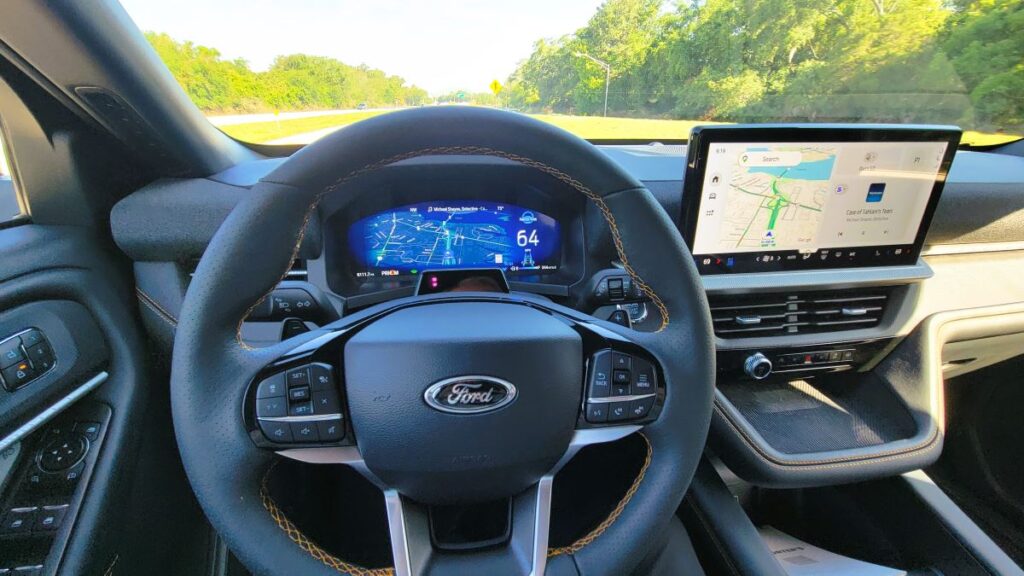
We had BlueCruise autonomous driving, which maintained speed, distance and the lane (with a bit of hunting) just fine on interstates and many state highways. I still don’t like auto-lane change – it activates if someone ahead is slower than preset speed – and it takes a steering jerk to shut it off.
The base rear-wheel-drive Explorer Active 100A with turbocharged 4-cylinder engine starts at $38,465; our four-wheel-drive Tremor 4WD started at $48,465 with a $11,850 Ultimate package with fixed moonroof, ambient accent lighting, B&O Sound System and a few more goodies, plus $495 Vapor Blue paint, $455 entry keypad and some other items for a final price of $64,495.
Bottom line: Seriously powerful with solid handling on-road; capable on moderate off-roading, and real roomy in its nicely lux interior – looks cool too.
2026 Ford Explorer Tremor Specifications
Vehicle type – 5-door, 3-row/six-passenger all-wheel-drive off-roadable SUV
Base price – $48,465 ($64,495 as tested)
Engine type – aluminum block 24-valve, dual-turbocharged DOHC V-6
Displacement – 3-liter
Horsepower (net) – 400
Torque (lb-ft) – 415
Transmission – 10-speed automatic w/paddle shifters
Wheelbase – 119.1 inches
Overall length – 198.8 199.3 inches
Overall width – 89.3 inches w/mirrors
Height – 69.6 70.2 inches
Front headroom – 40.7 inches
Front legroom – 43 inches
Middle headroom – 40.5 inches
Middle legroom – 39 inches
Rear headroom – 38.9 inches
Rear legroom – 32.2 inches
Cargo capacity – 18.2 cu. ft./47.9 w/3rd row folded/87.8 with 2nd and 3rd row folded
Towing capacity – up to 5,600 lbs.
Curb weight – 4,631 lbs.
Fuel capacity – 20.2 gallons
Mileage rating – 17 mpg city/22 mpg highway