


This week on EV Rider, we are looking at how you can use a vehicle-to-load device and your EV to charge just about anything.
What many EV owners do not realize is that quite a few EVs can export power as well as receive it, via what’s known as vehicle-to-load, or V2L.
PowerBridge Pro Product Page & Extended Warranty Offer To EV Rider Readers
Thanks to a small device called the Roam Energy PowerBridge Pro, I now have a massive amount of continuous power ready to go during power outages, camping, traveling, remote work, or just about anything else you can think of. It works due to an international automotive standard that many EV carmakers are adopting, called ISO 15118-20.
Roam has already validated it across more than 30 EV brands. Until recently, the hang-up has been deployment of bridge devices. While the protocol has been built into many EVs, some automakers have been slow to offer their own discharge devices.
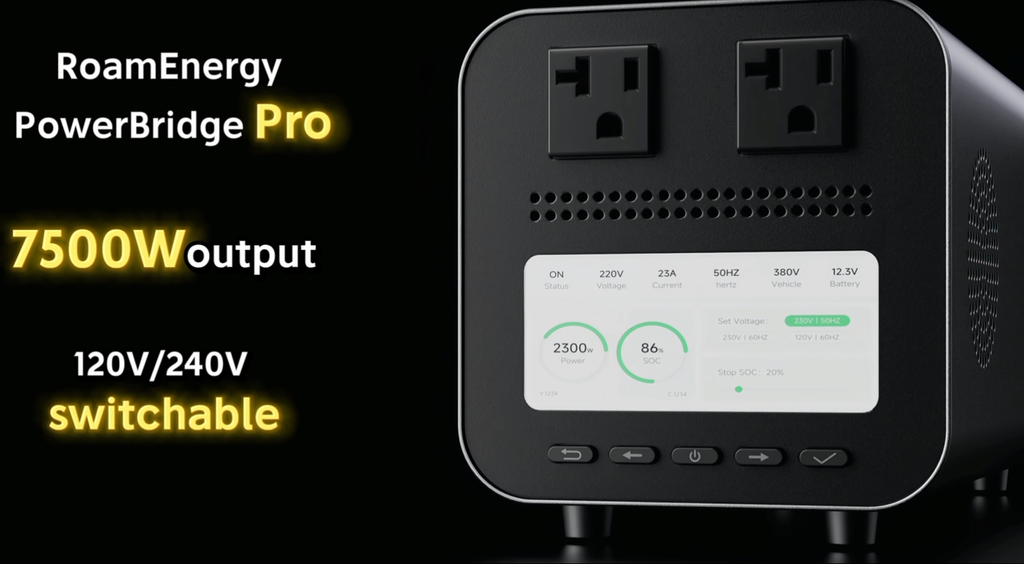
That is where the PowerBridge Pro comes in. It plugs directly into your car’s fast DC charging port. Then, typically after roughly 30 seconds or so, it is ready to dispense energy.
Power Bridge Pro Confirmed Compatible With More Than 70 EVs So Far
Roam has confirmed that the PowerBridge Pro works with more than 70 models, including 2022 and newer Teslas, Rivians, the Ford Mustang Mach-E, the F-150 Lightning, Toyota’s bZ4X, and Volvos, just to name a few. If your EV has a CCS port, like the 2024 Dodge Charger Daytona in the video at the top of this post, you will also need an adapter. But Teslas and other new supported EVs with NACS charge ports are ready to go out of the box.
Let’s start with the basics. First, to turn it on, you quickly press, let go, and then press and hold. This, by the way, is what I consider to be a safety feature. This way, a child or somebody who is not familiar with this device is not going to be able to easily power it on. Given we are dealing with high voltage, I think that’s good idea. Once it’s done booting up it will say “PB-Ready.” That means that your PowerBridge is now ready to be plugged into your EV.
Before you do that, you will want to make sure you have selected the correct settings. I’ve the voltage set at 240V /60 Hz, which is what I need to charge my Mini Cooper SE or my Zero SR/F electric motorcycle. You can also set it to power the 120V/60 Hz household outlets.
An important note: You cannot run the 120V outlets and 240V NEMA 14-50 outlets simultaneously. It is one or the other, but not both.
The PowerBridge Pro definitely comes with a very useful readout. For starters, you can see that it will show how much power the battery in the car actually has and how much power is being pulled from either the household outlets or the 240V NEMA 14-50 outlet.
The back of the unit has two detachable cables. One is for the NEMA 14-50 and the other is for the NACS port that will attach directly to your car’s DC charging port. It also has a DC-so you can charge the internal battery that boots it up. You can also charge that internal battery with a USB-C cable.
It is also possible to get updates to this unit. For example, if you were to run into an issue, you could reach out to Roam support, send in the logs, and then they send you updated firmware. You also have a grounding mode. Some devices may require you to switch the grounding mode. You can go over that in the owner’s manual.
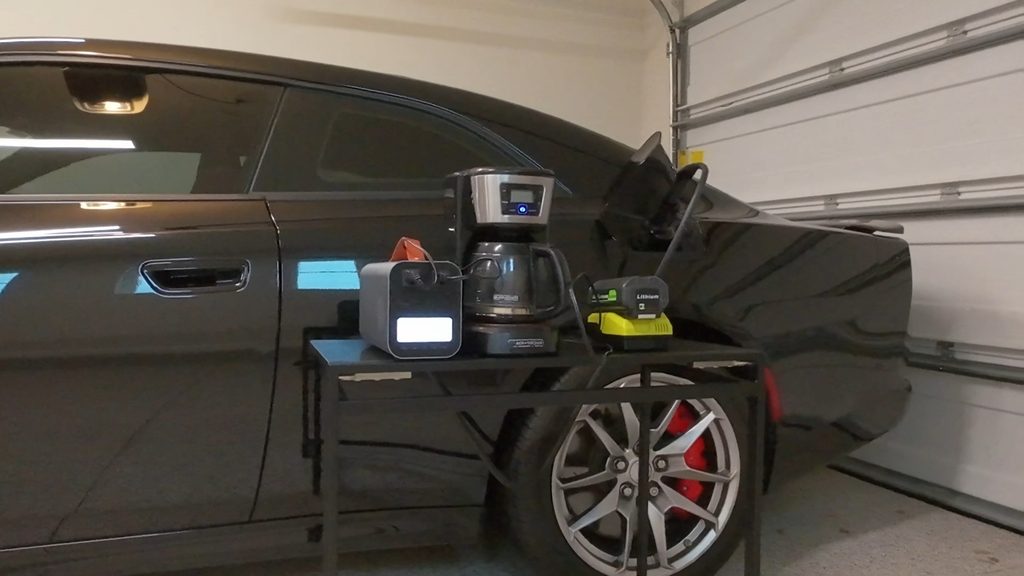
During my testing I ran high-voltage household items including a hair dryer, coffee maker and lawn mower battery charger. You can see those results in the video.
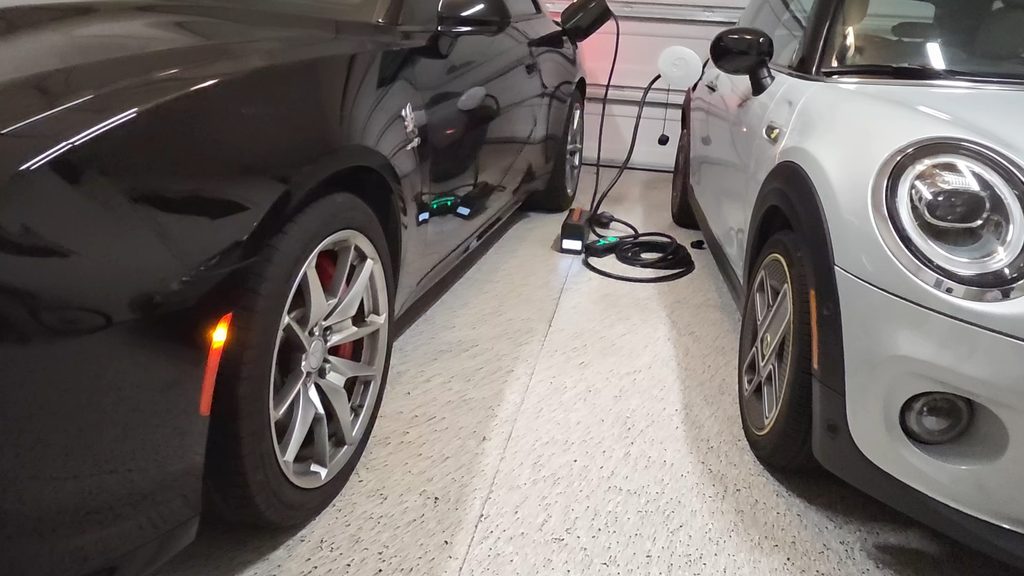
For the big stress tests I also charged a Mini Cooper SE EV and Zero Motorcycles SR/F EV. Those results are also in the video. But the short story: the PowerBridge Pro performed flawlessly, delivering more than 7 kW of continuous current to the Mini, which has a peak-rated AC charging speed of 7.4 kW.
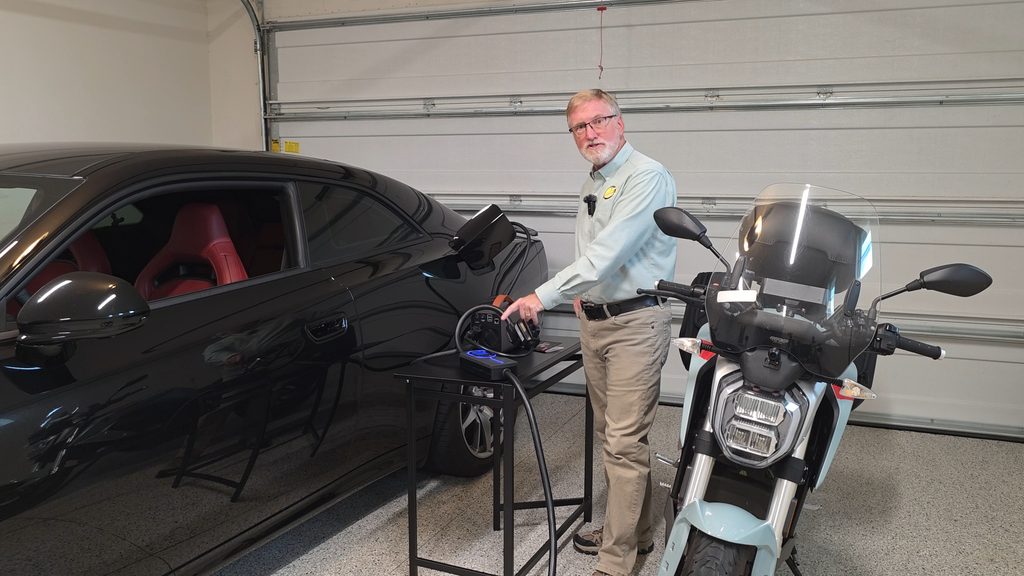
Roam PowerBridge Pro Can Provide L2 Mobile Charging To Other EVs
For EV motorcyclists, the PowerBridge Pro could be a great safety net. We all know EV motorcycles do not have as much range as EV cars, and for those of you who live in rural areas especially, if you run short on a return trip, you could always have a friend or family member with an EV bring the PowerBridge Pro to wherever you ran out of power. Within 15 minutes, you would probably have a good 20 miles of extra range to make it the rest of the way home.
For those of you who are not familiar with portable power supplies—whether it is this EV device, a gas generator, or any other type of portable power supply—one thing you really want to be aware of is what its limits are and how not to overload the outlets. An easy way to do that is with a volt and watt reader, like a Kill-A-Watt. You plug it into your household outlet, plug in the devices you want to run, and add up how many watts you are going to end up using. Do not exceed that number whether you are using the PowerBridge Pro or any portable power supply.
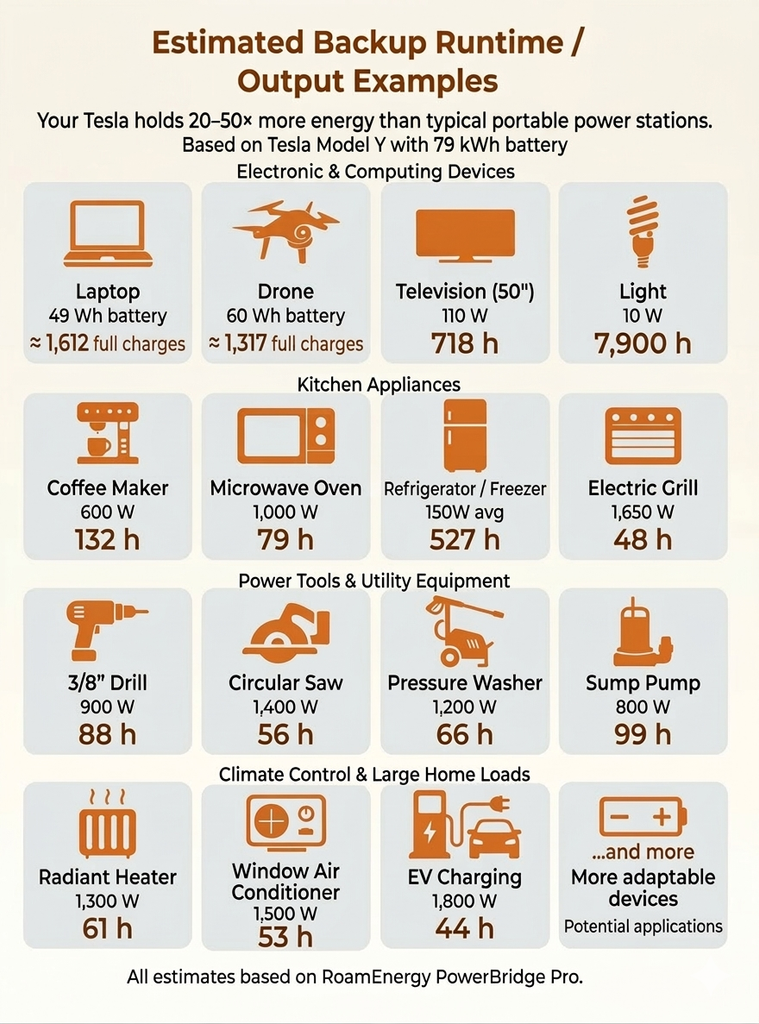
In terms of troubleshooting, let us go over some of the basics. First, almost all modern EVs come with timers for off-peak charging. If you have that engaged, that might prevent the PowerBridge Pro from working properly. The same thing applies if you set a charging limit for your EV. Many of us set our EVs to charge somewhere between 60% and 85% to maximize battery lifespan, so that could be yet another reason that might prevent the PowerBridge Pro from doing its job.
If you run into something unexpected, check the EV first before automatically assuming there is a problem with the unit. Also, some cars may power down unless you set them to keep running. You may need to engage something like Camp Mode in a Tesla to make sure that after half an hour or an hour, the car does not power down.
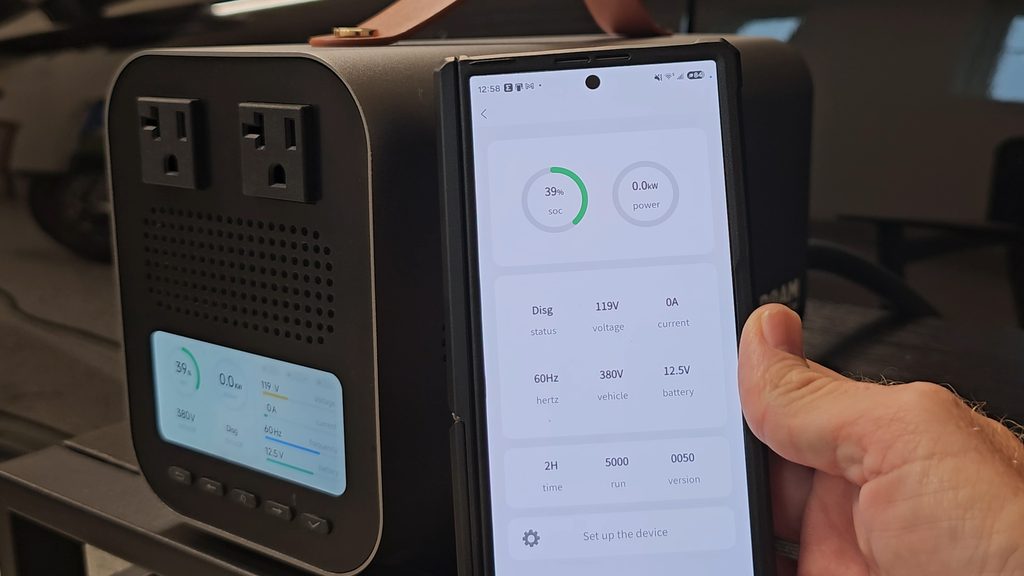
I cannot stress enough how important it is to confirm your settings before plugging it into your car and powering stuff up. You can also confirm your settings with Roam’s app for Android and iOS, which uses Bluetooth to connect.
You can check to see if your EV is compatible with the PowerBridge Pro on Roam Energy’s website. If your EV is not listed, the PowerBridge Pro still might work assuming your EV has the proper hardware and protocol support. In that case, you would get in touch with Roam’s support team, send in log files from the device, and they can look over the log files, add your EV to the compatibility list, and send you an update.
In terms of safety, during my testing, everything went fine. The unit seems well-engineered, and it powered right up and connected to my Dodge on the first try.
I imagine the biggest question most viewers will have is whether the PowerBridge Pro could hurt an EV’s battery pack. I am no electrical engineer, but here is what I can tell you: EVs are designed to be able to handle a lot more current than the PowerBridge will pull. For example, my Dodge Charger Daytona is designed to be able to handle brief peak loads of up to 500 kW during hard acceleration.
Even though it is possible for the PowerBridge Pro to handle up to 7.5 kW at 240V, I personally recommend capping your power draw to about 6 kW or so to maintain a nice safety margin and avoid potential premature wear of the components. One of the basic rules of anything electrical is not to exceed about 80% of capacity for continuous loads.
Is The Roam Energy PowerBridge Pro UL Listed?
As this video is recorded, the PowerBridge Pro is undergoing UL 9741 third-party testing. But just to be clear, that is not the same as being UL listed. A UL certification is widely recognized as the gold standard here in the US, but at the time of this recording, Roam had not achieved that benchmark yet.
It is listed with the FCC and complies with the European Union’s CE standard. Roam tells me it has been selling PowerBridges for about three years so far, and there has never been a confirmed case of a PowerBridge damaging a vehicle or affecting a vehicle’s warranty.
Roam Energy is collaborating with several automakers on V2L. “The goal is for PowerBridge to become an officially authorized third-party V2L accessory for those brands, and in development are vehicles that will display real-time discharge status on the car’s own screen while a PowerBridge is connected. We can’t name the automakers yet — but it’s coming in the not-too-distant future,” Roam’s representative wrote in an email.
While all that sounds good, what would happen if your EV’s electrical system malfunctioned and you had used the PowerBridge Pro? Would it void your car’s warranty?
Here in the US, the federal Magnuson-Moss Warranty Act is intened to prevent an automaker from denying a warranty because a third-party device was used, unless the damage was caused by the device. If something were to go wrong and an automaker claimed it was Roam’s fault, Roam tells me it carries product liability insurance from The Hartford that covers up to $1,000,000 per occurrence. Roam provided me with a copy of the policy. So in theory, if an automaker denied a warranty claim, blaming Roam, Roam’s insurer might cover the cost. But let me stress: I am taking Roam at its word on this, and I cannot predict how things would turn out should anything go wrong.
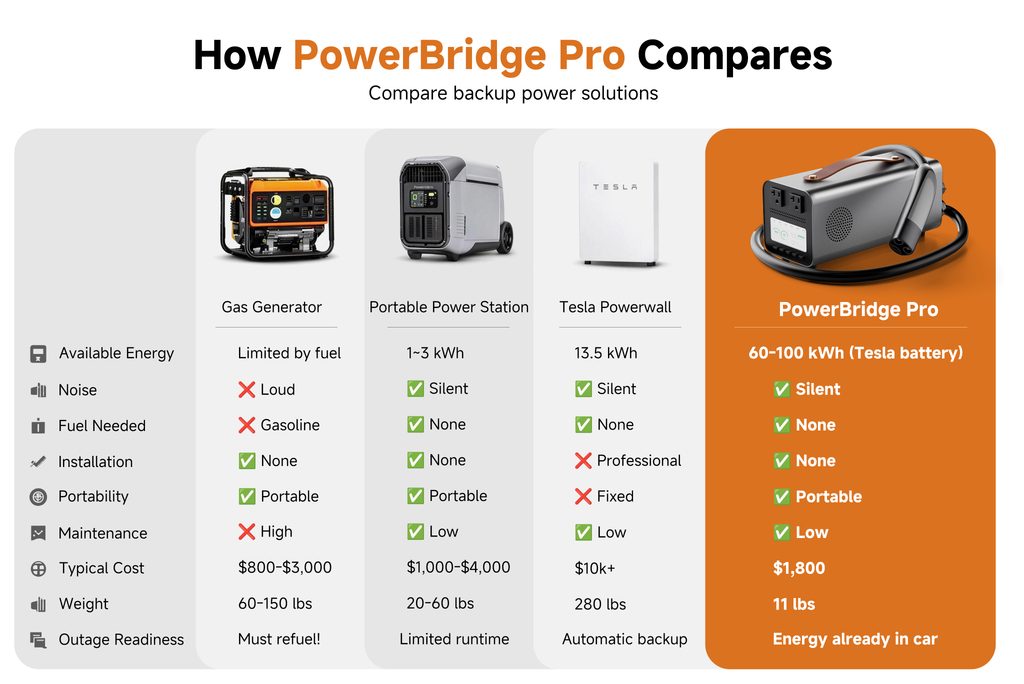
Another question I know a lot of you are going to ask is: Can the PowerBridge Pro tie into a breaker box to power the entire home? Technically, yes. In fact, Roam illustrates the process on its website, but personally, I am not going to try that for several reasons. The PowerBridge Pro is not UL certified yet, which could trigger permitting or inspection issues in some communities. It also requires an autotransformer because the PowerBridge Pro outputs 240V single-phase, while US breaker boxes are wired for 240V split-phase. Definitely consult a licensed electrician and your local authority first if you want to explore the full home backup idea.
Vehicle To Grid (V2G) Is On Roam Energy’s Road Map
Vehicle-to-load is a trend that is growing fast, and it is just the beginning. Another trend is a similar process known as vehicle-to-grid, or V2G, which allows EVs to feed power directly into the grid to help utilities, especially at peak load times. Tesla and Toyota are among the automakers already piloting programs here in the US. While today’s PowerBridge Pro is not V2G capable, Roam Energy tells me vehicle-to-grid is part of the company’s long-term vision.
For those interested in buying a PowerBridge Pro, Roam Energy is offering EV Rider viewers a special perk: extending the one-year standard warranty to two years for anyone who buys using the evrider.tv link.
Roam is extending the 2026 holiday shopping return window through January 31, 2027, so customers can try PowerBridge with more peace of mind. If there’s a product quality issue, Roam says it will cover return and replacement shipping. If someone changes their mind, they can still return it without a restocking fee, as long as the product and original packaging are undamaged and in resalable condition, but they need to cover the return shipping.
Related: EV Rider’s Editorial Policy Regarding Review Units
Roam Energy provided EV Rider with the PowerBridge Pro review unit featured in this post and video, but did not have any editorial input into this video’s production. However, given the complexity of the topic, I did provide a partial preliminary script to Roam so it could fact-check any potential technical errors on my part. Also, if you were to purchase a unit through EV Rider’s provided link, EV Rider may earn a commission.