


Now that I’ve got a full year of data, let’s look at how my rooftop solar set up is performing, and most importantly, how much money it’s generating.
I had my 8.4 kW system installed in January 2025 by Jacksonville’s Synergy Solar, which installs solar, EV chargers and battery systems across the First Coast. Synergy is also a full service state certified roofing contractor. The system was turned on in February 2025 after permitting and inspections were completed.
The system cost $21,705, including taxes and fees.
In its first 12 months it generated $975 worth of electricity. That’s based on my utility’s per kWh rate, including taxes and fees. It also qualified for a 30 percent federal tax credit of $6,511, which puts the return in year one at $7,485.
But I haven’t mentioned two significant payback factors yet. First, having solar keeps us from tripping into our utility’s higher tier two rate, which we would face many months of the year without solar.
And second, we own three EVs, which means our fueling costs are running less than half of what they would be to buy an equivalent amount of gas.
Let’s look at just one of our vehicles, my 2022 Mustang Mach-E, which runs almost exclusively on solar power, except when road tripping.
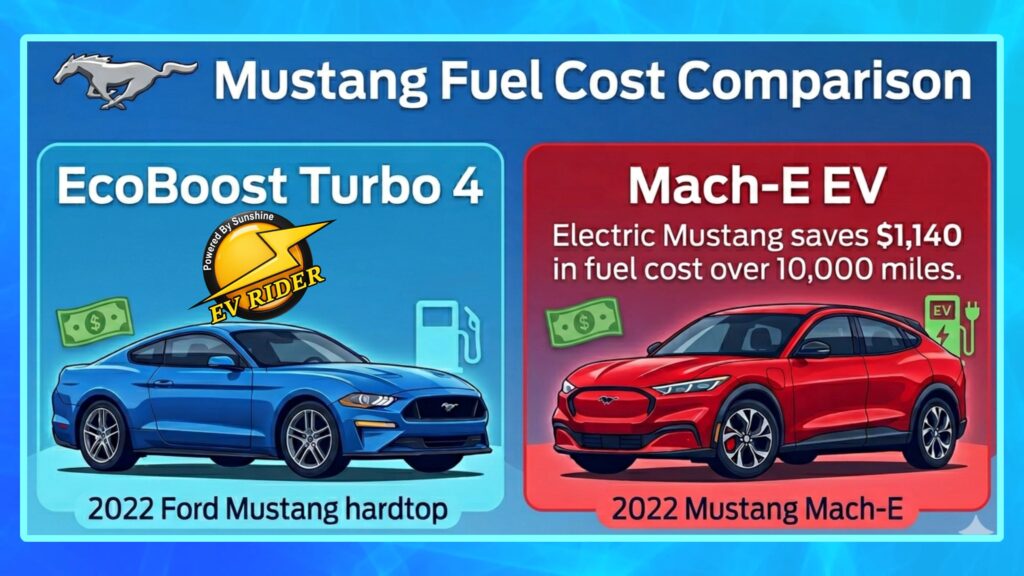
If we compare it to the most fuel-efficient gas 2022 Mustang, the EcoBoost Turbo 4, the electric Mustang saves $1,140 in fuel costs over 10,000 miles, which is my best guess of how many miles I probably drove on solar power over the past year.
I’m basing that assumption on the price of regular at my neighborhood gas station, which $3.91 on the day story was written and on my home per kWh cost, which was 14 cents..
To keep my payback assumptions from potentially being overly optimistic, I’m skipping calculations on what the other two EVs saved in fuel costs, especially since one of them is primarily charged at night, using grid power. That also gives me wiggle room to account for constant fuel price variations and any other factors that might skew the true return.
So, being conservative, it’s safe to estimate that we earned back $2,115 in year one, plus the $6,511 tax credit.
Now let’s look at the grand totals. After the tax credit, our solar system cost $15,194. Assuming we keep earning $2,115 a year, the system will have completely paid for itself in 7.18 years.
But keep in mind, those numbers don’t include inflation, which is another factor that should speed up the payback.
This year alone, JEA, which is my publicly owned utility, is seeking an 8% rate hike, which if approved, will kick in this October. Based on historical trends, it’s reasonable to assume JEA will seek additional rate hikes.
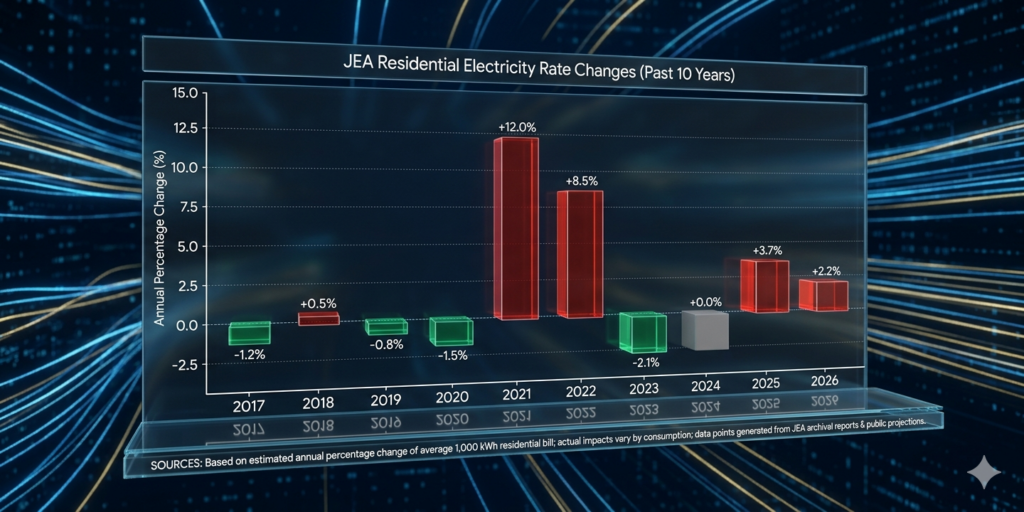
While it’s impossible to precisely predict our payoff period, based on the numbers, it appears to reasonable to forecast our solar setup will earn back its total cost in under seven years. After that, it will literally be generating free electricity.
By the way, for you numbers nerds, as I record this episode, we’ve generated 15.5 MWh of power since we turned on the system in February 2025.
That equates to saving more than 10 metric tons of C02 being pumped into our atmosphere, according to Google’s Gemini AI, which estimates the savings as ranging from 10 to 11 metric tons, depending on a variety of factors.
Whether rooftop solar makes sense for you depends on a lot of factors, including: how old your roof is, how much sun you get, whether you’ll be taking out a loan, what your power use patterns are, what your utility’s net metering policy is, whether you’ll want a battery storage system and more.
If I can help answer any questions you have about solar, feel free to drop me a line in this video’s YouTube comments section.
Related: 8.4 kW Rooftop Solar Install
Editor’s Note: Synergy Solar sponsored the video at the top of this post but did not have any editorial input or say about its production.