


If you think striking automotive design or EVs have to be expensive, think again.
Here in the US, many EVs, like Dodge’s Charger Daytona, are targeted toward upper-income buyers. But in some other parts of the world, EVs like the new Hyundai IONIQ V featured in the video at the top of this post are instead targeting the heart of the automotive market.
In China, it has a base price of roughly $17,800 USD, based on a recent check of exchange rates. And this isn’t some stripped-down penalty box.
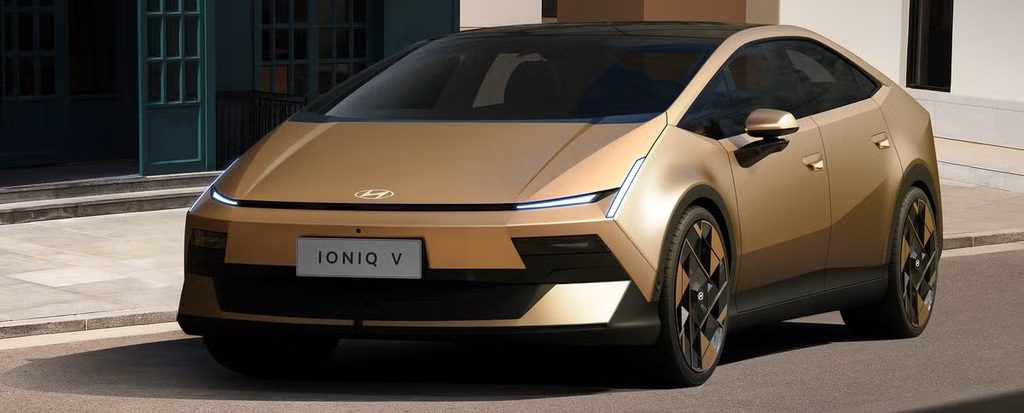
The top-spec version has about 320 miles of real-world range and styling that some might compare to a Polestar or even a Lamborghini. Inside, the driver and passengers are greeted with a panoramic 27-inch 4K screen that stretches across the dashboard.

Unfortunately for US consumers, the IONIQ V is just another example of how far the US is falling behind on the world EV stage, which is where the global automotive market is headed.
My personal EV that appears in the video is a 2024 Dodge Charger Daytona. The 2027 version of the Charger Daytona EV has a base price of more than $77,000 and can easily top $90,000 once options are added. But it’s not fair to compare a two-door performance car to a four-door economy car.
So instead, let’s compare apples to apples. Right now, the most affordable EV in the US is the Chevrolet Bolt, which has a base price of about $29,000. Of course, styling is subjective, but in my opinion, the Hyundai looks much more upscale than the Chevy.
Once you move inside, that appears to continue, since the IONIQ V has frameless doors, fastback proportions, and that gorgeous screen.
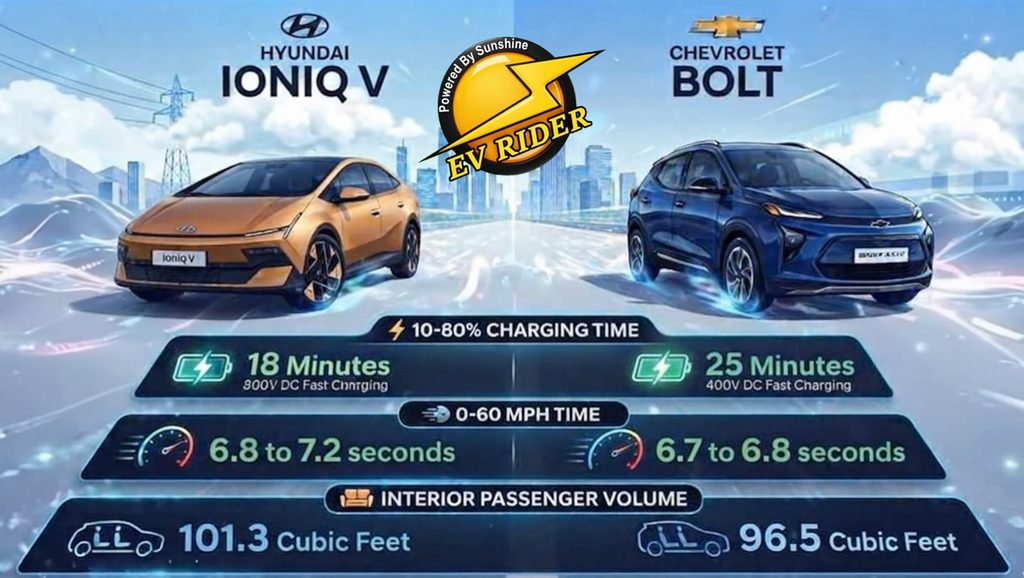
You’ll also be stuck spending more time at charging stations with the Bolt, since the IONIQ V can charge from 10% to 80% in 18 minutes versus 25 minutes for the Bolt. Performance is roughly the same between the two cars, although the IONIQ V is more practical when it comes to interior space.
So, what’s the point? Well, here’s where this post and video shifts into editorial mode.
The Trump administration is focusing on prolonging demand for gasoline vehicles by cutting EV incentives and adding $40 billion in fossil fuel incentives. By the way, that’s according to the Yale School of the Environment.
Meanwhile, other parts of the world are taking the opposite approach by accelerating EV development. The question becomes: Can the US auto industry keep up when global incentives point in the opposite direction of US incentives?
We won’t know for years to come, but the next big test is coming soon.
Next year, Ford will be debuting its upcoming midsize Fathom EV pickup that will have a base price under $30,000. It’s expected to introduce design and manufacturing advancements to make it more competitive with foreign companies in the US space.
And even the Dodge Charger Daytona is expected to see big changes over the course of its lifetime. For more on that part of the story, see this video:
If you found this post or episode of EV Rider useful, please go ahead and give the video a like, hit subscribe and maybe even the the nonfiction bell on YouTube. Thanks so much for watching, and we’ll see you again soon.