


The compact truck market is competitive in the U.S., with everyone from Chevrolet and GMC to Ford and Toyota selling pickups that can still fit in an average garage.
While many folks love a lot of muscle in their small trucks, they also want them to be able to comfortably commute as well as handle a weekend do-it-yourselfer’s hardware store loads.
Nissan has offered a compact truck since the 1980s, when it was a spunky, chunky kind of thing called a Hardbody that sold very well with more than 127,000 in the U.S. in its last full sales year.
Fast forward to now, and the Frontier – the nameplate debuted in 1997 – is three years into its third generation, and gets an inside and out refresh for 2025. This follows a solid sales year, with just over 68,000 sold in 2024.

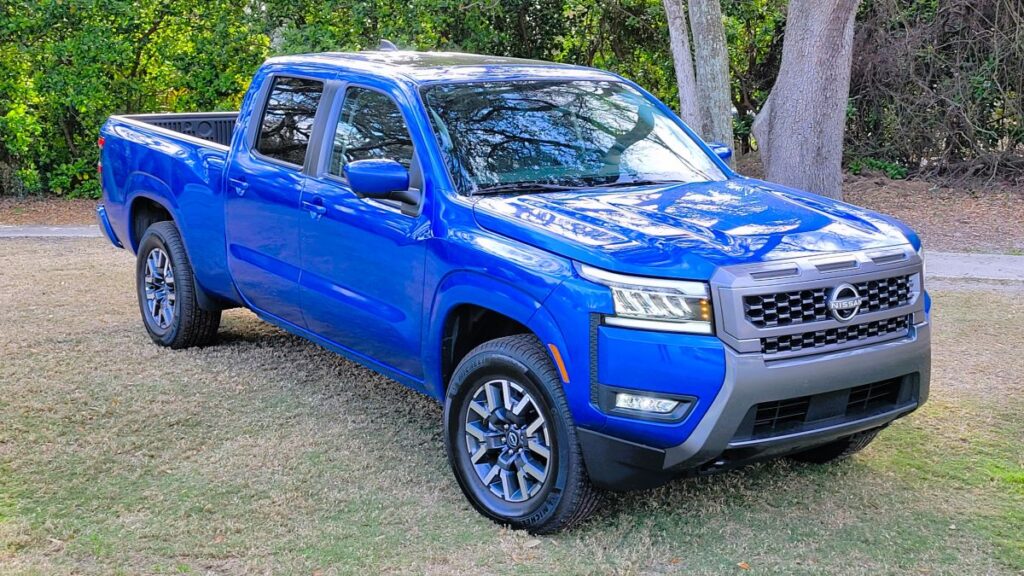
The Frontier lives on the same 139.8-inch wheelbase of its 2004-2021 model, but there’s been some serious work done to give it a new face. The grill gets bolder with a pewter gray mesh framed in angular accents with a trio of faux inlets above, and a deep lower one framed by a chunky H-shaped bumper accent. DRL bars accent slim LED headlights units that flank it, faux intake slits connecting them to turn signals.
More Pickups
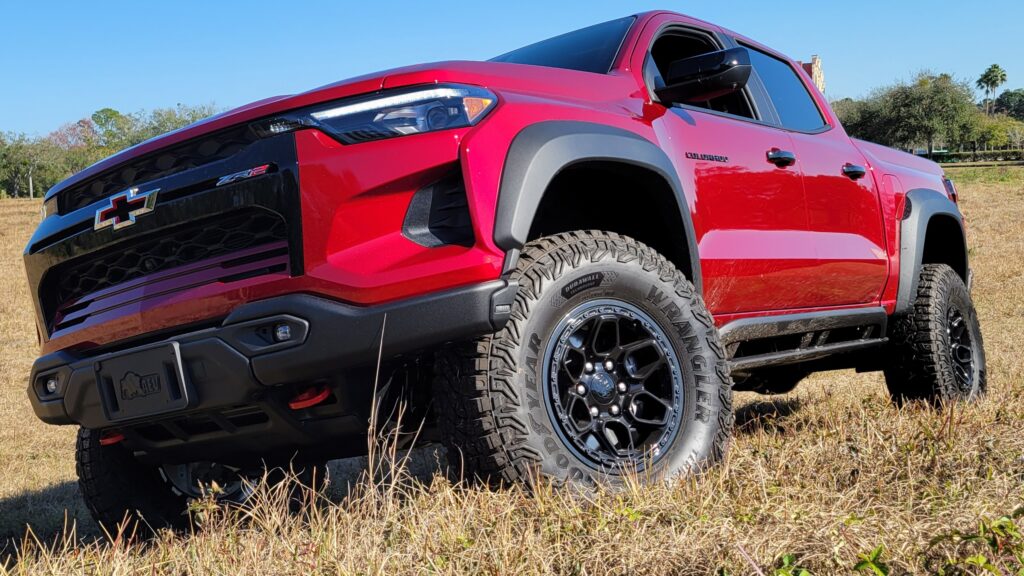
Chevy Colorado ZR2 Bison Easily Handles Rough Stuff
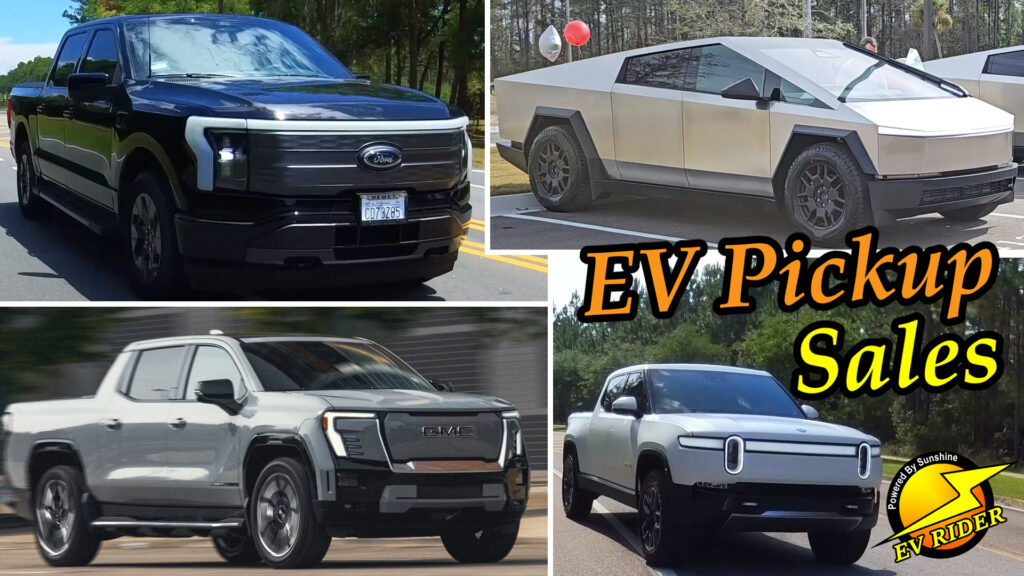
Ford F-150 Lightning Outsells Other EV Pickups
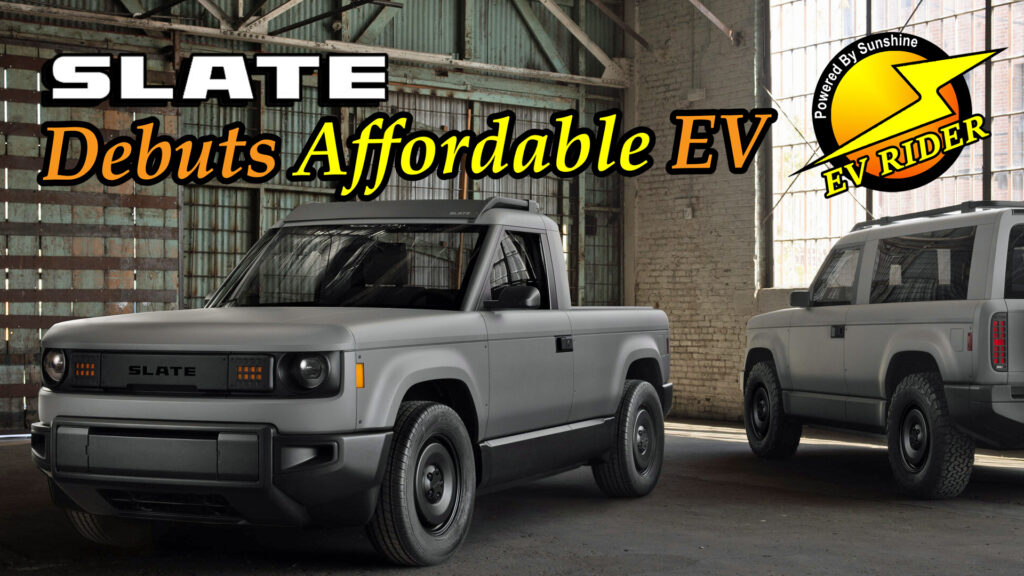
Clean Slate: Finally, A Compact Entry Level EV Pickup
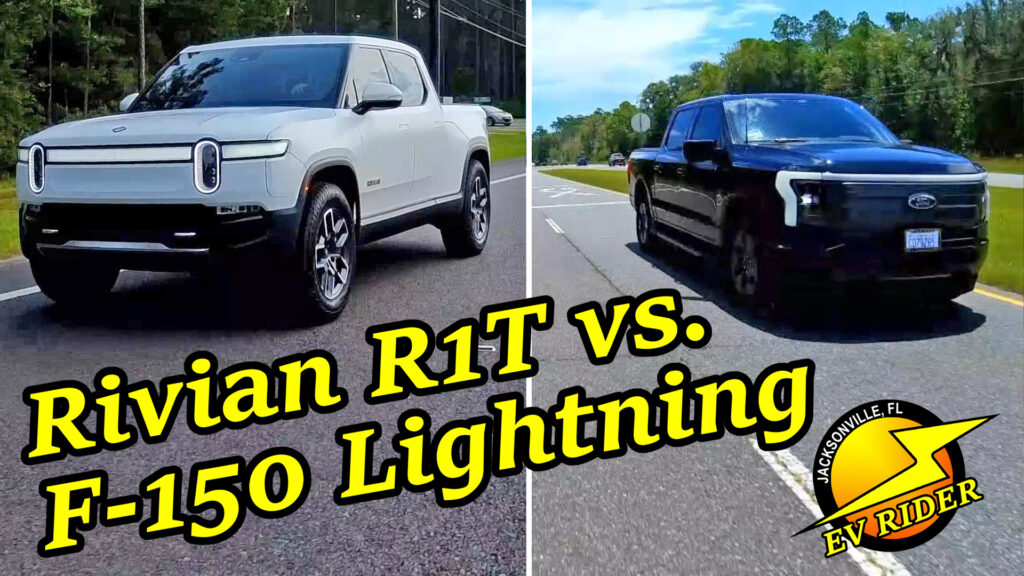
Showdown: Ford F-150 Lightning Vs. Rivian R1T
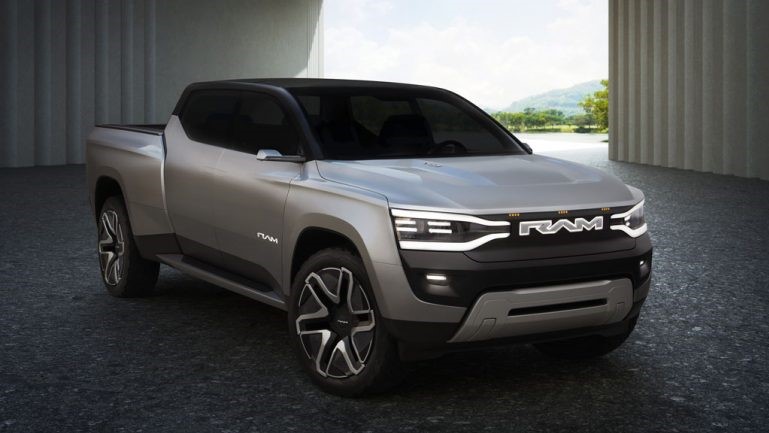
Ram Brings The Heat With Its Electric Pickup Concept At CES 2023
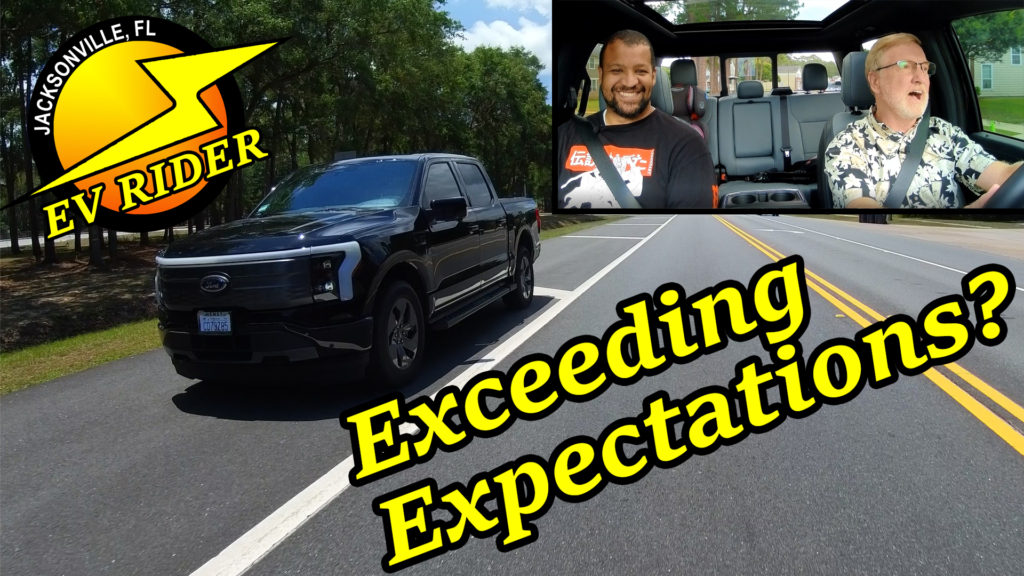
F-150 Lightning: Features Tour, Owner Perspective
There are squared-off fenders front and rear framing slightly rectangular body-color flares over 12-spoke silver and gray anodized alloy wheels wearing 17-inch Michelin Primacy rubber. Front door windows dip like the Ford F-150’s to give drivers better views under the side mirrors. The crew cab roof sits low and squared off, with a 6-foot-long cargo bed capped with big LED taillights and a chunky, body-color step-bumper.

There are some hints of the good old Hardbody, specifically the trio of upper grill inlets, that ring the nostalgia bell. It’s tough enough to carry the look off. Co-workers called it “cute.”
2025 Nissan Frontier Interior Highlights
Our Frontier had a black interior with a 12.3-inch center screen with “FRONTIER” in bold silver letters underneath.
The front doors are long enough and the ground clearance high enough to allow easy access, although the roofline is a bit low. Once inside, there’s lots of hard plastic on door and dashtops, the latter softened a bit with stitched leatherette in front of the passenger.

Nissan’s leather seats were flat if comfortable, with a bit of lateral hold and minor manual lumbar support with power adjustments. Nissan also did some nice embossed patterns front and rear – yes, I said leather seats. New for 2025 – telescoping adjustment on the tilt steering wheel, while a hard plastic cowl frames a traditional analog 120-mph speedometer and 8,000-rpm (7,000-rpm redline) tach with configurable color display in between for trip computer/off-road info/stereo/navigation info display and more.
That center screen is more than three inches wider than the 2024 Frontier, with crisp detail on navigation, backup camera display and more. There’s a Wi-Fi Hotspot, and wireless Apple CarPlay and Android Auto. The 10-speaker Fender sound system was good with real volume and tuning knobs below it as well as audio, map and home screen buttons. Dual-zone climate, seat and steering wheel heat controls are at the bottom of the center stack, with parking sensor and dual USB buttons below that. A big rubberized tray at the head of the center console is flanked by grab handles. Cup holders, gearshift and an inductive smartphone charger make up the rest of the console, with decent storage and a 12-volt outlet under a padded center armrest.

2025 Nissan Frontier Has 6,700 Pound Tow Rating
Being a compact truck, the rear doors on this Crew Cab are a bit narrow in length, so it’s a bit tight to get into the bench seat. The rear floor is high and the bench is low, meaning your knees stick up a bit. But we found adequate head and leg room. The whole seatback folds flat for storage; or flip up the 70/30 seat bottoms for storage space underneath. But the real space is in the bed.
The 6-foot-long bed has 49.2-cu.ft. of space, with a nicely damped locking tailgate, plus movable tie-downs on three bedsides. The Frontier can also tow up to a usable 6,700 pounds of trailer.

The real surprise is under the hood – a 3.8-liter direct-injection V-6 with 310-hp and 281 lb.ft. of torque at 4,400 rpm, atop a body-on-frame chassis that’s somewhat the same as the last generation. It’s also a bit heavier than direct competition like the Ford Ranger, and a bit lighter than the Toyota Tacoma or Chevrolet Colorado. The V-6 is mated to a 9-speed automatic transmission with a basic rear wheel/4-wheel-high/4-wheel-low, plus trailer sway and hill descent control, tow/haul mode and electronic locking rear differential. Some of those buttons are set low and to the left of the wheel out of sight.
Set in 2-wheel-drive, our 4,400-mile-old Frontier launches well. The V-6 growled at full throttle as we hit 60 mph in 7.8 seconds. In 4-wheel-drive, the same run took 8 seconds. The automatic transmission shifts cleanly just shy of 6,000 rpm, with decent downshifts when power is demanded for passing, which it does just fine. Slap the shifter left for manual shifting. We heard a bit of tire noise at highway speed, but it’s fairly quiet. Auto-engine start was a bit clunky firing back up from a stop, but you can shut it off. It delivered as high as 22 mpg, and as low as 19 mpg.
For comparison, a 2022 Frontier PRO-4X I tested for a since-retired website hit 60 mph in 7.5 seconds, and averaged 18 mpg on regular.
The 4,928-lb. truck has an independent double wishbone up front and over-slung multi-leaf rear suspension with Dana axle, stabilizer bars all-round, plus hydraulic cab mounts for reduced road vibration and urethane jounce bumpers for a smoother ride. The result – this is a truck that offers a taut, yet comfortable ride over most roads with a solid platform. It’s a fine commuter, with fairly quick suspension compression to bumps and a buffered rebound. There was some after-bounce on speed bumps and more serious potholes.

All-round handling was fine for a pickup in RWD, a bit of body roll and some understeer if pushed, where it wasn’t happy. And wet weather handling was secure, even in rear wheel drive, all four tires staying stuck to the road in turns.
We did a brief round of off-road driving on wet grass and some seriously potholed dirt, and the ride remained fairly comfortable, with decent traction.
The hydraulic rack-and-pinion steering gear had more heft than we liked, especially in slow turns, although it was accurate with a solid dead-center feel. Decent turning radius as well. The disc brakes had a nice pedal feel and controllable bite high on the pedal. There was a bit of wiggle with and nose dive when we braked hard from 60 mph, plus some ABS chatter at the limit, but stopping distances were good with no fade after repeated use.
For safety, the Frontier includes an around-view video system, automatic emergency braking with pedestrian detection, rear automatic braking and intelligent cruise control that maintains speed and distance to a stop.
A base Frontier King Cab S 4×2 starts at $28,340; our to top out at $46,570.

Bottom line: I appreciated the Hardbody design cues in a nice exterior/interior redesign atop a classic platform with decent moves and power, plus some off-road cred.
2025 Nissan Frontier Specifications
2025 Nissan Frontier SL Crew Cab LWB Specifications
Vehicle type – mid-size 5-passenger four-wheel-drive pickup truck
Base price – $37,240 ($46,570 as tested)
Engine type – DOHC 24-valve aluminum V-6
Displacement – 3.8 liter
Horsepower (net) – 310 @ 6,400 rpm
Torque – 281 @ 4,400 rpm
Transmission – 9-speed automatic transmission
Wheelbase – 139.8 inches
Overall length – 224.1 inches
Overall width – 74.7 inches
Height – 72.9 inches
Ground clearance: 8.6 inches
Front headroom – 39.1 inches w/sunroof
Front leg room – 42.3 inches
Rear headroom – 38.6 inches
Rear legroom – 33.2 inches
Cargo bed volume – 49.2-cu.ft.
Towing capacity – up to 6,700 lbs.
Maximum payload – 1,020 lbs.
Weight – 4,928 lbs.
Fuel capacity – 21 gallons
Mileage rating – 17 mpg city/21 mpg highway