
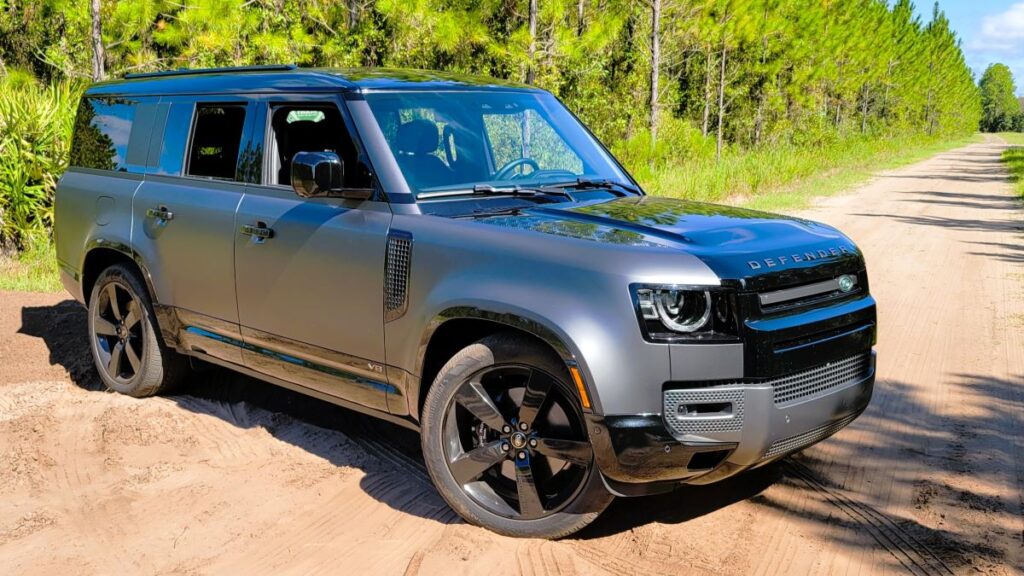


We stalked down the rural dirt road, dust lightly coating the stealthy semi-matte Carpathian Gray paint on our Land Rover Defender 130.
We were on the lookout for that perfect MFS – Main Photo Site – as this latest version of the venerable Rover Car Company’s iconic four-wheel-drive vehicle looked better suited for hunting UFOs.
This Defender is the 78-year-old descendant of the original 1947 “Land Rover” Series 1, a very basic 2-seater with flat metal fenders. A 4-door was added, the mainstay of cross-Sahara journeys and safaris. That “Landie” morphed into the Defender 90 and 110 in the 1990s. And in 2023, this “longest” 5-door joined a 2-door Defender 90 and 4-door 110
Time to hunt those UFOs.

Defender 130 Styling Analysis
The Defender 130’s sleek boxy shape is a cleanly-hewn square atop square, with some rounded edges that hint at the original Series I. Its 211-inch length is just over 13 inches longer than the Defender 110 – all added aft of the rear axle to change 2-row/5-seats into 3-row/7-seats. Everywhere I took it, it got looks, starting with the matte paint and intimidating grille with hooded headlights.
Road Tests Of 2-EV Competitors: Cadillac Vistiq | Rivian R1T
This generation of Defender is only a year-and-a-half old, so there’s no changes in design. But with just over 43,000 of this generation’s three lengths sold in 2024 and into this year, they are a bit rare. And that matte paint job is a rare one, especially well matched with a gloss black hood whose color flows down into the flat grille’s slit upper and middle intakes, lightened with a silver bar bearing the Land Rover badge. There’s a mesh lower bumper intake, slits extending left and right under glassed-in LED headlights with half-circle DRLs that give a hooded glare. The silver brush guard hides tiny LED fog lights with perforated side intake accents. And yes, those are twin diamond plate-like accents on the long hood – they are composite.

More gloss black frames bumper corners, side sills and squared-off fender flares that frame edgy 5-spoke black wheels shod in 22-inch Continental Contact rubber. Aft of the front wheels, functional fender vents say “DEFENDER” on simple flanks with nary a detail other than design edges running under window sills, then become rear fender shoulders.
Rear fenders end in sharp corners with stacked lights that pay serious homage to the 1960’s Series II. Up top there’s a gloss black roof with a long moonroof. On the sides there are tinted windows with matte black body-colored panels aft of the long rear doors, which add some detail interest.

As for the inches added to the 130’s rear, some thought it made the SUV’s keister look too big. But the long, smooth shape’s roof looks low and cool, also a homage to the rounded long roof of the old Series II “Landie.” The spare hangs off the side-hinged rear door in a hard-shell cover over dual sporty double-tip exhausts. As for the body, it’s steel in the fenders, the rest is a lighter alloy.
Defender’s Interior Features Room For Up To 7
Despite being an off-roader at its core, the 130’s air shocks bring its 8.6-inch ground clearance a bit lower. Defender’s leather and cloth seats are easy to slide into. Dusty boots rested on shaped rubber floor mats as we enjoyed comfortable heated/cooled power buckets. There’s even grab handles integrated into the gray dashboard’s ends to help hoist oneself up.

The thick leather-wrapped steering wheel has power adjustments with stereo, cruise, phone and information display buttons. The wide color gauge display under the padded hood can show a central 7,000-rpm tach with digital speedometer dead center, or 150-mph speedometer and tach. Either gets an info screen added to the mix with navigation info, audio, trip, 4-wheel-drive/wheel angle status, and more. You can toggle in a navigation map in either.
Cool fact – a structural magnesium alloy beam runs horizontally across the dashboard, providing rigidity as well as a lightweight mounting point for instruments and controls. It also gets an embossed buff gray panel bearing the “DEFENDER” name, an upper stitched leather bar becoming a grab handle, while the lower part is a rubberized shelf for small stuff, almost all the way across.

At the dash’s center is a large 11.4-inch-wide touchscreen for navigation, audio, all-round and overhead camera display, off-road wheel angle/dangle info, plus apps and more. It even shows an “under-the-hood” augmented camera – it delays the nose camera image just a bit so you know what stump you’re passing over. There’s a USB port near the embossed DEFENDER name, with colored accent lighting. It’s in door map pockets too.
The wide screen is crisp and quick to use. Many functions are hands-free with “Hey Land Rover” voice commands — but it can’t understand me with the windows open at speed. A lot of needed functions are a tap or two into some menus – and there’s a lot of icons to tap for features that include Wi-Fi, wireless Apple Car Play and Android Auto. The Meridian sound system is pretty good.

The center console and door panels are dark gray, with Torx bolts for a rugged look. There are grippy cup holders, a cellphone inductive charger slot behind them, and a storage drawer in front of them that’s deep enough to hold a soda bottle. Under the stitched leather armrest is a small refrigerator.
Dash center, a stubby electronic gearshift lever mounted next to dual-zone temperature control knobs that double as temperature displays — tap each to activate heated or cooled seats. That panel also has the drive mode’s main button — tap it and the on- and off-road mode buttons quickly appear on the screen above. Other functions like suspension lift, hill descent control, traction control, and auto-engine off are grouped to the left of the central button panel for fairly easy access.

The long back doors really ease access to dual captain’s chairs with nice head and leg room for adults, plus climate control and USB ports. The seats slide fore and aft, with room in between for access to livable rear seats, again roomy enough due to that tail stretch. Everybody in back gets a/c vents and USB ports. This will handle six adults comfortably. A seventh can be squeezed in the middle backrow. It helps if center row occupants give up a bit of leg room to help those in back.
Our Defender had the middle row captain chairs but its also available with a middle bench seat, upping seating capacity to 8.
With all seats occupied, there’s only a slim, (13.7 cubic foot) cargo area in back. Tap some cargo-area buttons, and the third row splits and drops flat for added space; you can remotely drop second row captains chairbacks for 80.9-cu-ft. It is a high lift over to get stuff back there, with some slim under-floor space – but the Defender has buttons in the cargo area to raise or lower the tail for easier loading.

You can lower all windows and open the sunroof with the key fob; and among all those camera modes is the ability to display a 360-degree video of the Landie as it’s driven.
This Defender pops when it comes to power. A supercharged V-8 with 5-liters offers 493 hp and 450 lb. ft. of torque to all-wheel-drive with twin-speed transfer cases and an 8-speed automatic with sport and manual (paddle) shift. Other Defender 130s have a turbocharged inline 6 mild-hybrid with 296 hp, or a turbocharged inline 6 mild\-hybrid with 395 hp. Our Land Rover is rated to tow up to 8,200 lbs.

Defender 130 Is One Thirsty SUV
The V-8 barks to healthy life out of those pipes. There’s Eco Drive Mode, and also Dynamic, Comfort and off-road modes for sand, mud, even wading. Eco still allows that V-8 to move this 5,860-lb. SUV quickly – launch is fast off the line. It has a hiss of front wheel spin en route to 60 mph in 5.8 seconds with smooth upshifts. There’s decent passing power when requested, and the auto-engine off system is fairly transparent in use, no jerks when it restarts at a stoplight. But even cruising a lot in Eco mode, the best we saw was 16 mpg on premium.
You Might Also Be Interested In:
2025 Subaru BRZ tS Keeps The Manual Flame Alive
2025 Jeep Gladiator Delivers Willys 4×4 Heritage

2026 Gas Equinox Ups Its Game With Redesign

2025 MINI Cooper S Convertible Is A Smile Machine
2025 BMW X6M Competition Defies Its Weight
2025 Ford Mustang Convertible: Open Air Fun
2025 Kia Telluride: Comfortable, Capable Family Hauler
Bronco Sport Badlands Beefs Up Off-Roading Bits
2025 Cadillac Escalade Combines Pace With Grace
2025 Kia K4 GT-Line Turbo: Stylish & Comfy
Tap in Dynamic mode, notch the shifter left into “Sport,” and the exhaust note gets rortier as the Defender jumps off the line to hit 60 mph in 5.2 seconds – quicker, precise upshifts, and a hint of crackling overrun from the pipes when you back off. Paddle shifts are very quick up or down. There’s even a bit of supercharger whine, while Dynamic mode also sharpens steering feel, as the suspension firms up a bit as well – it’s the most fun mode to drive in.
For comparison, a test of the 2023 Defender 130– with that 395-hp mild hybrid six – hit 60 mph in Eco in 6.8 seconds, and 6.4 in Sport mode – just about 17 mpg.

Our 2,000-mile-old Defender 130 rides on a Short-Long-arm suspension with double wishbone twin lower links in front, and an integral link in back, plus electronic air suspension with adaptive dynamics. The result was a firm ride over any surface, but just posh enough to smooth over cobblestones, potholes and speed bumps. Big bumps were handled with quick, well-damped rebound, a tad of after-bounce. This is no sports sedan with its almost 6.5-foot height. So there’s a bit of lean, but mostly neutral and secure as its multi-mode 4-wheel-drive manages power distribution between the front and rear axles.
The electronic power assisted rack and pinion steering was direct, a bit too much boost, but well-weighted with a solid centering feel. It’s not overly sensitive off-road, and offered a tight turning radius. The 14.3-inch front/13.8-inch rear disc brakes offered a decent bite high up on the pedal, good adjustability and solid stops with a bit of nose dive, but no fade after repeated hard use.
Going tally-ho on tarmac is one thing – a Landie is designed to handle off-road, with Grass/Gravel/Snow, Mud, Sand, and Rock Crawl modes, height-adjustable suspension, and Terrain Response system varying front/rear and side-to-side power distribution for sure-footed off-road use. Running over a pockmarked hard-pack dirt lot and it easily absorbed bumps with no head-bobbing. I tackled a deep grass and sand field with some landscaped bumps.

Air suspension gave us 11.5-inches of ground clearance, while the “under-the-hood” camera view showed some gopher holes, thick weeds and dirt lumps that we easily traversed, some sliding over skidplates underneath. The Defender easily handled heavy rain, but we didn’t get to test its ability to wade through up to 35.4 inches of water. We can say that its aluminum-intensive architecture and torsional rigidity meant nary a sound over any bump.
FYI – there’s a 30-degree approach angle and a 24.5-inch departure angle, pretty good despite the extra tail length.
2025 Land Rover Defender 130 V-8 Pricing
A base Land Rover Defender 130 S with less-powerful engine starts at $74,850. Our Defender 130 V-8 starts at $118,900 with lots of standards, and options like: $5,155 matte protective finish on the $1,485 Carpathian Gray exterior with accents; $1,000 for heated/cooled second-row seats; and some other extras for a total of $130,418.
Bottom line: It looks like no other big people hauler, with a Land Rover’s off-road ability and a lush enough on-road experience.

2025 Land Rover Defender 130 V-8 Specifications
Full-size 7-passenger four-wheel-drive sports utility vehicle
Base price $118,900 ($130,418 as tested)
Engine type – Supercharged V-8
Displacement – 5-liter
Horsepower (net) – 493 @ 6,000-6,500 rpm
Torque (lb-ft) – 450@ 2,500 to 5,000 rpm
Transmission – 8-speed automatic
Wheelbase – 119 inches
Overall length – 211.7 inches
Overall width – 79.1 inches
Height – 77.6 inches
Ground clearance: 8.6 to 11.4 inches
Front headroom – 40.6 inches w/moonroof
Front legroom – 44.5 inches
Second row headroom – 38.4 inches
Second row legroom – 42 inches
Rear headroom – 38.4 inches
Rear legroom – 38.4 inches
Cargo capacity – 13.7 cu. ft./43.5 w/3rd row folded/80.9 w/2nd and 3rd row folded
Towing capacity – up to 8,200 lbs.
Curb weight –5,860 lbs.
Fuel capacity – 23.8 gallons
Mileage rating – 14-mpg city/19-mpg highway