


What’s in a name?
A proper question as we test this 2026 Subaru Outback Wilderness – not too long after we trod the pavement, and some grassy fields, in the new Outback Premium.
Yes, the sheet metal is the same, but this Subie’s different – more attitude, 80 more horsepower, and a bit more off-road.
Do not forget, the 2026 Outback has been moved into a more SUV-like shape by designers at what was formerly Fuji Heavy Industries. So let’s see what’s in a name – and a design.
In the beginning the Outback started as a gently-cladded version of the Subaru Legacy sedan and wagon decades ago. Over time it gained ride height and more serious fittings so it could handle what many other folks’ crossovers and SUVs did. Think things like fields and beaches. So the first thing we see with the Outback Wilderness, other than that boxier, chunkier shape; is a far more serious set of body cladding front, center and rear.
Subaru sold almost 169,000 Outbacks in 2024, its highest since 2019. Outback sales dipped to just under 158,000 in 2025, while the factory says it sold 37,626 as of April this year, versus 51,435 in the same 4-month period in 2025, down 26.9%.
More Subaru Coverage (story continues below)
2026 Subaru Forester Ups Its Game With Wilderness Trim
Subaru Solterra Gets Substancial Overhaul For 2026
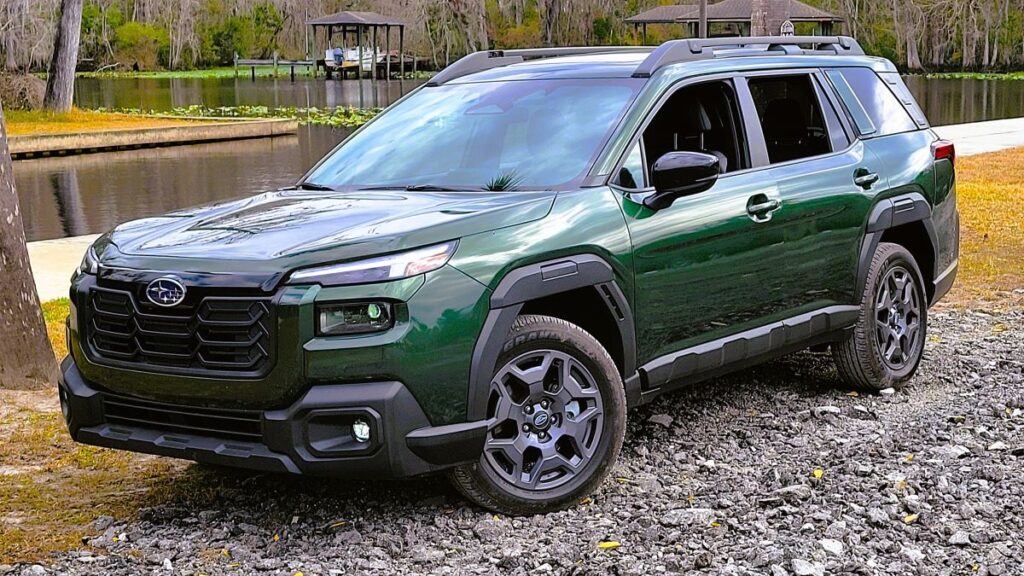
Subaru Outback Premium Updated For 2026
2025 Subaru BRZ tS Keeps The Manual Flame Alive
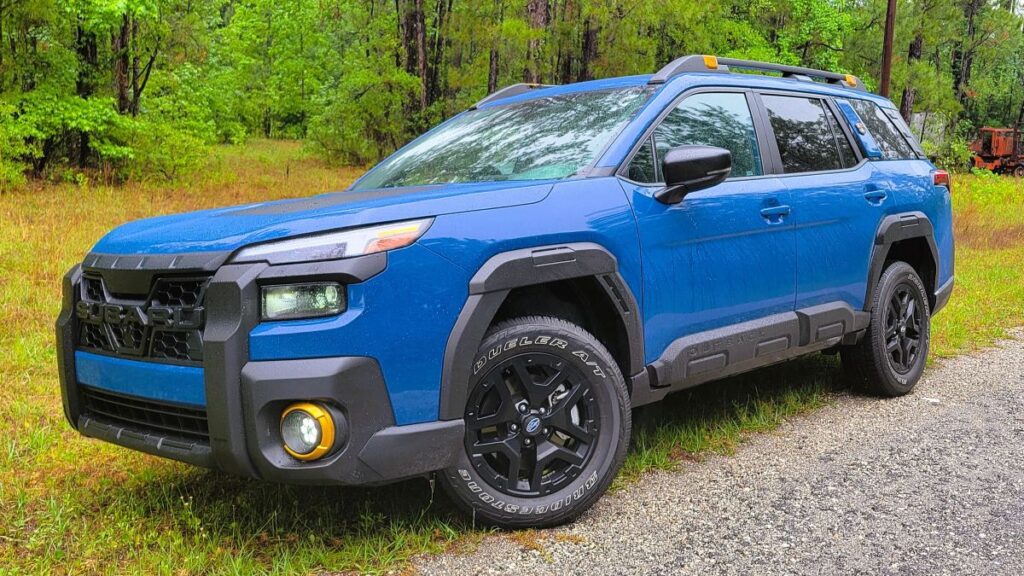
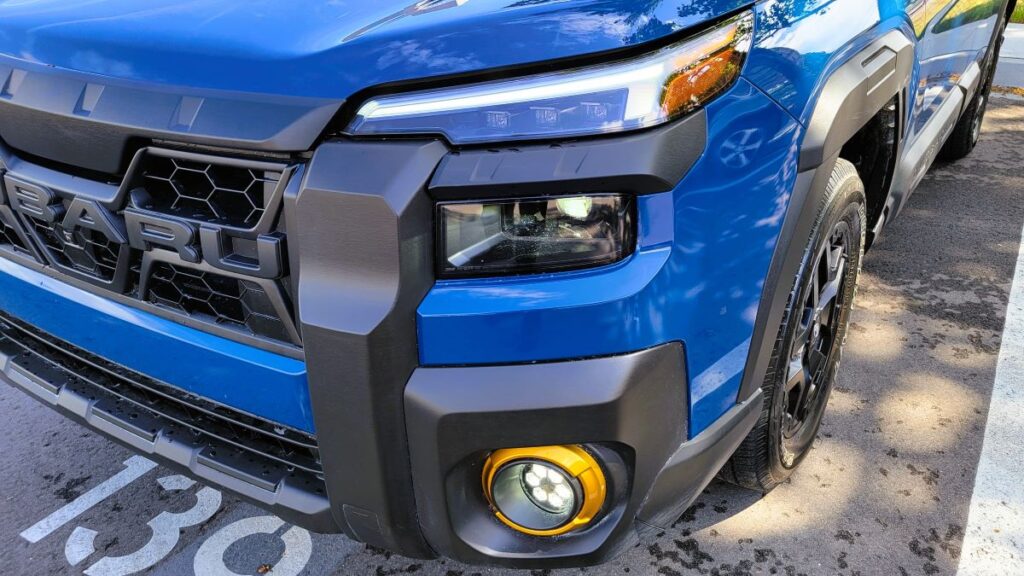
The Outback Premium has its share of angular black plastic in its lower air intake and side fog light pods. The Wilderness gets a more serious dose. The black grille gets “SUBARU” written large as its center bar over larger honeycomb and accent pieces. There’s no Subaru star emblem here. It’s flanked by thick black bars that go from the slit LED DRLs that live under the hood’s corner edges, right down to the lower cladding where they flank the intake and skid plate accent. Big, round fog lights get Wilderness-specific copper rings for a serious standout look. The real headlights live below the DRLs’ black trim.
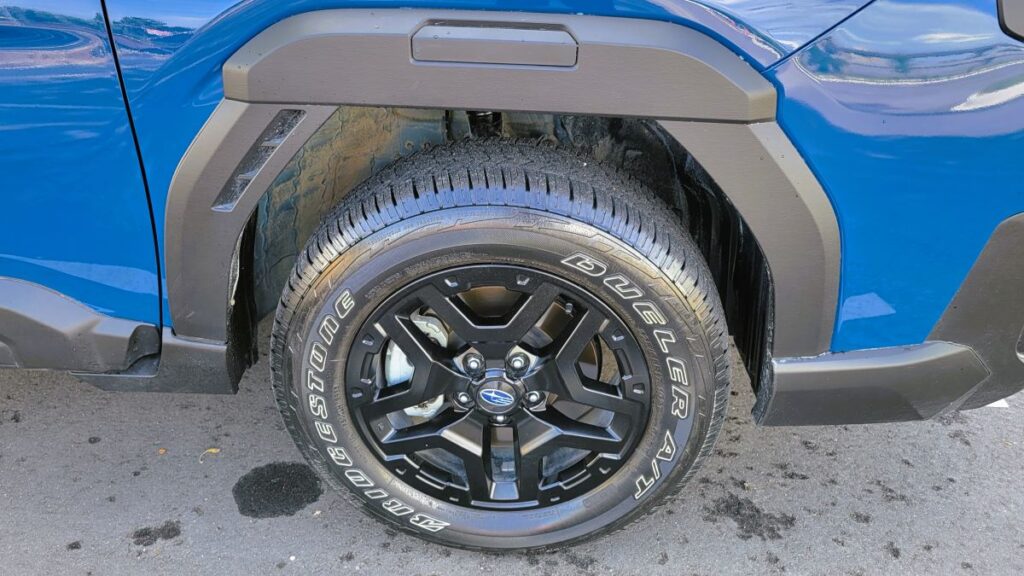
Geometric black fender flares with real rear venting frame slightly chunkier, all-terrain 17-inch Bridgestone Dueller rubber on semi-gloss black 10-spoke alloys. Lower side cladding is deeper, taller, more willing to take a beating when you sling dirt.
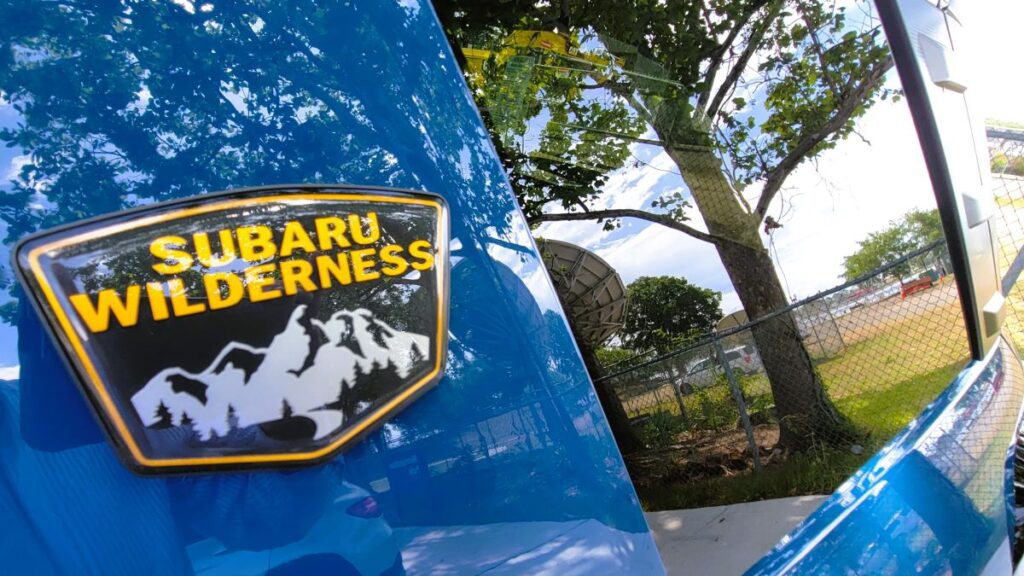
The roof rack is chunky as well. It’s able to handle 220 pounds of stuff, and almost four times more when parked, if you want to mount a rooftop tent. A copper-colored Wilderness badge is affixed to accent panels on each C-pillar.
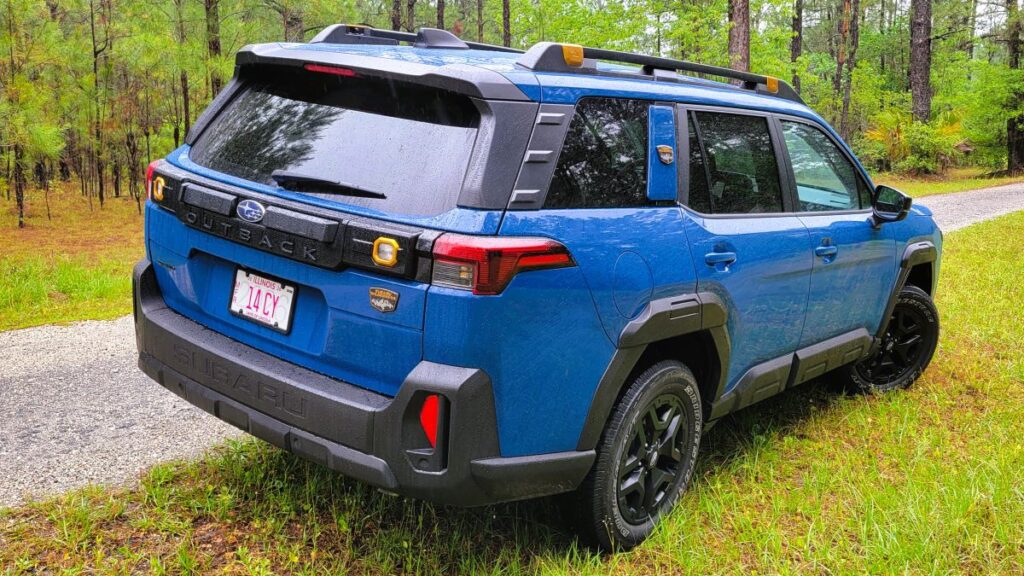
Most of this body is aluminum. Only the rear quarters are steel. And to make sure you know it’s an off-roader, the center of that alloy hood is done in matte black to lessen reflections on the trail. The new Outback Wilderness sure looks more the part of an off-roader, and less a family station wagon.
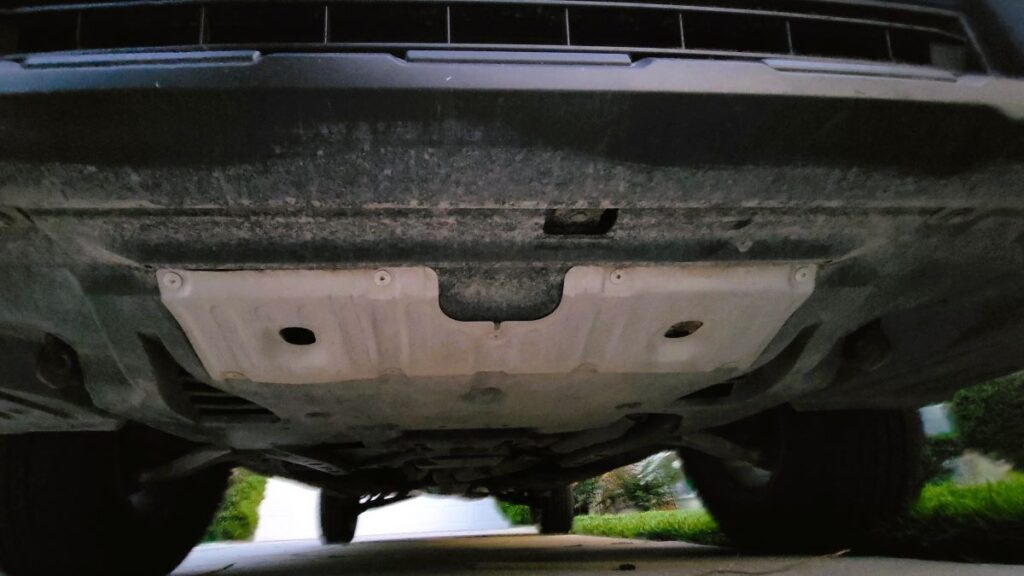
Along with the “OUTBACK” name embossed on lots of the black cladding, there’s a real skid plate behind the front bumper to help with off-road travels.
Copper Accents Adorn 2026 Subaru Outback Wilderness Interior
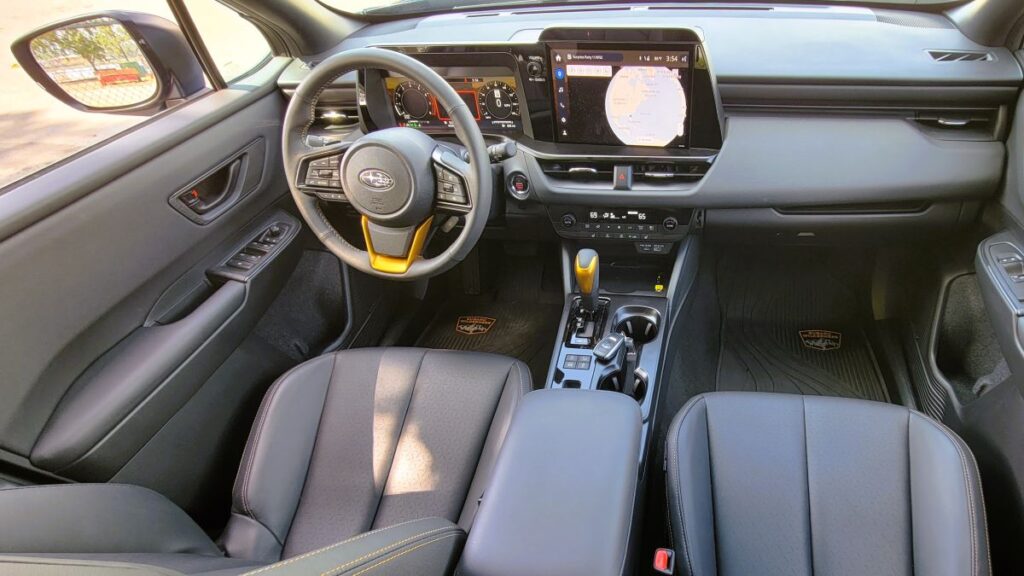
The copper accents outside continue inside the Outback Wilderness, as driver and passengers easily slide into the faux leather seats due to the increased ride height. And since this is the Wilderness model, the gauge and navigation screen show off welcome animations of a mountain range, sunrise and all.
The boxier shape sits atop the same 108.1-inch wheelbase as the more sedan-shaped predecessor. That does seem to translate into a bit more room, particularly above our heads. The StarTex (waterproof faux leather) seats feel supple, with heat up front and nice copper stitching, as feet rest on swirl-patterned black rubber mats, and hairdos have “Wilderness”-embossed head restraints.
The chunky leather-wrapped steering wheel is copper stitched inside. It gains a copper bottom spoke accent, small paddle shifters behind, and the usual buttons in front. Manually adjustable, it offers a clear view of a configurable digital display that can show a 160-mph speedometer and 8,000-rpm tach, or map with speed display, or other streamlined options.
It also displays Subaru’s safety systems, like blind spot sensing that shows when something’s ahead or beside you, or if you are drifting out of a lane. The EyeSight safety system monitors where the driver’s eyes go. If you glance away too long at the audio system or car beside you, it garners a “Hands on Wheel” flashing red alert.
The 12.1-inch navigation touchscreen has a volume knob with all other systems attached to menus accessed by a left-side row of icons. The system is a bit slow to fully warm up when you start, and some items are a menu or two down. But I liked that many needs can be accessed by a simple “Hi Subaru” voice command, then asking for the function.
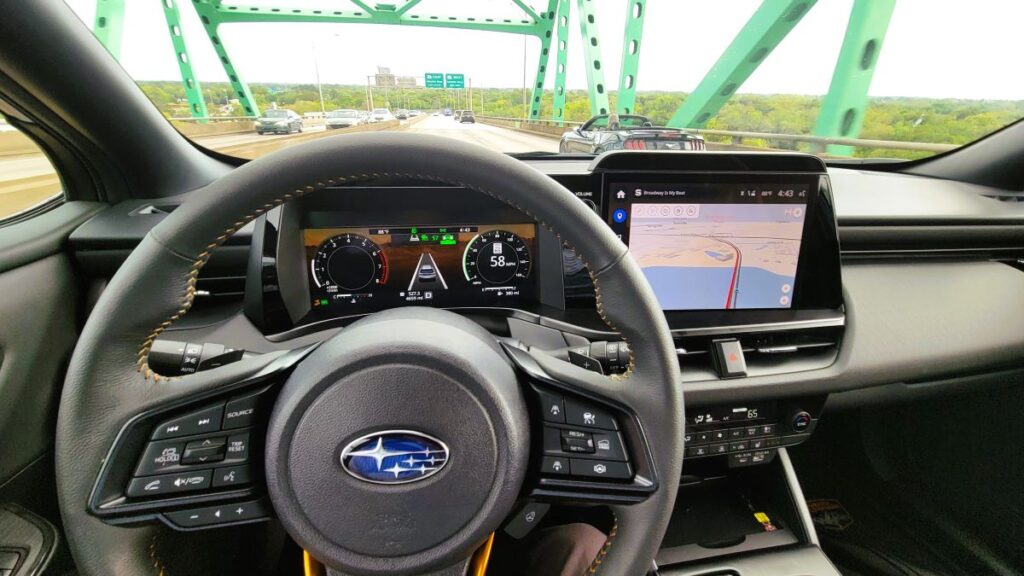
Wireless Apple CarPlay and Android Auto are standard, and there’s HD Radio as well. And while you can adjust climate control via the screen, there are dual zone temperature knobs and real buttons below to handle the basic stuff.
More copper accents the gearshift next to cup holders and there is an inductive charger for your cellphone along with USB ports. The 360-degree/overhead/side camera button is there, as are other driving controls. I really liked the flannel-like cloth lining the door map pockets, to keep water bottles from rattling.
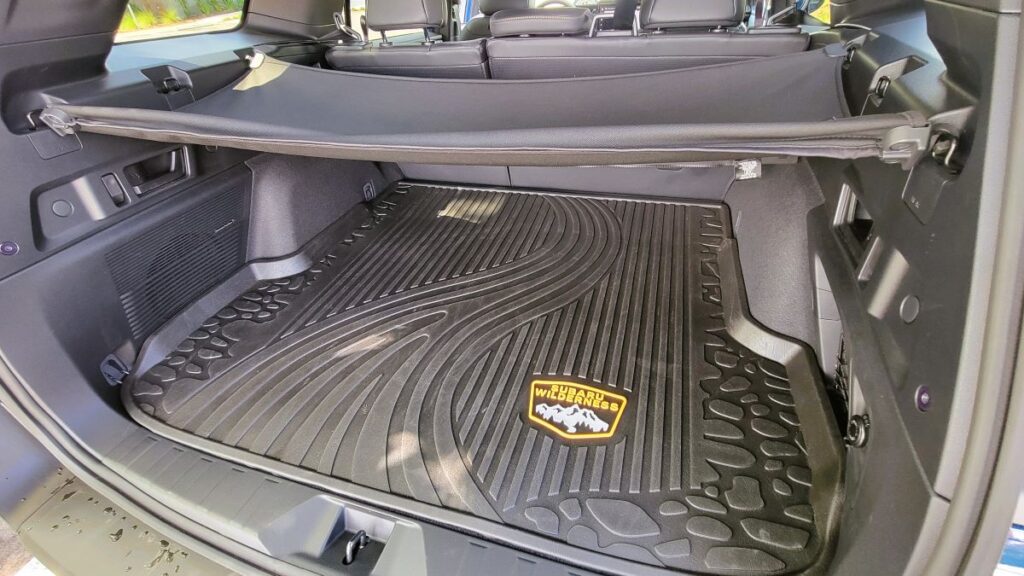
The rear seats have decent leg room, and good headroom, perfect for two adults with a/c vents. They fold fairly flat to access a larger (32.6- to 34.6-cu.ft) cargo area. If you drop both second row seatbacks there is 80.5-cu.ft. of space. There’s a soft, washable security cover as well that can be set up like a hammock to hold wet clothing. The power rear hatch opens high enough to clear my forehead, which is appreciated.
Overall, there’s a sense of sturdy richness here. We have tested an Outback Premium recently with 8.7 inches of ground clearance and a normally-aspirated 2.5-liter BOXER (opposed-four) engine with 180-hp and 178 lb.-ft. of torque at 4,800 rpm. But this is the G.O.A.T. Outback. It has 9.5 inches of ground clearance and a turbocharged 2.4-liter BOXER with 260-hp and 277 lb.-ft. of torque at 2,000-4,800 rpm. Both get power funneled through a Lineartronic CVT, this one with 10 simulated speeds vs. 8, plus paddle shifters and all-wheel-drive. There are no drive modes, just an X-MODE mud and snow option.
Extra Subaru Outback Wilderness Horsepower Makes A Difference
That added power revealed itself at launch. Our 3,973-lb. (232-lb. more than the Premium) Outback Wilderness, on all-terrain rubber, grabbed and got to 60 mph in 6.6 seconds. The engine revved to between 5,000- and 6,000-rpm as the CVT’s belt and pulley did its thing. That compares to 7.9 seconds for the lighter, less powerful Outback Premium.
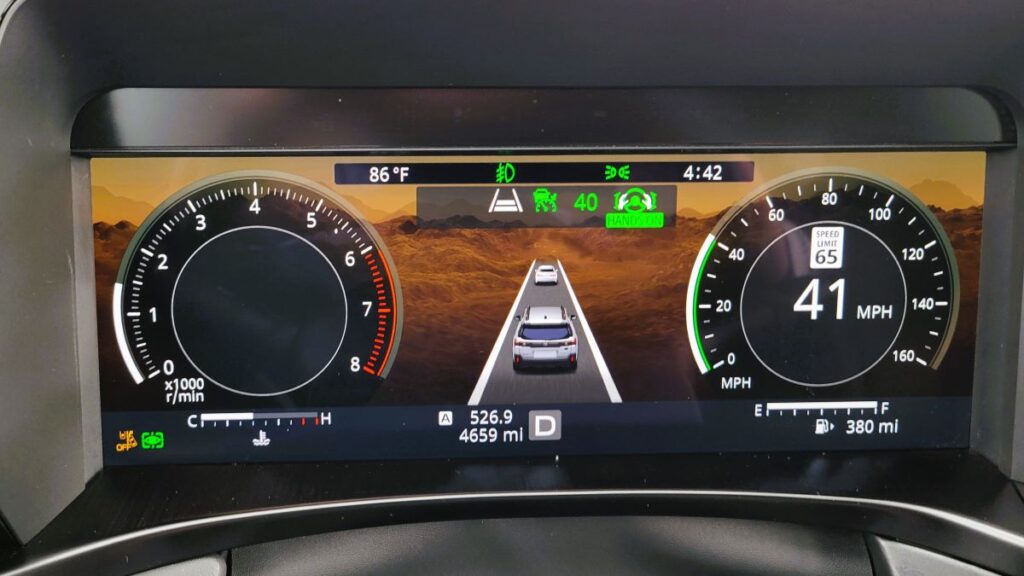
The continuously-variable transmission did a decent job of simulating up- and downshifts in regular driving, and even as it varied between rpms under harder acceleration, it remained fairly quiet doing so. We averaged about 21 mpg, which is a tad less than the Outback Premium. The auto-engine off system was clean enough shutting the engine off at stops, but lurched a bit re-firing as I went from brake to gas.
The Outback Wilderness’s electronically controlled dampers allow for firmer or softer suspension tuning depending on road, or off-road surfaces, based on sensor inputs. The result was a supple yet taut ride over bumps, with no harshness on any speed bump except for sharp little ones, where the rear suspension thumped a bit on rebound. The other result was minimal body roll despite the added height in turns. The Outback Wilderness was quite neutral in corners, and well-mannered in steady-state turns under power in roundabouts. There was almost no understeer in tight, twisty two-lanes.
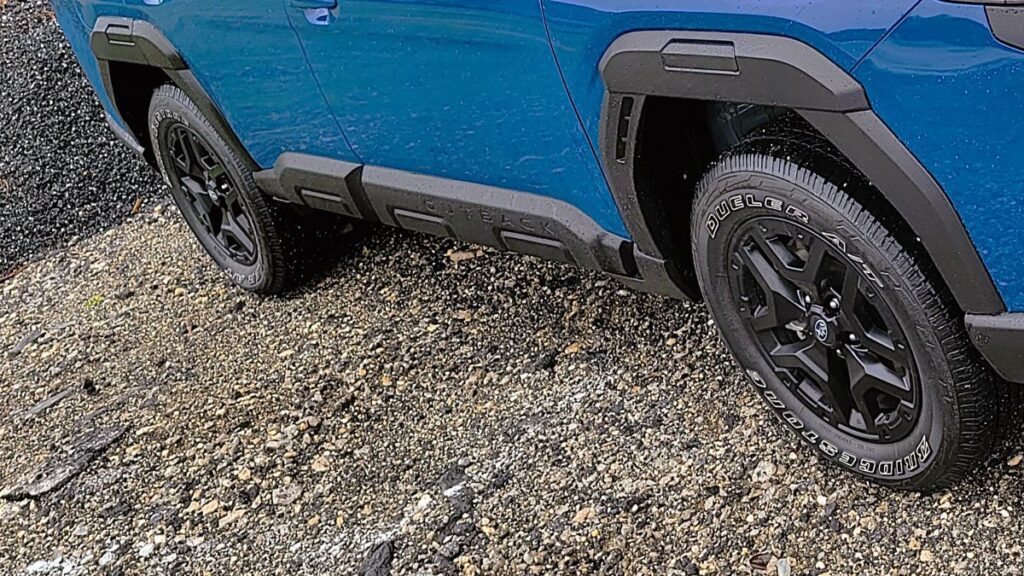
All-wheel-drive not only showed its ability in the dry, but in a 30-minute Florida gullywasher. On slick, fresh, very wet asphalt, traction was solid straight and curved.
And with X-Mode, when sat-nav put us on a narrow dirt road in a downpour to get from one road to another, traction in the mud was fine. Each wheel did its job. The ride over holes and lumps was controlled and comfortable. The two X-Modes cut out at 25 mph. But there’s also a hill-descent control.
Steering was a tight 2.3 turns lock-to-lock, with decent feel and acceptable power assist. It had better feel than the Premium. The 12.4-inch front/11.8-inch rear disc brakes had a decent pedal feel, and a tad of travel before bite on our 4,700-mile-old test car. They stopped the car straight and drama-free. There was a tad of nose-dive and ABS at full stop, but no fade after hard repeated use.
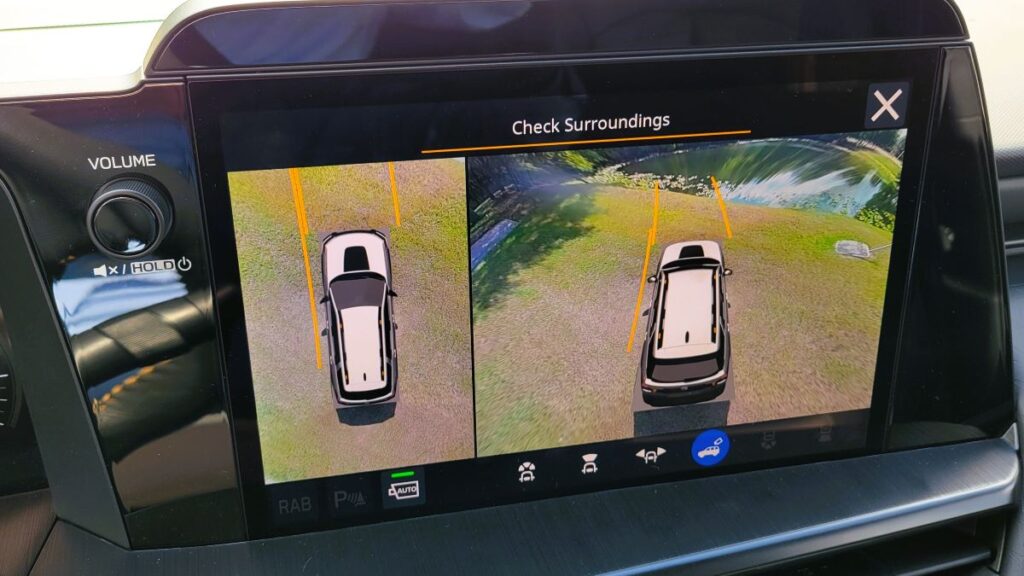
We also had a bit more time to get used to the EyeSight Driver Assist, which looks at the driver’s eyes to make sure they are looking at the driving world. It is hyper-sensitive, beeping if I looked too long at a merging car or my gearshift. The adaptive cruise control offers a sometimes firm lane centering and steering wheel feedback. But it does alert you to those in the left and right rear blind spots – and can be backed off via the in-screen menu, albeit one a layer or so down.
The base Subaru Outback starts at $34,995; Our top-line Outback Wilderness gets all we had standard for a final MSRP of $44,490.
Bottom line: A very complete, all-weather mini-SUV, for a price.
2026 Subaru Outback Wilderness Edition Specifications
Vehicle type – 4-door, 5-seat all-wheel-drive sports utility wagon
Base price – $34,995 ($44,490 as tested)
Engine type – turbocharged 2.4-liter 16-valve DOHC aluminum boxer 4-cylinder
Displacement – 2.4 liters
Horsepower (net) – 260 @ 5,600 rpm
Torque (lb-ft) – 277 @ 2,000 – 4,800 rpm
Transmission – CVT automatic with 10-speed – manual mode and paddle shifters
Wheelbase – 108.1 inches
Height – 67.5 inches
Overall length – 191.7 inches
Overall width – 74 inches w/mirrors
Ground clearance – 8.7 inches
Front headroom – 40.5 inches
Front legroom – 43 inches
Rear headroom – 40.5 inches
Rear legroom – 39.5 inches
Cargo capacity – 34.6 cu. ft./80.5 w/seats folded
Towing capacity: up to 3,500 (800 more) lbs.
Curb weight – 3,973 lbs.
Fuel capacity – 18.5 gallons
Mileage rating – 21 mpg city/27 mpg highway