


EVs have become so engrained in our consciousness, so long a part of our automotive world, that they are familiar to us in all their configurations, from sporty compact crossovers to fairly large SUVs.
And from the roots of those first mass-market EVs like 2011’s Nissan LEAF and 2012’s Tesla Model S, rare in their day, we now have electric vehicles of some sort – EV, PHEV and hybrid – sold by almost every manufacturer.
Yet since my first drive in a 1996 GM EV1 – fast as a Vette, but under 100 miles of range – I have loved EVs, but wanted more bang for the buck – style, substance, plus urbane drivability – and lots of range.
Now the updated Kia EV-6 seems to have what I want.
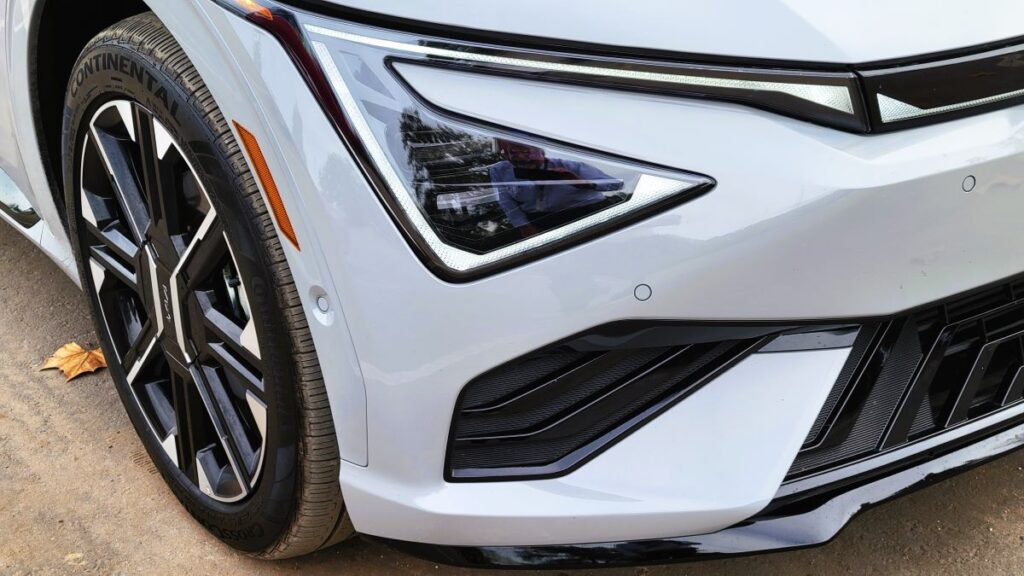
Our 2025 EV-6 GT-Line lives atop a version of Hyundai’s E-GMP platform, which is also shared by that company’s Ioniq 5, 6 and 9, as well as Kia’s EV9. That means the long 114.2-inch wheelbase of an SUV, with short overhangs. After being introduced in 2021, the 2025 EV-6 has received a dramatic front-end facelift, a rear-end touch-up, and some major tech upgrades.
2025 Kia EV6 GT-Line Tech, Styling Upgrades
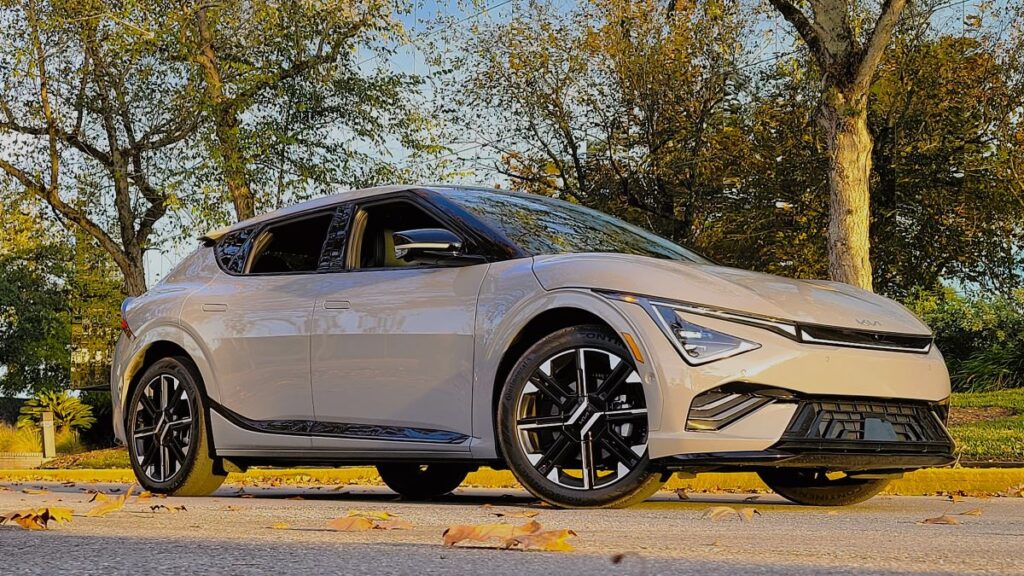
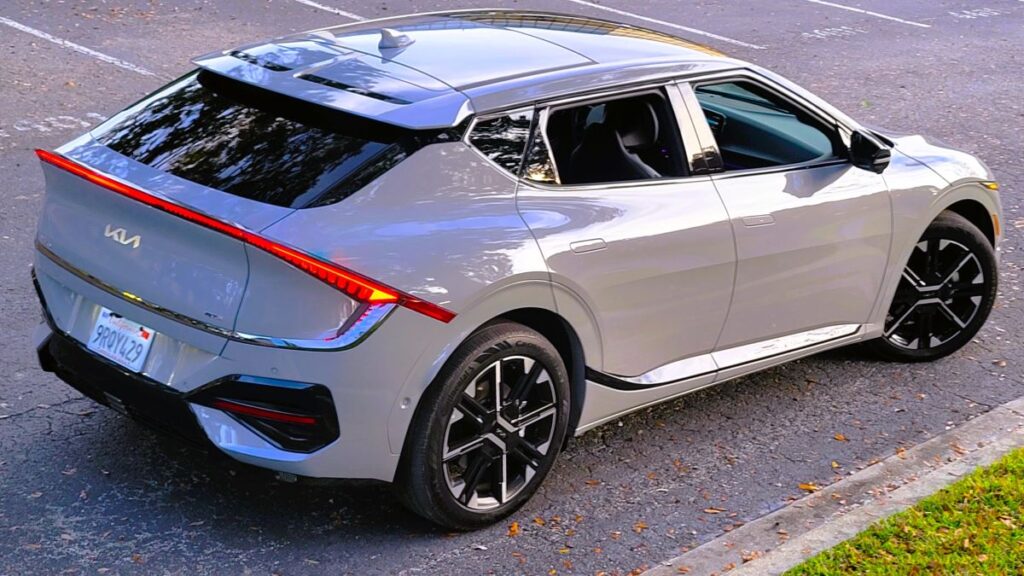
Up front is a streamlined nose with a more aggressive headlight design, a central LED light bar connecting angular J-shaped daylight running lights (DRLs) framing small-but-intense headlights. A wide black lower intake with active shutters is flanked with gloss black sides over a slim air dam that conveys sporty intent. Then come 20-inch Continental Cross Contact rubber at the four corners of this 60.8-inch-tall 5-door, neatly filling flared front, and curvaceous rear fenders.
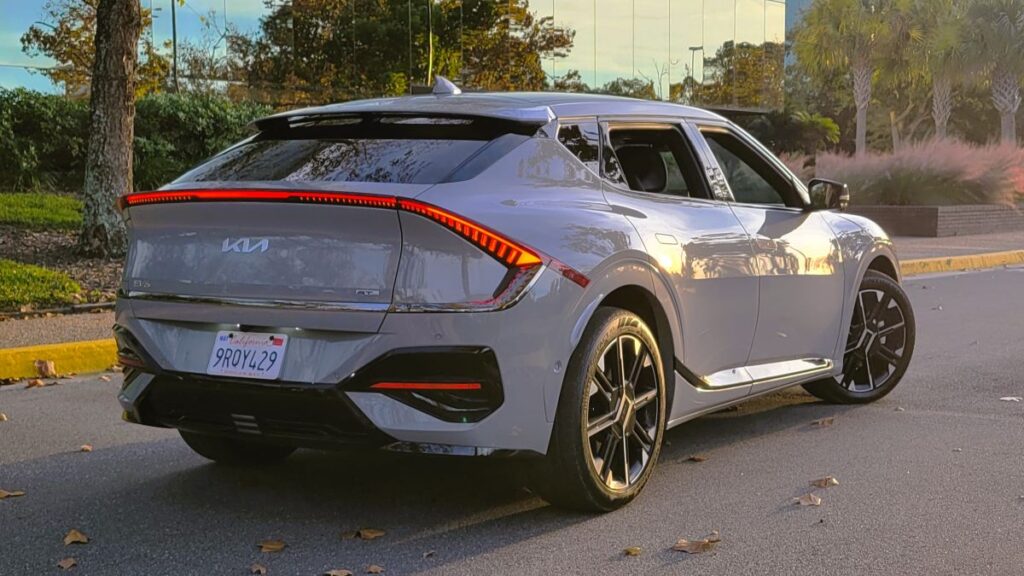
A sweptback windshield flares off the rounded bonnet, then a tapering roofline dips aft to help slim the car’s height. Low down, gloss black sill accents rise at rear wheel openings, tapering to design lines that spear staccato taillights that frame the tail and wraparound rear spoiler at the rear of the raked fastback hatchback. And – of course – no exhaust tips.
Cartoon: Zappy Checks Out The EV6
The consensus: this sleek (.297 coefficient of drag), low, wide and metallic gray crossover is almost a hot hatch; with a distinct look and wide, long wheels-at-each corner stance. Most folks who saw it, liked it.
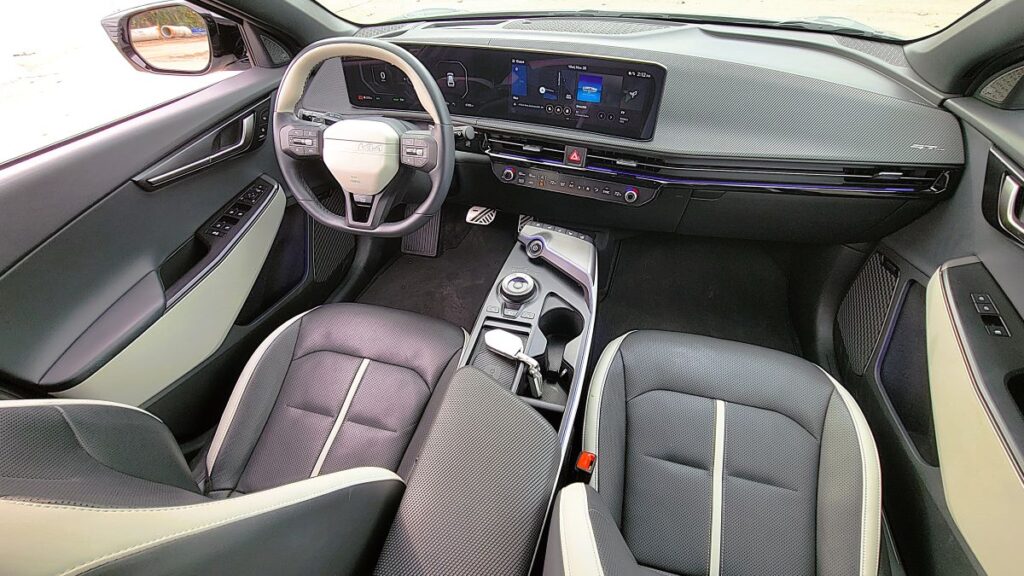
Trigger the remote’s unlock, and unique puddle lights glow from the outer edges of the rear hatchback shade/spoiler. Then you slide into black and dove gray pleather bucket seats with heat, cooling and power adjustments that are comfortable and fairly supportive. The driver gets dual memory presets and a heated steering wheel. The 2025 update sees a slightly squared-off power-adjust steering wheel with handy controls up front, and regenerative brake level paddles (up to iPedal Max’s full regeneration when the “go” pedal is released) behind. There’s a drive mode button on the lower spoke; with Eco, Normal, Sport, Slippery or custom setting.
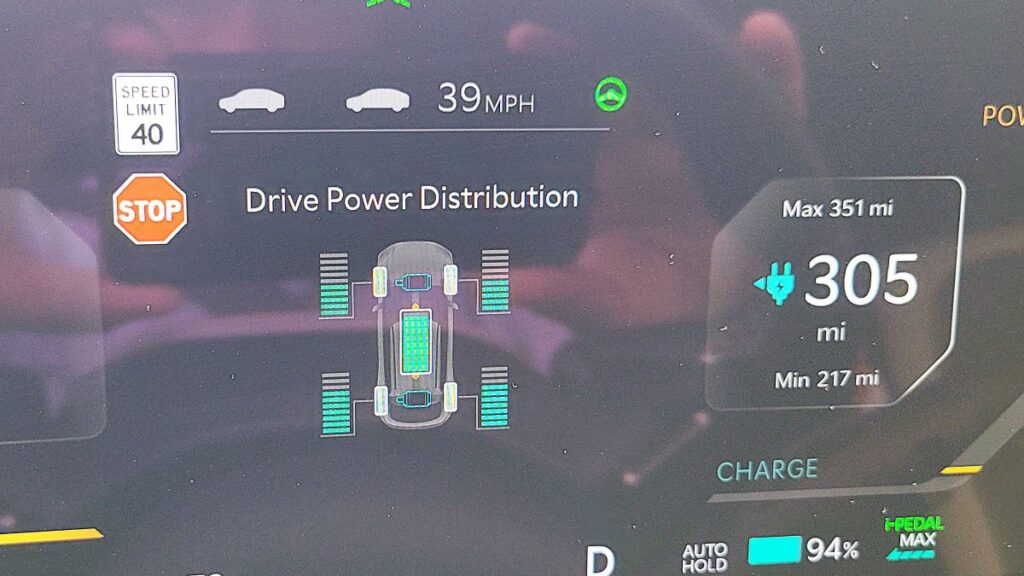
There’s a wider, more rectangular curved display, with updated software and (I think) a cleaner gauge display. A digital speedometer is joined by a EV range display, framing a configurable center screen with audio, navigation, EV range, all-wheel-drive split, and more. My favorite – left and right ends of the screen show blind spot camera views when you activate that turn signal.
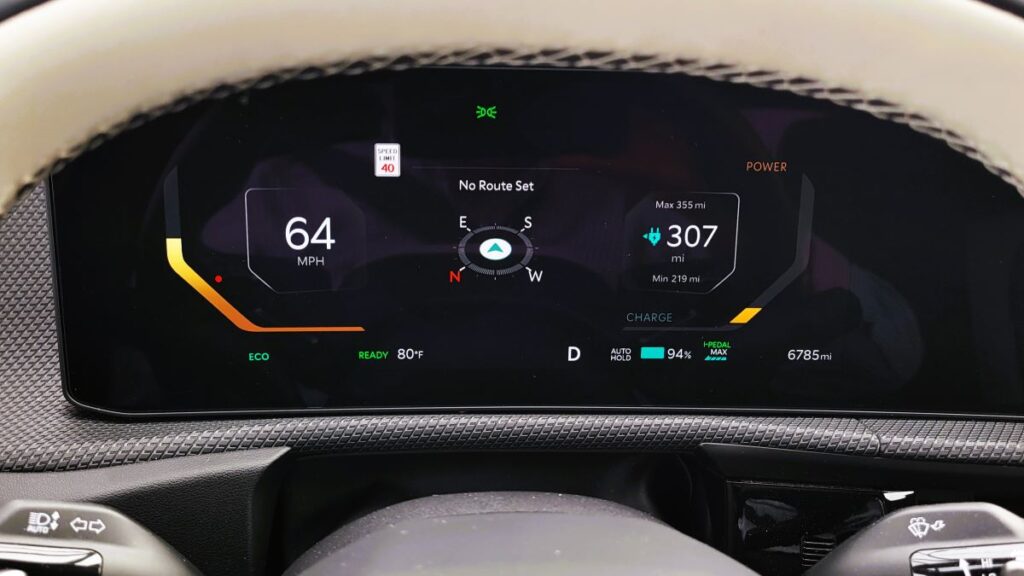
There’s a wider navigation screen flowing off the gauge display, or you can tap in a home screen. Swiping or tapping brings up other menus, although some displays are buried up to six button taps deep, like drivetrain sound effect level or Sounds of Nature.
The screen floats atop a textured padded gray dashtop, another change from last year. There’s a wide ambient light strip over a main menu selection touchscreen flanked by volume and tuning knob. Tap the fan icon, and you get climate touch controls as the knobs become dual-zone temperature control. One appreciated change – whichever screen you select, menu buttons or climate, stays put instead of reverting back as in previous Kias. It can wash out in sunlight.
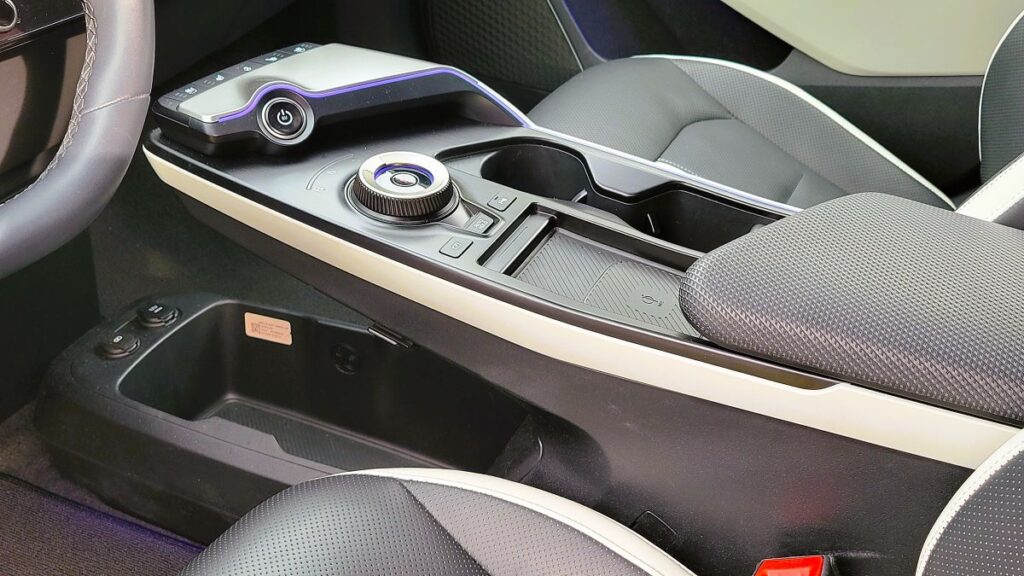
Another nifty interior aspect is no drimeline hump. That’s thanks to the battery pack parked low under the floor. There’s a storage bin with plenty of USB ports under the floating center console, with start/stop button, gear selector knob, plus inductive phone charging tray, cup holders and a deep armrest storage area. There’s hooks on either side of the console to hang small grocery bags. It’s all sleek and smart, even if there’s a bit of hard plasti, but there are some padded door tops and armrests as well.
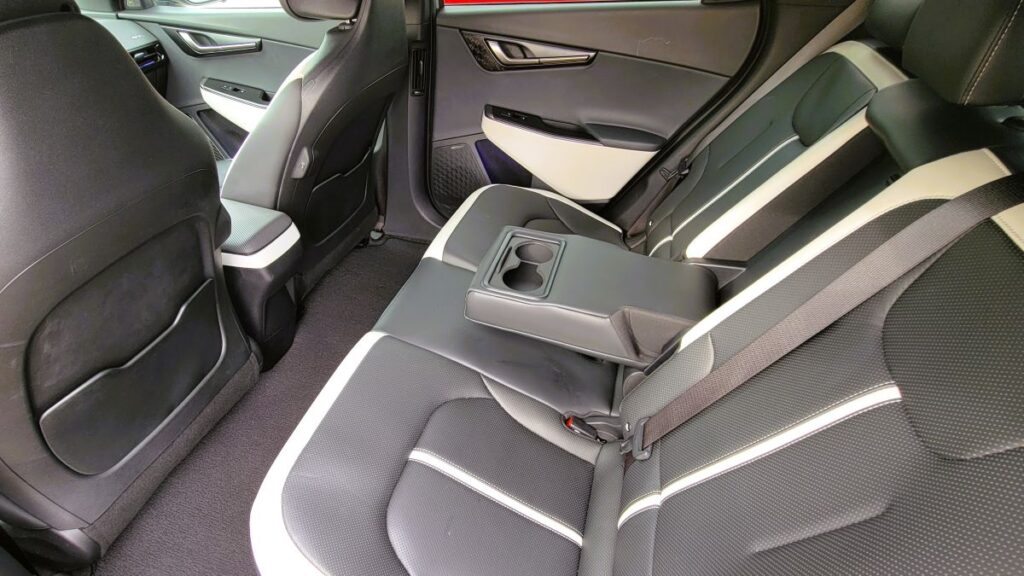
That SUV-level wheelbase equates to rear seat space, a true 3-person bench with reclining seatbacks, superb head and leg room and a fold-down center armrest and dual USB ports. There’s a 120-volt plug near the floor. The tapering roof means I had to duck a bit to get into that back seat, and the high beltline and tapering roof made for limited outside visibility. The power rear hatch opens tall enough to clear my head, but liftover is a big high with slim storage underneath. The space is expandable via the 60/40 split rear seatbacks. There is a tiny frunk under the clamshell hood.
2025 Kia EV6 GT-Line Gets Native Supercharger Support
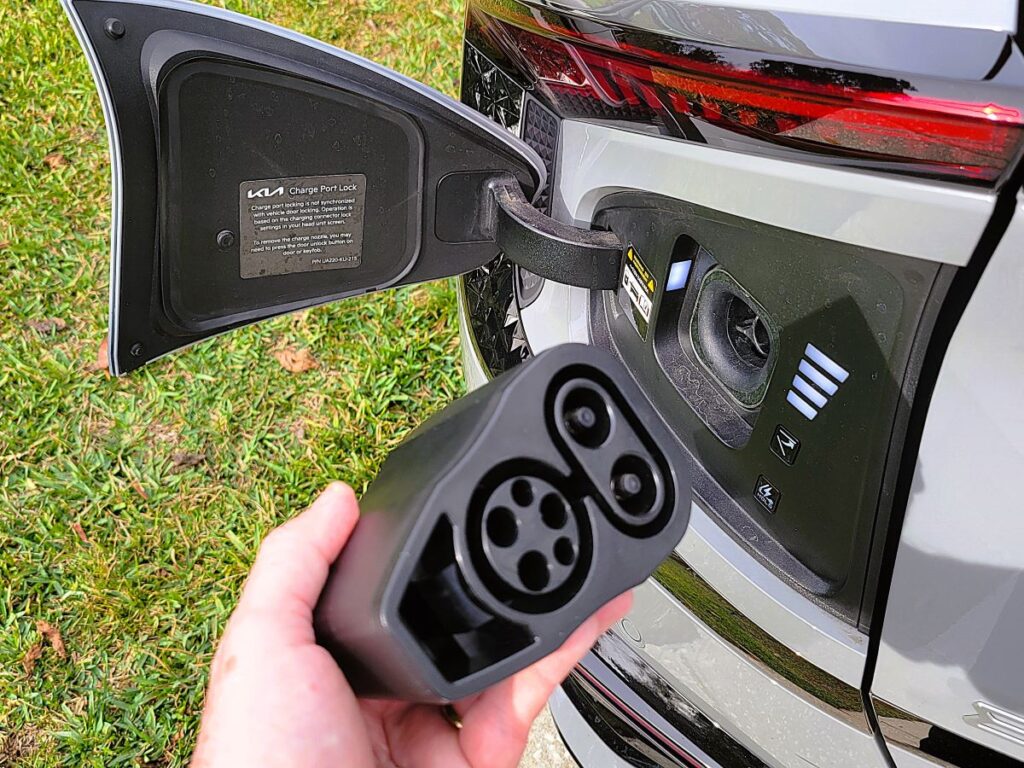
The charging port has been moved to the left rear and now has a Tesla Supercharger-compatible NACS port. That opens up access to thousands of V3 and newer Tesla Superchargers across the U.S. The older Superchargers don’t support non-Teslas.
Kia supplies a CCS-compatible charge port adapter so you’re fully covered at other DC fast chargers such as Ionna or ChargePoint. For Level 2 charging, you’ll need a second adapter if you’ll be using a J-1772 plug as opposed to a L2 NACS plug.
The Kia has increased our EV6’s top trim battery capacity to 84-kWh pack, up from 77.4. Under ideal conditions the EV-6 can go from 10 to 80 percent charged in about 20 minutes.
NACS charging plugs are lighter than CCS plugs. The cables are also often lighter, making Superchargers easier to handle and plug in.
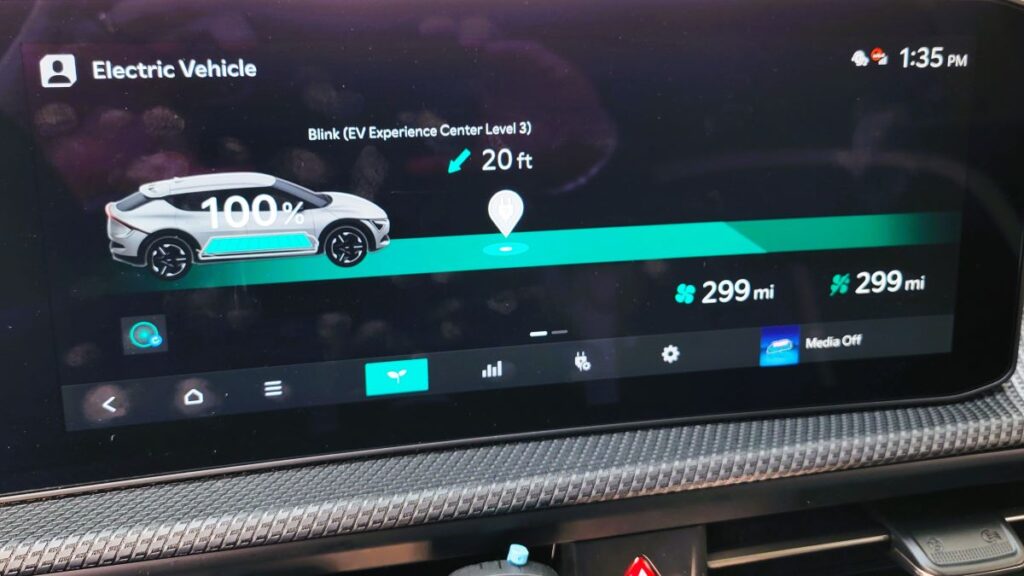
I have a charging park near me with four versions of Level 3 chargers, including one with NACS. I plugged in with 25% charge and 66 miles of estimated range left. After three minutes, we were up to 31% charge, and an estimated 85-mile range. In 45 minutes we had 100% charge and an estimated 299-miles of range.
The Kia has a peak rated charging speed of 240 kW, although reaching that peak speed depends on which L3 DC charging station you’re using. Most Tesla Superchargers haven’t been upgraded yet to support the Kia’s peak charging speed, although many CCS stations operated by Electrify America, EVgo and others do. If you want to hit that peak speed, look for V4 Superchargers or CCS chargers that support 350 kW or higher charging.
I started my test drive with 95% charge, and 311-miles of estimated range, which are fine numbers to live with. The only negative is that the estimated range display is optimistic for my driving style. My actual miles driven was 44 miles less than the estimated range as displayed. Using iPedal Max did give back a mile or so of added range on my short commute.
With 320 hp and 446 lb-ft of torque, our 2025 Kia had a considerable performance advantage over lots of similar-size gas crossovers, and even some EVs, increasing its fun factor.
The optional front-mounted motor works in tandem with the rear motor. The rear does most of the work in normal driving, but the front joins in on acceleration, and cornering assist. Eco mode delivers less hp. EV torque is available quickly in all modes, while tapping Sport mode causes a noticeable surge. We used the EV6’s adjustable turbine sound effects that change tempo as you accelerate. They really help give the driver aural input during acceleration. At speed, all you hear is a bit of tire and a/c fan noise. If you don’t like the sound effects you can turn them off.
2025 Kia EV6 AWD GT-Line Is Quick
We first sampled Eco, my daily mode to conserve battery. Foot to the floor acceleration in Eco mode is not spectacular, but quick enough and seamless in power application, with no upshifts of course. After a minute pause, we moved out quick enough to hit 60 mph in 6.7 seconds. Tapping in Sport mode frees up all the electrons. From full stop the EV-6 leaps out of the pocket, all wheels getting full power as we hit 60 mph in a quick 4.7 seconds. There’s no drama, no wheelspin, just traction to the limit as we were pushed back in our seats. The motors stayed strong and torquey, pulling hard all the way. Passing was “Think and it goes,” especially in Sport mode. Yes, Sport mode dropped battery range. But, EV-6’s EV screen routinely told us we could get up to 10 more miles of range if we shut off climate control.
2023 EV6 GT Road Test Video (story continues below)
Now time tunnel back to EV Rider’s 2023 test of the original EV6 GT with smaller battery. In Eco, we managed 60 mph in 6.5 seconds. Tap drive mode to Sport while driving, and we hit 60 mph in a quick 3.9 seconds. The GT edition is not being sold in the states this year.
The Continental rubber is hooked to MacPherson type front suspension and multi-link rear, with a controlled-yet-supple ride that tackled road ripples with a quick-yet-damped rebound and no harshness. Interstate trips were smooth and quiet. Being wide and low with batteries in the floor, it seemed to hug turns with just a bit of lean. It was agile and capable at any speed, and fun to push hard with no bite-back. With iPedal Max’s regenerative braking on full, motors act as generators and slow us down, so we could “downshift” into a turn, then power out. We could vary the “downshift” or “upshift” via regernative paddles. The result was neutral corner carving, with most of the power driving the rear wheels until the front power application was needed. Pushed in our skid pad, it stayed mostly neutral. We could push harder and feel a bit of understeer, but it was easy to control. And bumps in mid-turn caused no directional issues.
In daily driving, the EV-6 felt agile and compact, easy to place. The power steering was a bit artificial in feel sometimes, but feedback firmed up in Sport mode, although it still felt a bit augmented. And with 12.8-inch front and rear disc brakes and a responsive pedal that didn’t overreact, hard use saw some nose dive and ABS chattering, but stops were straight and fade-free, even after some repeated hard use. Then there’s Drift mode, with 100% power to the rear Continentals and no traction control. You could hang the tail out – cool.
For safety, lane-keep firmly nudges you to stay between the lines and helps steer through highway curves. It will even assist in a lane change if you signal. But it’s not a hands-off driving system. Removing hands from the squared-off wheel triggers alerts. There’s also an overhead 360-degree camera view, and Smart Park. You can use the key fob to remotely pull in or out of a parking spot while you stand outside. The head-up display offers lots of information, even icons showing cars ahead, behind and passing.
A base Kia EV6 Light RWD starts at $42,900. Our loaded AWD GT-Line starts at $58,900. Ours had carpet mats and cargo cover, the only options, for a final of $60,740.
Bottom line: Extremely quick and roomy, with a sporty shape that’s a delight to drive and live with. And Kia gave me what I wanted: an average 300 miles of range. This is the way to EV.
2025 Kia EV6 GT-Line Specifications
Base price – $58,900 ($60,740 as tested)
Motor type –Permanent-Magnet Synchronous Motors with Lithium-ion Polymer batteryHorsepower (net) – 320
Torque (lb-ft) – 446Battery energy – 84kWh
Wheelbase – 114.2 inches
Overall length – 184.8 inches
Overall width – 74.4 inches
Height – 60.8 inches
Front headroom – 36.8 inches
Front legroom – 42.4 inches
Rear headroom – 39 inches
Rear legroom – 39.5 inches
Cargo capacity – 24.4 cu. ft./46.7 w/rear seat folded
Towing capacity – up to 2,700 lbs. w/brake
Curb weight – 4,630 lbs.
Range – 270 miles on full charge/97 combined MPGe