

It was one of the coolest pickup trucks ever made – Jeep’s 1971 J-10 and J-20, with flared front and boxy rear fenders, and a square-jawed face that dared you to find a sand dune.
And just as the current Gladiator is based off the Wrangler, the J-10/J-20 was based off another Jeep, namely the big Grand Cherokee SUV. It carried names like Honcho, and Golden Eagle.
You Might Also Be Interested In: Wrangler Rubicon 4xe Long-Term Review | Bronco Sport Badlands Review
Now there’s the Gladiator, Jeep’s first pickup since the Cherokee-based Comanche of 1986 to 1992. Among the available trims are names like Rubicon and Mojave. The one with the most history is what we have: the Willys.
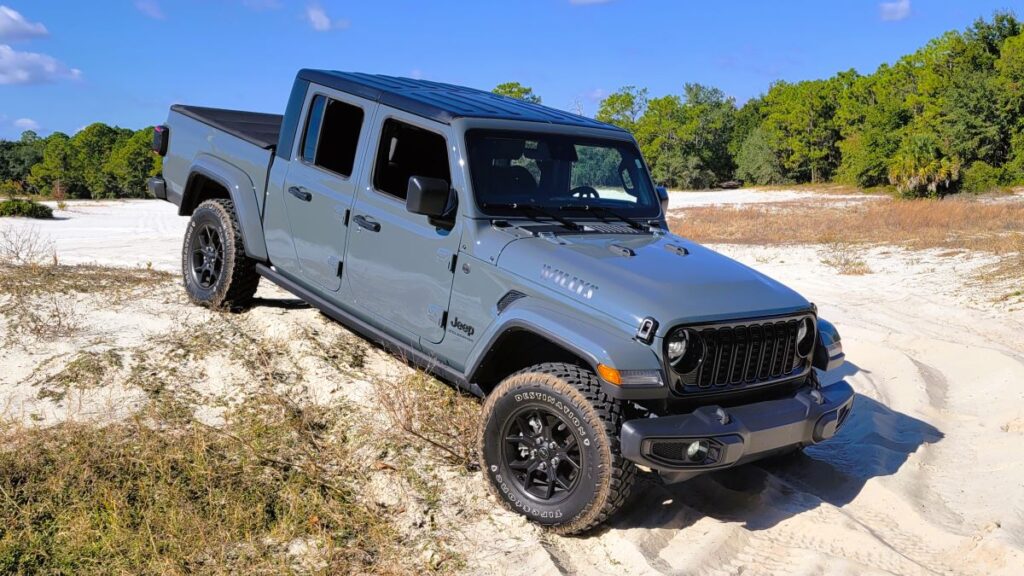
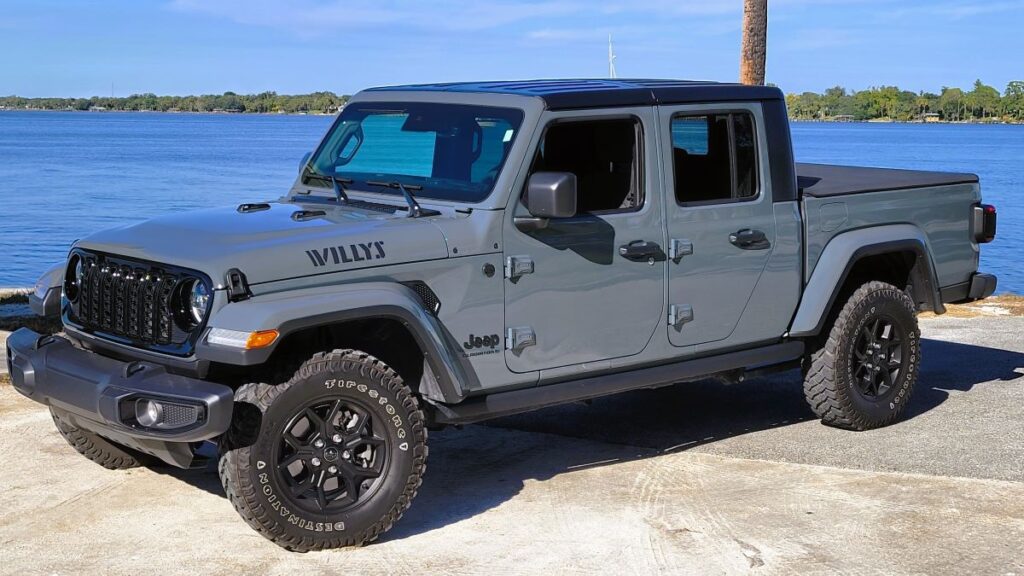
Willys-Overland was one of three companies that developed the first Jeep for World War II and then trademarked the “Jeep” name post-war to market the civilian version. Fast forward to late 2025, rolling to the front line in Anvil Gray paint comes EV Rider’s Jeep Gladiator Willys Edition. “Willys” is done in flat black on rounded bonnet sides.
So far Jeep has sold just over 42,000 Gladiators in 2024, and 38,000 more sold through September of 2025. That compares to 151,000 Wranglers sold in 2024, and 128,000 sold as of September of this year. The Gladiator has three classic Wrangler attributes: a folding windshield, removable roof choices and removable doors. It’s also a classic Wrangler with a 19.4-inch wheelbase stretched to become a 219-inch 4-door pickup, with steel pickup bed and aluminum body.
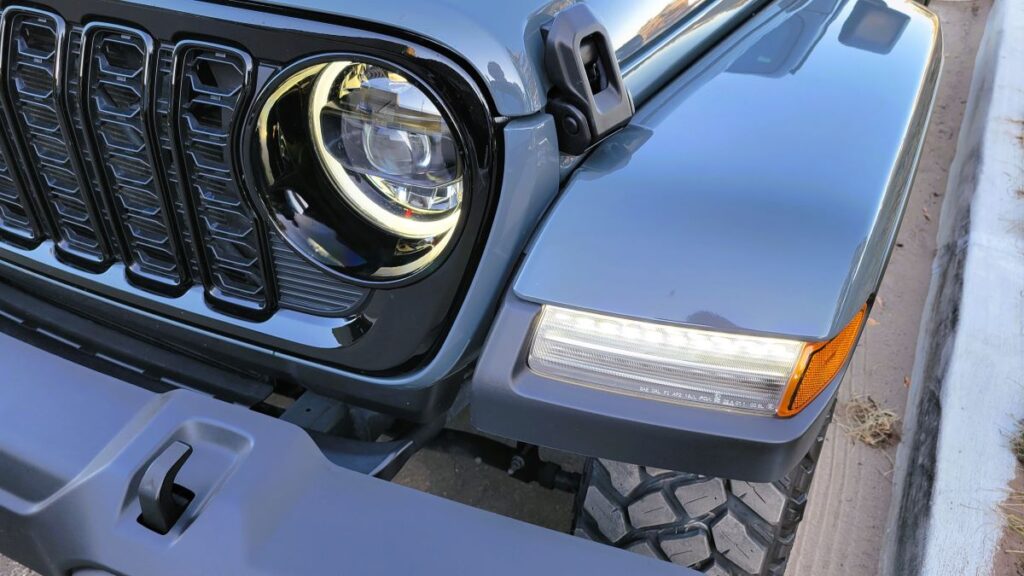
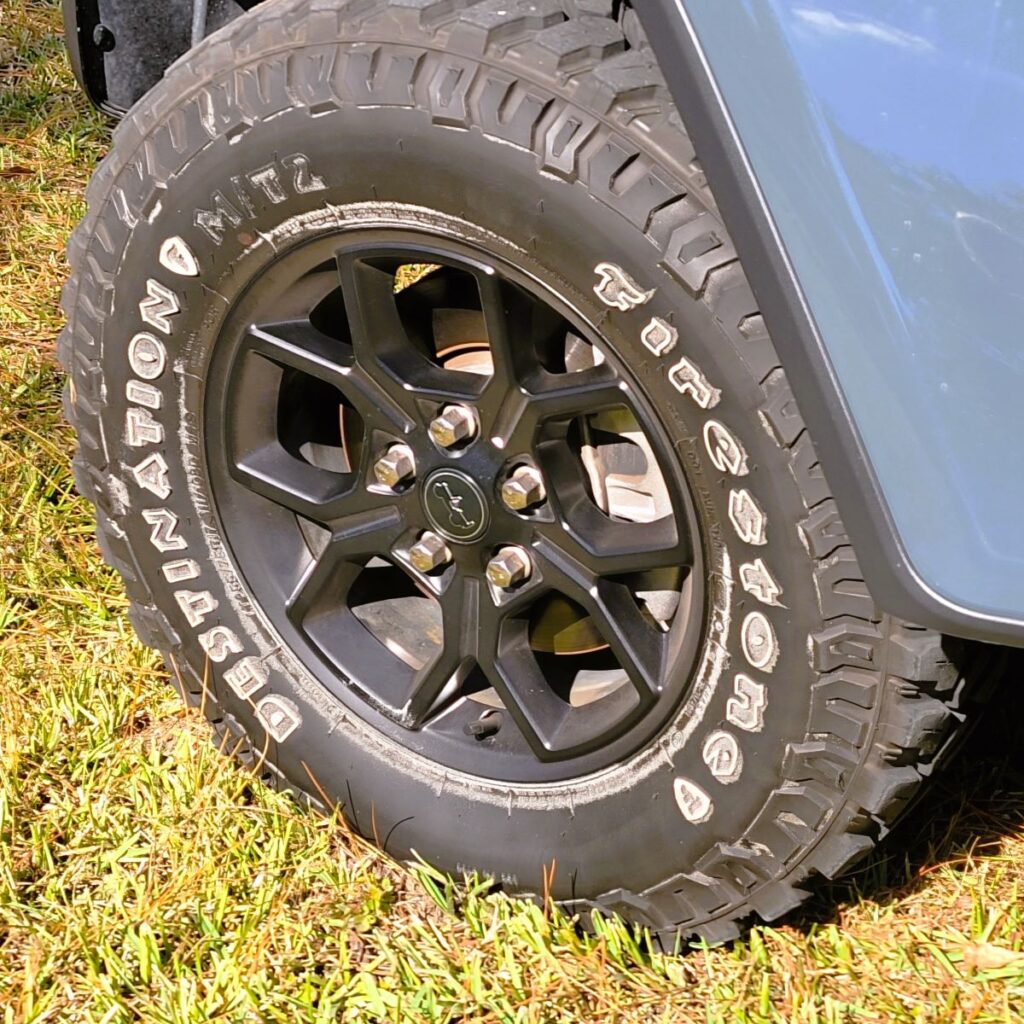
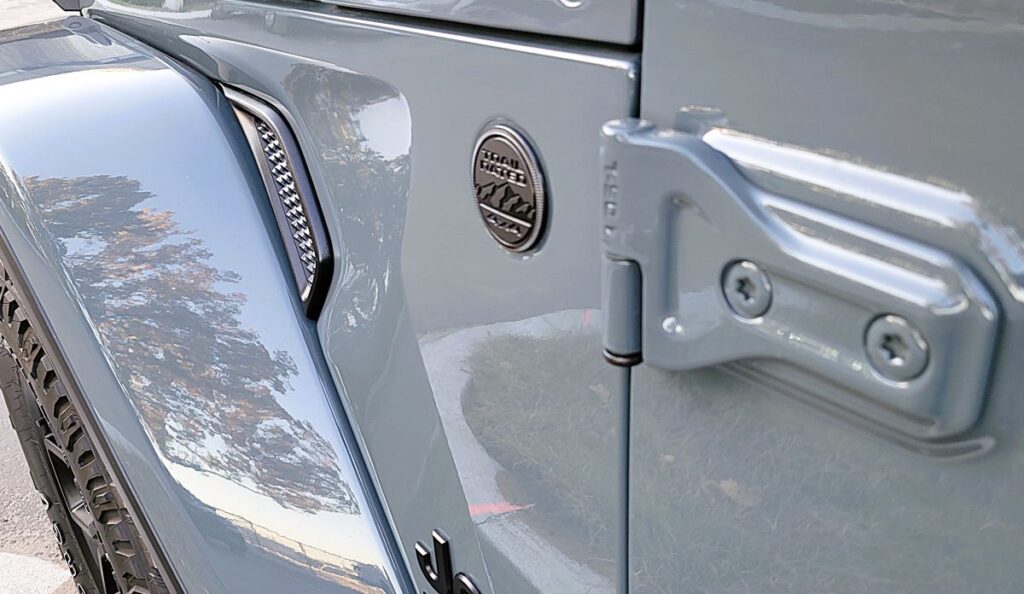
The Gladiator debuted in 2020, but got some changes for 2025, most notably a black 7-slot grille and slightly rounded nose between bright LED headlights with Daytime Running Light (DRL) halos. The new grille is a bit slimmer in height. Slim turn signals live on plastic front fender leading edges. The freestanding bumper has LED fog lights integrated into its design, plus black tow hooks and a brush guard under the front bumper. There’s fake vents aft of the front fenders, with “Trail Rated” badges. Under black plastic trim are deep-treaded 17-inch Firestone Destination off-road tires on forked 5-spoke alloy wheels. It’s has traditional hood clamps, plus more to clip the nearly flat windshield down – after removing four bolts on the frame.
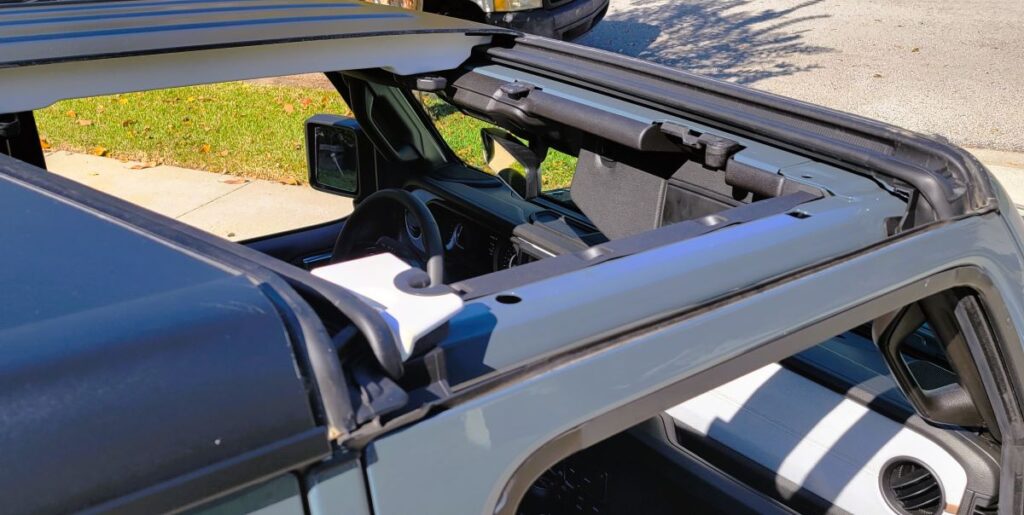
Like the regular Wrangler, there’s a boxy roofline with lightweight T-tops over front seats that unclip quickly. But they look a bit rough inside with black rubber inserts as half-headlining framed by a textured painted white. Slab-sided aluminum doors come off after a Torx bit kit undoes those exposed hinges. The kit works on the windshield as well as composite rear roof. That leaves you gazing at the sky through the roll cage; its center bar houses stereo speakers and LED interior lights. The rest of the top is just heavy enough that it needs a few folks to carry and it has to be left at home.
On the sills down below, beefy steel done in black lives atop 11.6-inches of ground clearance. The 5-foot cargo bed gets a vinyl cover under an opening rear center window – manual, not power. The rear bumper is another massive metal piece with plastic covering and inset reflectors. There’s a spare tire below the bed, while square LED taillights live proudly on a 33.9-inch-deep/56.8-inch-wide bed with more tow hooks atop the bumper.
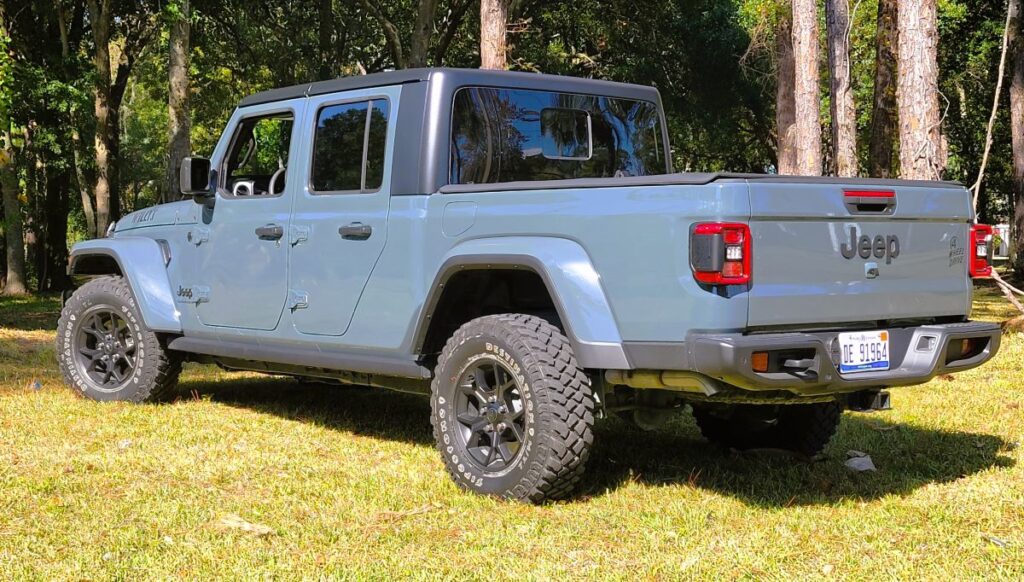
I still love the longer, leaner Gladiator’s looks four years after its intro. The wheelbase stretch and long bed gives it balance and a tough look.
Flat side doors have fabric straps to keep them from blowing open too far, since there’s only basic exterior hinges Grab handles help you climb over the sill lips and into 2-tone gray cloth seats which have almost denim-like bolsters and some contrasting stitching. They are flat but comfortable, with manual adjustment and heat up front.
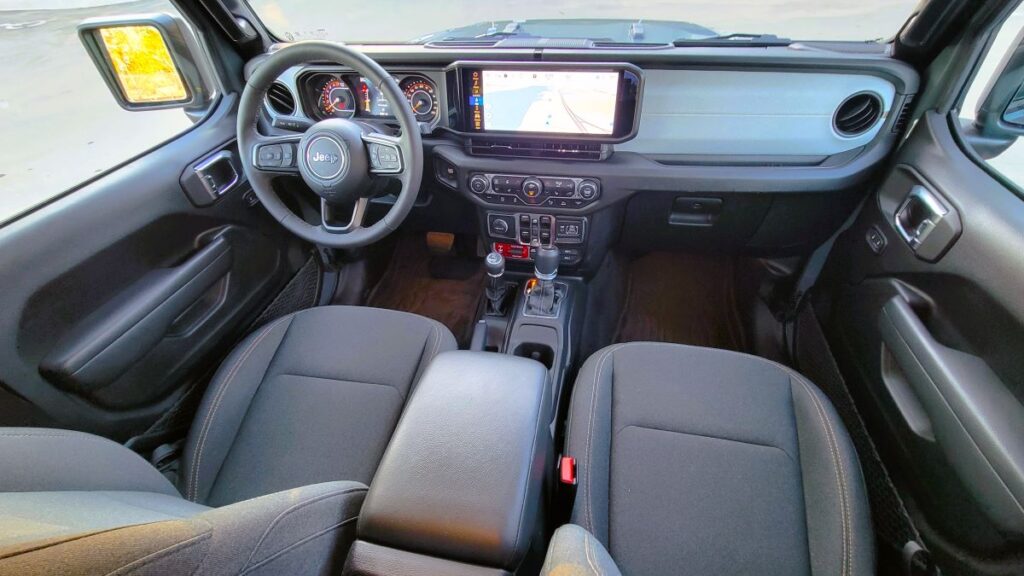
The dark gray dashtop is hard plastic, lighter cloth in front of the passenger and left side of the steering wheel. The passenger gets a grab handle. In case you get your boots dirty, there are rubber mats underfoot. A classic Willys Jeep silhouette climbs the passenger corner of the flat windshield.
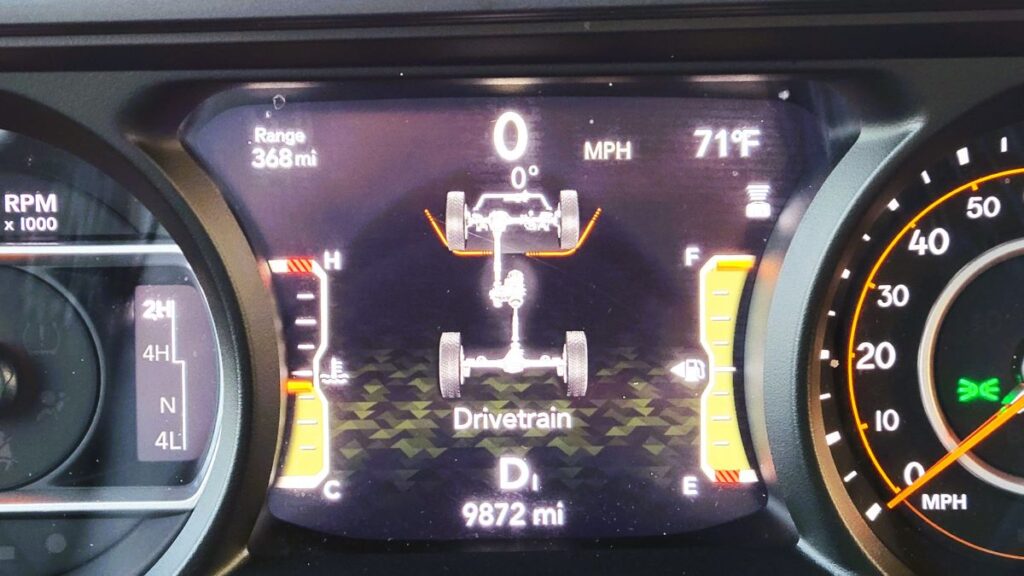
A chunky leather-rimmed steering wheel that manually tilts and telescopes is great to grab with stereo controls behind it. The analog gauge package is purposeful on a basically flat dashboard. There’s an analog 120-mph speedometer and 7,000-rpm (6,500-rpm redline) tach. In between, a 7-inch display with audio, navigation, fuel economy, tire pressure, tire-fill alert, digital speed readout and adaptive cruise status. You can also call up a pitch and roll, or four-wheel-drive/locked center and rear differential status.
As classic as those are, change has occurred center stage on the flat dash. There’s a 12.4-inch-wide center screen with map, Alpine HD audio, front and rear camera displays, climate control and multiple apps screens, plus wireless Apple CarPlay, Android Auto, Wi-Fi and more. Despite having “HD” audio there is no HD radio tuner. Instead, you’ll have to settle for analog radio without the additional channels and refined sound quality that HD Radio provides. We do have a “Hey Jeep” voice command for audio and other needs.
You can access Off Road pages with bigger off-road displays, engine gauges and more. Folks with gloved hands can rejoice. There are rubberized volume, tune and fan speed knobs, with big buttons for traction and hill descent controls and more. Under those, there are vertically-placed power window controls that are awkward to use, plus a 12-volt outlet and USB ports. Then lower you’ll find the rear axle lock button, OFF-ROAD+ mode that adjusts throttle, transmission and stability control when in 4WD high or low range, and buttons to control aftermarket goodies like lights.
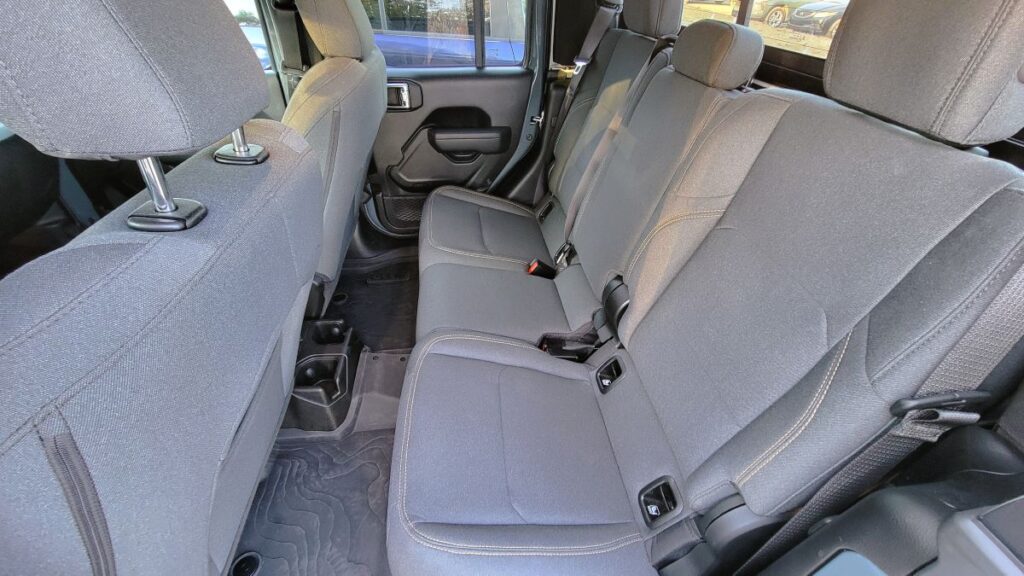
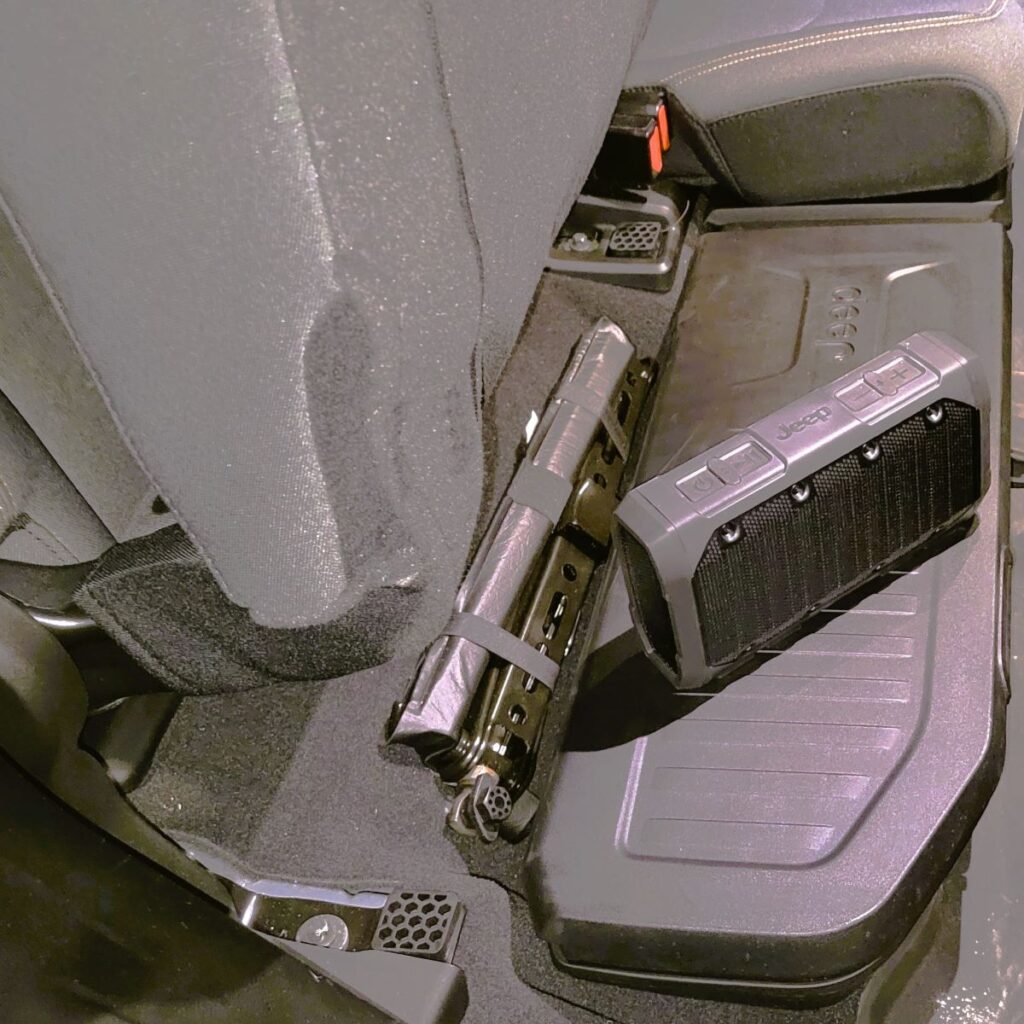
Added wheelbase means more interior length. Despite a somewhat tight rear door opening for tall folks, the bench seat offers comfortable leg room for two adults, with storage bins under flip-up bottoms. There are a/c vents, while an Alpine Bluetooth speaker is behind a fold-down seatback. It slots into a charging rack.
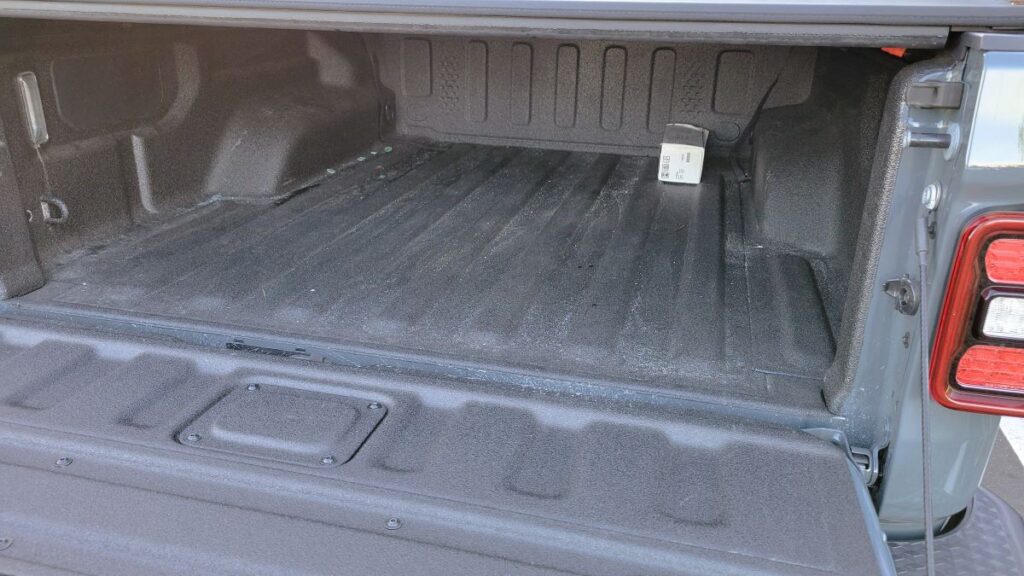
The pickup bed is a bit shallow with a high load lift-over. But at 35.5-cu.ft., with a lightweight aluminum tailgate, 110-volt outlet, tie-downs and LED lights under a soft cover, it is useful. It has 1,450 lbs. of cargo ability, plus up to 7,700-lbs. of towing ability.
The first Willys Jeep had an L134/Go Devil inline-4 with 60 hp, which was fine for hauling Gen. Patton around. This Willys has a 3.6-liter V-6 with 285 hp and 260 lb.-ft. of torque, plus a stop-start system that was evident when it reawakened as I left a stop. The 8-speed automatic helped get the most out of the beast, albeit with a growly grumble under acceleration.
The V-6 didn’t have enough power to get any wheelspin in a straight-line launch, but 10,000-mile-old Gladiator battled to 60 mph in RWD in a quick enough 7.4 seconds. The 8-speed transmission cleanly if carefully upshifts, with leisurely kickdown when passing was demanded
Passing was achieved fairly quickly, although this pickup’s 4,982 pounds and blocky aerodynamics means it has to work a bit to get there. At 70 mph, there’s wind noise around the plastic roof and side mirrors, plus tire rumble – hey, it’s a Jeep! We did a fair amount of highway driving and managed 19 mpg. For comparison, another 2025 Gladiator we tested a year ago launched to 60 mph in 7.9 seconds in rear-wheel-drive only, and 8 seconds flat in 4-wheel-drive high – it averaged 18 mpg..
The Gladiator’s steel frame and alloy body has classic solid axles front and rear, aided by a five-link coil front suspension. With that longer wheelbase, the ride was less bouncy, swallowing speed bumps and supple over potholes at neighborhood speed, with little of the hobby-horsing of a shorter Wrangler. It was comfier on commutes, other than a bit of bounce over some pavement gaps and tar strips.
We had the Command-Trac 4×4 system with two-speed transfer case, 2.72:1 low-range gear ratio, all/rear-axle locker, heavy-duty Dana 44 front and rear axles with a 4.10 rear axle ratio, skid plates and electronic sway bar disconnect on top of those off-road tires. It can wade through up to 30 inches of water with a 43.6-degree approach angle, 20.3-degree breakover and a 26-degree departure angle.
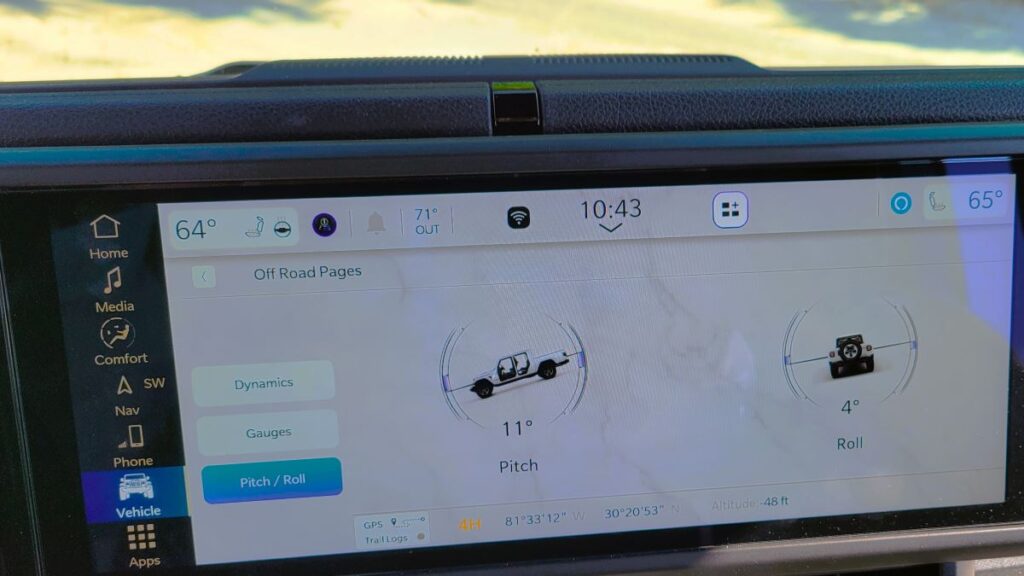
It took a tug to pull the transfer lever into 4-wheel-drive. Then we pulled it again into low as we aimed at very soft sand. The Gladiator plowed through with no effort. Power steering was fairly direct, easily breaking us out of ruts. The longer wheelbase and suspension absorbed those bumps nicely. The fairly narrow width, and knowledge that the four corners are plastic fenders, allowed me not to worry about scratches. It still has a tight turning radius. The off-road display showed us getting 11-degrees of downward pitch coming off a sand dune, and a 4-degree sideways roll. But the longer rear overhang meant its rump did dust some stuff at the base of dunes.
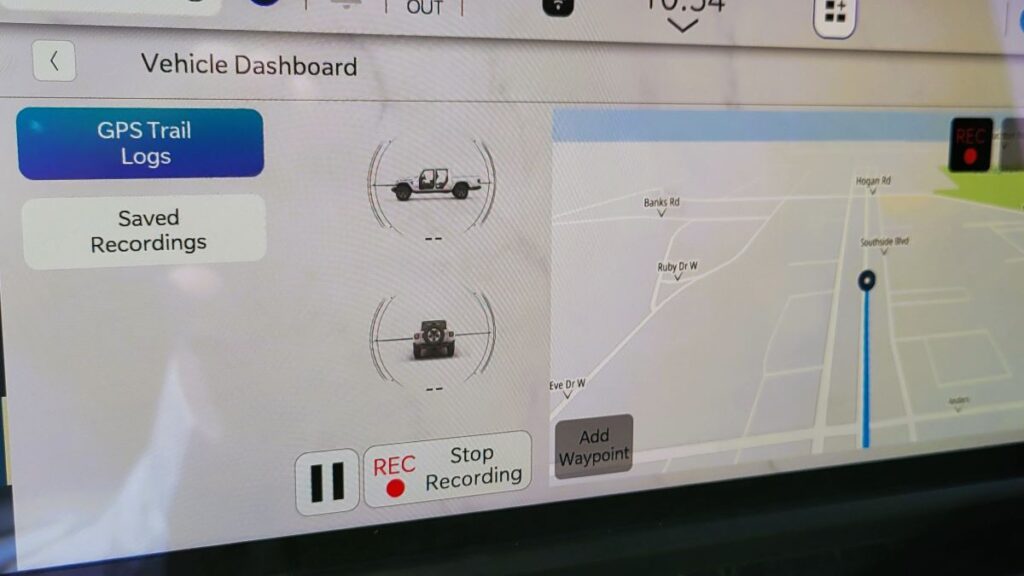
One other display was the GPS Trail Log, which is a digital bread crumb system that tracks your off-road drive, records it, and can be played back to get yourself un-lost.
As for daily running, the Gladiator (in RWD) was pretty neutral in basic cornering, with body roll that you felt a bit due to the high seating position. Push harder in a tighter corner and you could feel the front rubber — and its tread blocks — hiss a bit, but it was catchable. What surprised me was how well it hung on when driven around our skidpad in 4-wheel-drive high, other than some easy-to-handle understeer. But easily hang on in the wet with no understeer. Using those off-road pitch and roll meters, we saw the Gladiator take a 16-degree tilt on our asphalt skidpad.
The power steering had a slightly vague steering feel; with a hint of dead spot on center, meaning some minute course corrections on the street and highway. The disc brakes had a decent pedal feel and stopped the Jeep well with nose dive at full halt, and no apparent fade after repeated hard use. For safety, blind-spot monitoring, rear cross path detection and adaptive cruise control that maintained speed and distance to stop.
Our Jeep Gladiator Willys starts at $38,100 – options included $7,100 Customer Preferred package with Tru-Lok rear axle, 17-inch wheels and special suspension, LED headlights and more; $2,095 bed cover and 115-volt outlet; $3,690 hardtop/soft top; and a few more for a final $58,475.
Bottom line: A longer, leaner but still real Jeep that more comfortably holds people and stuff, still giving serious off-road ability with a smoother ride – still like the look, even if it is a bit classic.
2025 Jeep Gladiator Willys 4×4 Specifications
Vehicle type – 5-passenger four-wheel-drive sports utility pickup truck
Base price $38,100 ($58,475)
Engine type – DOHC 24-valve aluminum block V-6
Displacement – 3.6-liter
Horsepower (net) – 285 @ 6,400-rpm
Torque (lb-ft) – 260 @ 4,800 rpm
Transmission – 8-speed automatic transmission
Wheelbase – 137.3 inches
Overall length – 218 inches
Overall width – 73.8 inches
Height – 74.1 inches
Front headroom – 42.8 inches
Front legroom – 41.2 inches
Rear headroom – 40.8 inches
Rear legroom – 38.3 inches
Cargo capacity – 35.5 cu.-ft in 5.025-ft. bed
Towing capacity – up to 7,650 lbs.
Curb weight – 4,974-lbs.
Fuel capacity – 22 gallons
Mileage rating – 17-mpg city/22-mpg highway