
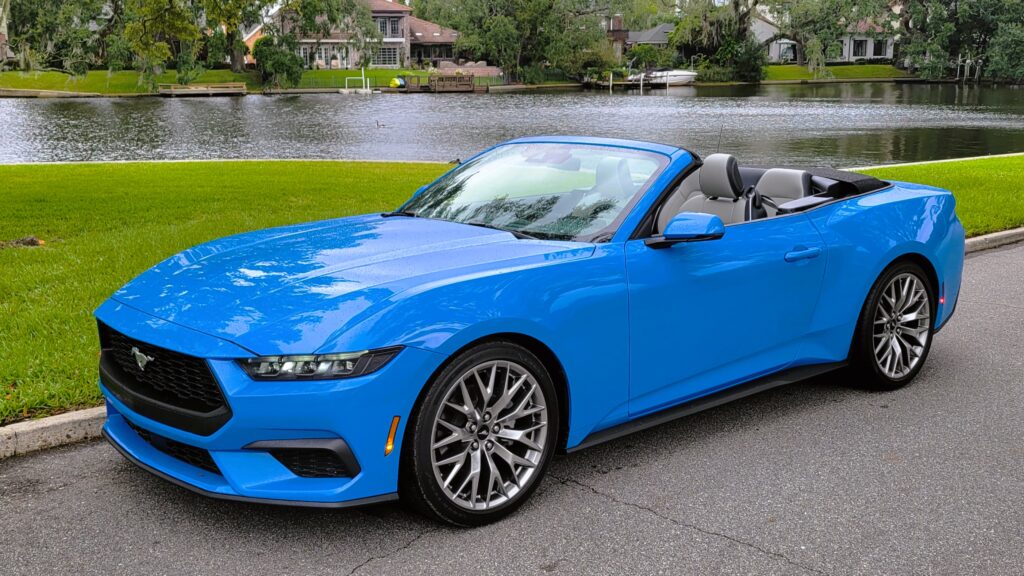


When Ford rocked the socks off the car world with the first 1964½ model year Mustang, the pony car was born.
But while Mustangs would someday host 500-hp engines, that first one wasn’t a V-8, but a 170-cu. in. (2.8-liter) inline 6 with 120-hp.
And after those Boss 428s and Shelby GT350’s rumbled off the late 1960’s Ford lots, came what some consider the bad old 1973-1978 days of the Mustang II, with its 2.3-liter Pinto inline-four with just 109 hp.
But four-cylinder engines aren’t the mouses of yesteryear, as Ford dropped the Focus RS’ turbocharged 2.3 liter EcoBoost four in to the Mustang in the late 2010s. So as summer fades to fall (sort of) in Florida, we gave a drop-top ‘Stang a hard ride.
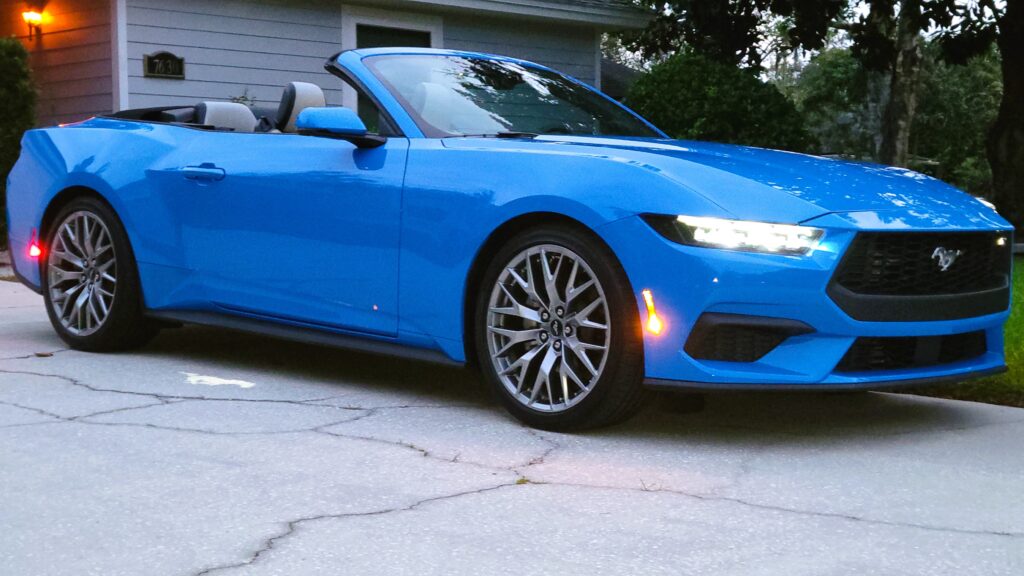
With a long nose, short tail and seriously defined rear fender shoulders framing a black cloth power top, our seventh-generation Mustang is 189.7- inches-long atop a 107-inch wheelbase, an inch longer than the sixth-gen, with about the same wheelbase.
Taken to Caffeine and Octane Jacksonville, it got admiring looks among hundreds of mega-cool classics and exotics. Some looks were for its long hood fronted by a chromed pony on a black hexagonal grill over deeper, fang-like vanes separating center from outer intakes and a deep air dam. Tri-Bar LED headlights live in slits under segmented DRL bars that also act as sequential turn signals.
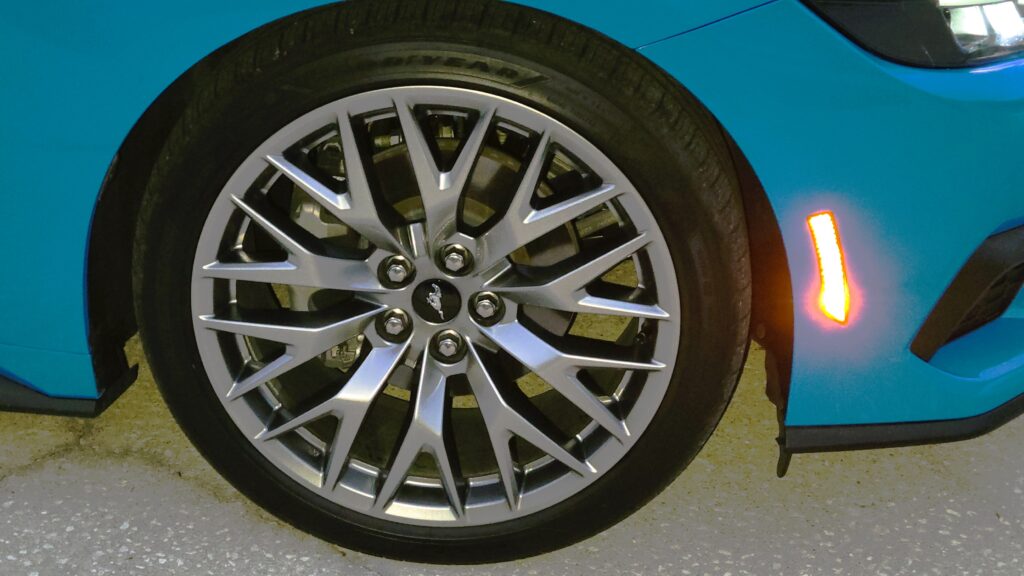
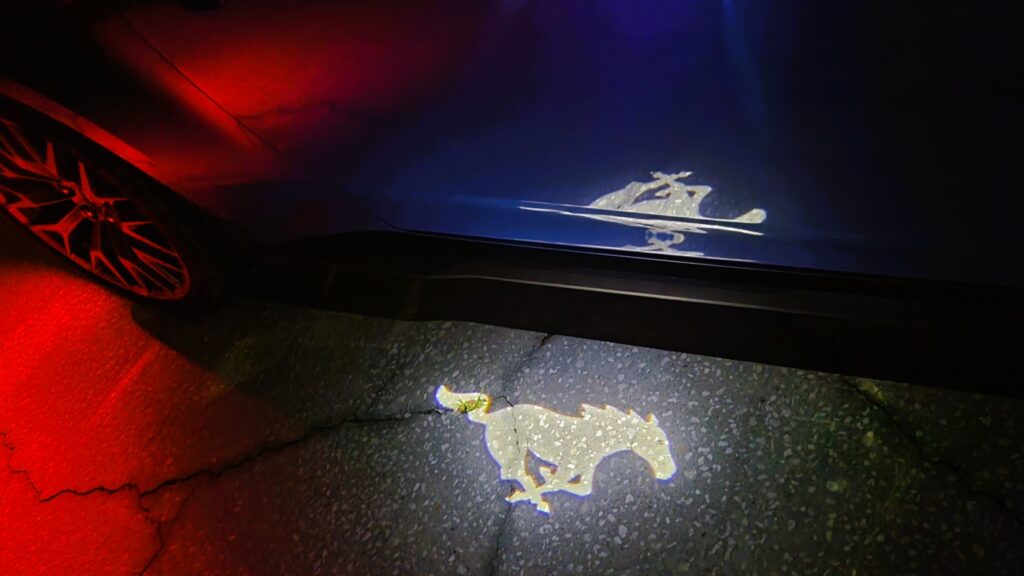
Flared front fenders tightly wrap around 20-inch Goodyear rubber on forked buff silver alloy wheels, also liked by many a passer-by. Front and rear wheels frame flared black lower door sills. Above the sills, smooth flanks with no design channel in doors that used to mimic original rear fender vents – and no Mustang badge. And at night, a galloping mustang is projected from side puddle lamps.
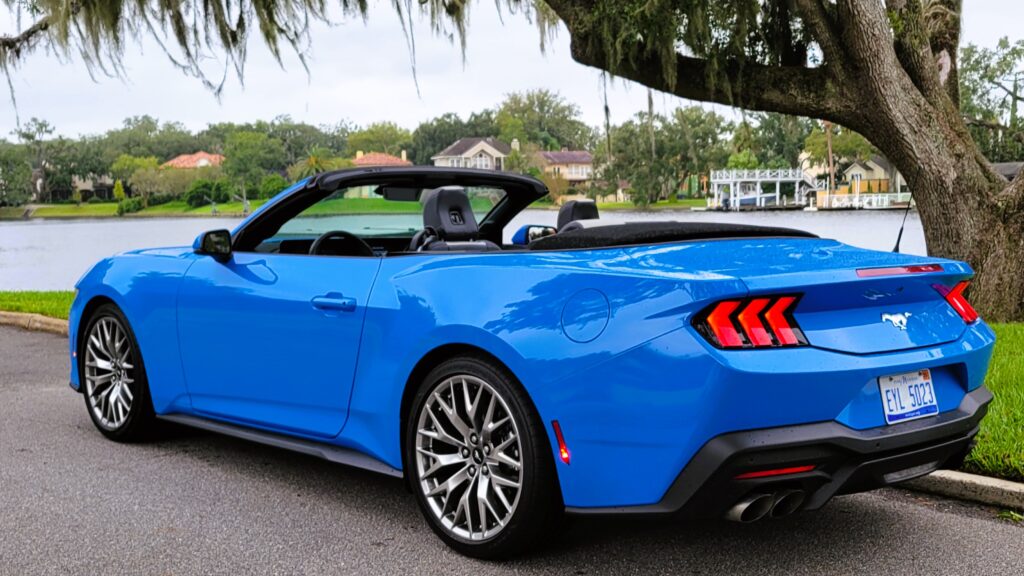
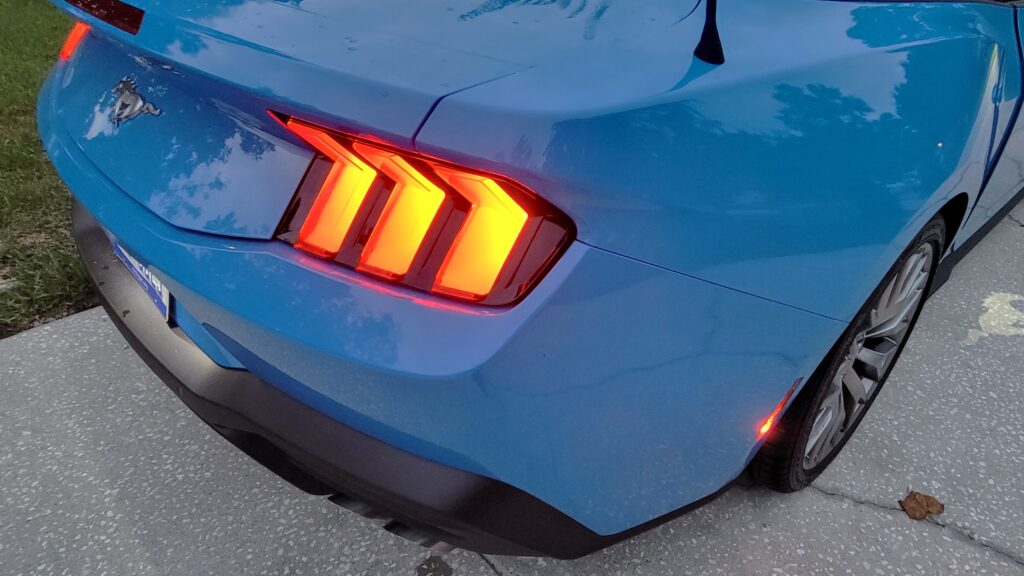
The windshield flows into that smooth cloth top, then down the notchback to a rear deck framed by wide, edgy rear fenders over a short overhang. Familiar tri-bar taillights live over a lower diffuser for improved aerodynamic balance. Despite a turbocharged four under the bonnet, there’s aggressive quad megaphone exhaust tips – also loved by folks.
Compared to the sixth-gen, it is a cleaner, yet more aggressive and lower look, even better looking when the soft top drops flush with the rear deck. And like a pony eagerly greeting its owner, the Mustang’s head- and taillights pulse as you walk up – you can also remotely drop side windows with the key fob.
Mustang aficionados had mixed feelings about the gen-7 dashboard.
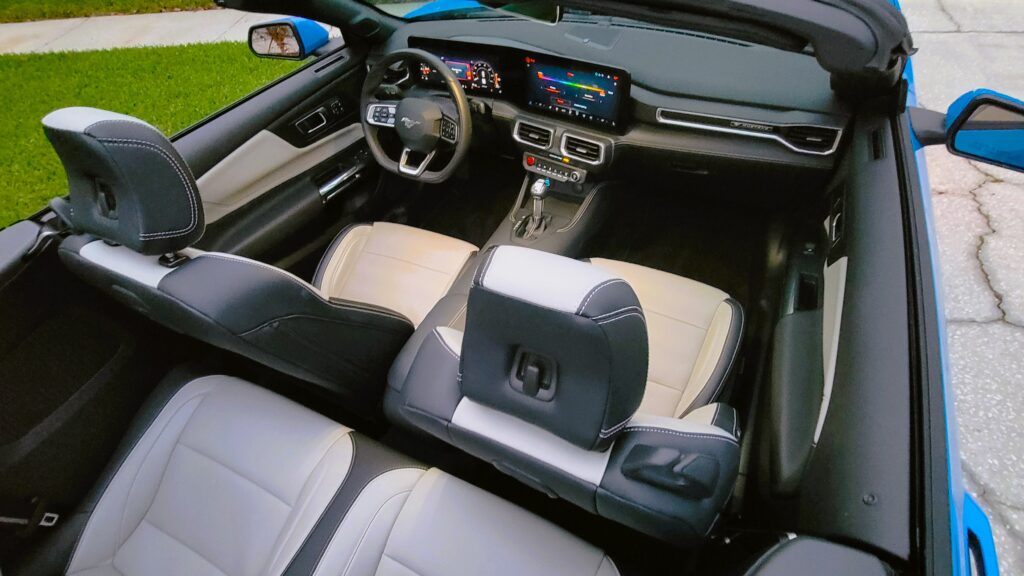
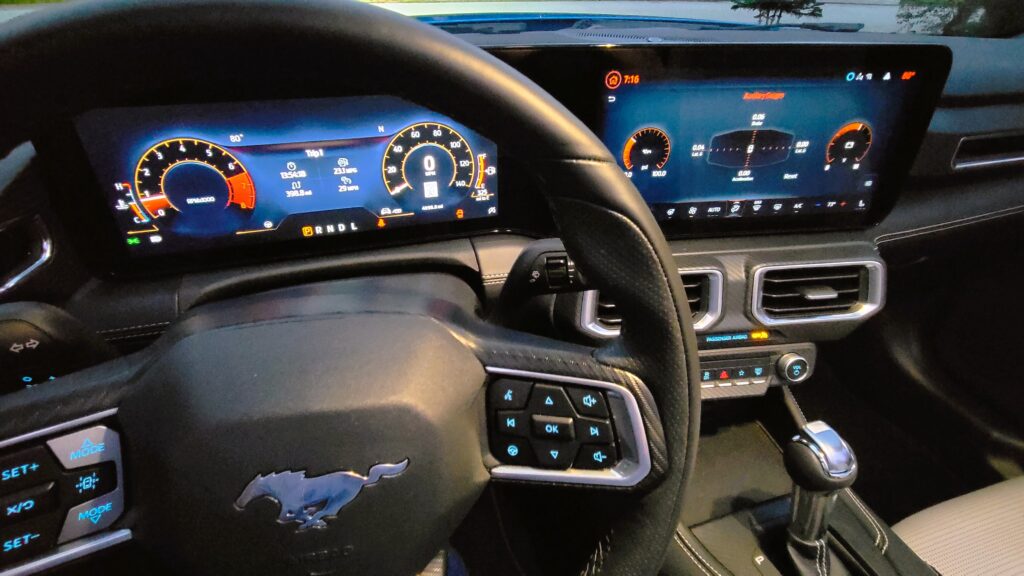
I know, I know – you are probably wondering, what happened to the classic dual-cowl dashboard design most Mustangs had since the beginning. Well, it went with the seventh-gen redesign in 2024 to handle the 12.4-inch-wide gauge display that flows into the 13.2-inch center stack screen amidst a mostly dark gray interior, some padded leather-like sections with contrasting white-stitching and buff alloy trim to break it up.
Although, a dual-cowl dashboard remains on sale in the Mustang Mach-E EV variants.
2025 Mustang Interior Offers LED Displays Of Earlier Models
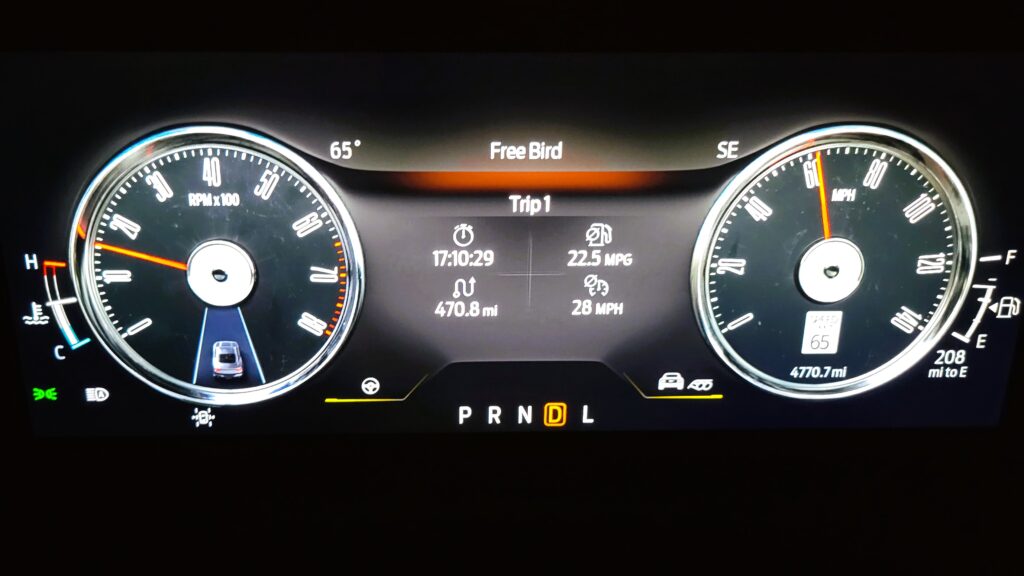
But fear not, pony car fans – that digital display in front of the driver can show a slick, de-cluttered speed display with info and curved mph and rpm, or a classic 1960’s first-gen 180-mph speedo and 9,000-rpm tach. A cool bar graph tach with digital speedometer is available; so’s white-faced SVT Cobra dials; or a nostalgic Fox body (’87-’93) analog design – simple white-numbered tach and speedo. All have screens for scrollable engine, navigation and audio info, as well as cylinder head, axle oil and engine oil temp and more.
The fat leather-clad, flat-bottom steering wheel tilts and telescopes, with the usual controls, including Drive mode, on upper spokes. The gray and white faux leather bucket seats, with more white stitching, are comfortable and supportive enough, their shoulder belts gaining a white racing stripe. Both get power seat bottoms and manual rake adjustment – the driver has memory presets.
The center touchscreen has icons on the bottom to handle seat heat/cooling, climate control and more, plus a “Home” screen button to call up maps, apps and more. Angled toward the driver, it can show a big navigation map, or shrink that down to show phone and audio.
2025 Mustang Keeps Physical Controls Despite Getting Bigger Screens
Physical buttons are limited to a small center dash panel for things like flashers, performance and traction controls – next to a red start/stop button and volume knob. But tap the drive mode selector and get Track Apps, Auxiliary Gauges (G-force, oil pressure and temp, even air/fuel ratio and more), although sometimes it took a while to boot up. Track Apps reveal buttons to handle acceleration and lap timers, and brake performance. There’s even a line lock, to lock front brakes and warm up the rears for better dragstrip launches.
There’s carbon fiber weave-textured hard plastic on parts of the dashboard, and basic plastic below the padded dash center, while the door armrest handle – where I rest my left knee – are hard as well. And while there’s wireless Android Auto and Apple Car Play, plus some USB ports, there’s no inductive charging area – just a padded rubber place to put the phone ahead of the gearshift, cup holders and electronic parking brake. The B&O Sound System is solid, powerful enough to hear at speed with top down. And the center armrest may be low, but it hides decent storage.
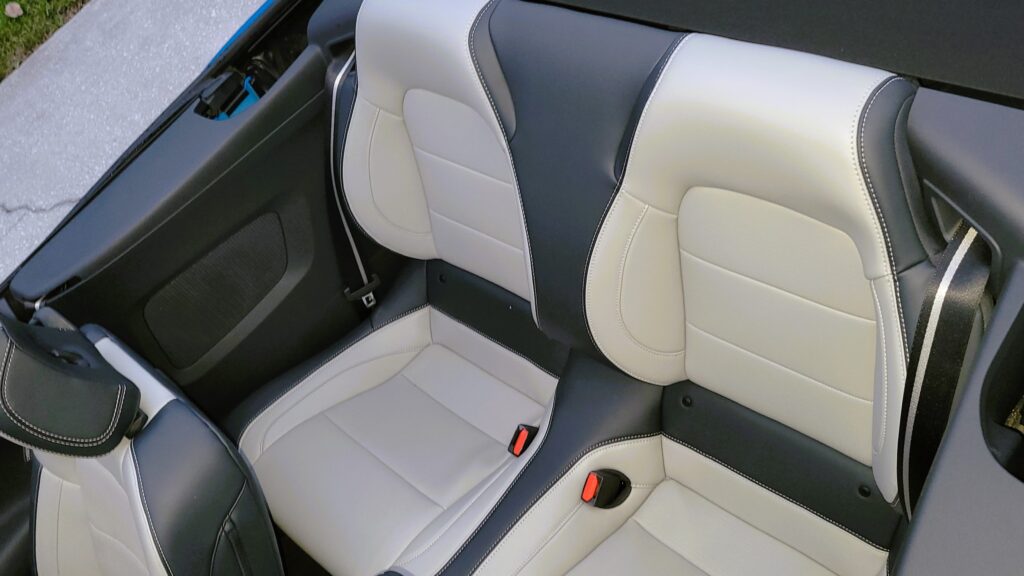
The front seats don’t power forward quickly to access the scooped-out rear mini-bucket seats, which are narrowed a bit in shoulder room due to the power top. Unless the front seats move up, it’s tight leg room for adults, although a 9-year-old belted in with room to spare. This pony car has a decent 10-cu-ft trunk (top up) with a big enough opening, plus storage space under the floor. But one side gets a bass speaker, and there’s no spare tire in the well, just an air pump.
2025 Mustang Has Well Engineered Convertible Top
Speaking of top down, it’s a bit old fashioned – you grab and twist a handle to unlatch it from the windshield header, then it power drops in just over 10 seconds, flush with the deck. Top up, it’s well finished inside and tight. The glass rear window big enough, although there’s some blind spots. Top down, wind buffeting is acceptable at speed, with just a hint of chassis flex in the windshield pillars over railroad tracks.
2025 Mustang Ecoboost Offers Keeps Sport Mode Fun
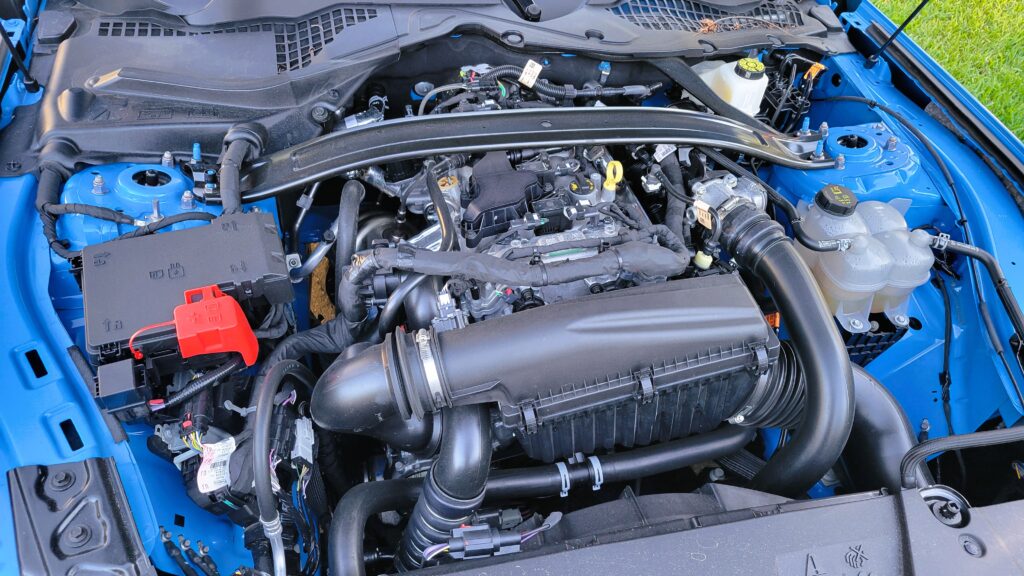
It was a surprise when Ford said that its sixth-generation (2014-2023) Mustang would offer a four-cylinder powerplant along with a V-6 and V-8. Now the seventh-gen carries on the tradition – mostly – with the EcoBoost four and two flavors of 5-liter V-8 – 315, 486 and 500-hp respectively. That turbocharged four-cylinder gets a strut bar over it to enhance stiffness.
OK, I loved the Dark Horse when I tested one for a now-defunct website a year ago – especially its 500 ponies. But our 2.3 EcoBoost was surprisingly punchy, with multiple Drive modes – Slippery, Normal, Sport, Track or Custom, where you select exhaust, shift and engine mode. You can also ramp up steering feel via another steering wheel button – but it does not stay in the firmer Sport setting when you shut down.
Sport drive mode also defaults to Normal. And with only a Low setting on the auto-box, which downshifts the gearbox when moved, there’s really no way to manually row up and down all gears. I’d love some paddle shifters. but at least in Sport mode, it downshifts rapidly with throttle blips in between, even a bit of overrun exhaust crackle.
The engine starts with a raspy bark, then moves out in Normal mode moderately, before briskly hitting 60 mph in 5.5 seconds. The transmission smoothly shifted as needed, and passing power was ample for any highway maneuver.
Tap in Sport mode, and put exhaust note into Track – the active valve exhaust has Quiet, Normal, Sport and Track – and we had a heck of a snarl under hard acceleration, but a bit wearing on long drives. It easily showed its hooves to other cars, launching quickly to 60 mph in 5.2 seconds. And if you left-foot-brake/right-foot-gas it, then let go, it will lay some rubber enroute to a snarling 60 mph in 5.1 seconds – not bad for a four.
That’s not too bad compared with the Dark Horse – Normal drive mode had power off the line, and some wheelspin en route to 60 mph in 4.6 seconds. Sport mode gave serious power offline, plus controlled wheelspin – 60 mph in 4.2 seconds, and 100 mph in 9.1 seconds, with a deep-chested exhaust bellow. For fun, Track mode gave controlled wheelspin at launch – decisive shifts as it tracked straight – for 60 in 4 seconds, and 100 in 8.9. For fun, how about my long-ago test in a 2017 Ford Mustang Convertible – a 310-hp 2.3 EcoBoost with 60 mph in 6.2 seconds.
Design Comparison: Mustang Coupe, Convertible vs. Mustang Mach-E
There’s a unitized steel chassis with perimeter subframe with McPherson strut front suspension, and integral-link independent rear. And weighing in at 3,741 lbs. for our EcoBoost Convertible, vs. 4,012 for the V-8 version, the 271-lb. loss of weight in the nose made our droptop fairly nimble on its Goodyear tires.
We had a firm, tightly controlled ride, supple with just enough rebound control over sharper edges to make the ride fairly decent. The rear end handled bumps in curves with no rear hop. There was no suspension or body judder on our 4,900-mile-old test ragtop. It’s a livable commuter with minimal body roll in corners. Powering up an expressway ramp, the grip just kept coming as we roared out. There was no understeer and directional control was solid. A 3.15:1 limited-slip rear axle kept everything in control as we dove deeper into corners, transmitting power to the ground effortlessly. The convertible could power out its tail a bit on exits for fun while remaining very catchable in Track mode. Stability control joins in quietly as needed.
We also stopped just fine due to 12.5-inch vented front disc brakes with twin-piston floating aluminum calipers; and the same diameter solid rear discs with single-piston floating calipers in back, connected to a very sensitive and controllable pedal for great stops, time and time again from high speed with no fade.
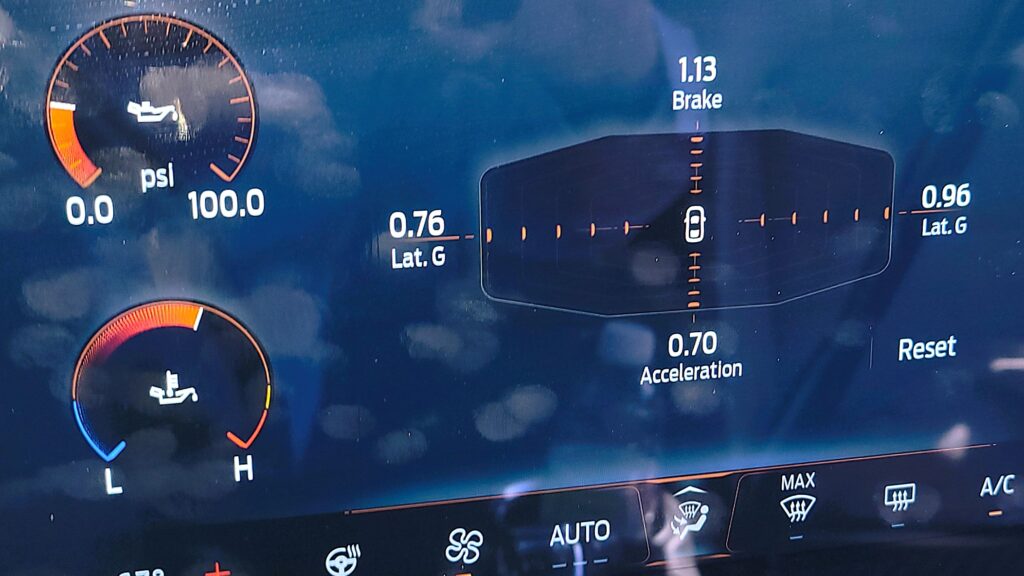
One display for the Mustang is a gauges app that plants a G-force meter dead center. We saw a moderate .70Gs on launch, and a good .96Gs in lateral loading on our skid pad. We secured repeatedly great 1.13Gs when the brakes were applied hard – nice! And we also averaged up to 23 mpg on regular. The Dark Horse showed an impressive .81Gs at launch, 1.15Gs on skidpad, 1.26Gs at full stop – and 20 mpg. For safety, lane centering and adaptive cruise control. It’s fairly quiet bar tire noise and some wind noise at speed.
A base Ford Mustang convertible with EcoBoost four starts at $40,120; our Premium pony began at $43,045, options including $1,450 for 20-inch wheels; $1,225 tunable exhaust; $995 B&O sound system; $200 carpet mats and $395 Grabber Blue paint – final price: $51,905. Domestically, there’s no longer any competition since GM dropped the Camaro and Dodge doesn’t make a factory convertible Charger.
Bottom line: Built in Flat Rock, Mich., this is a sporty, fun, usable and cool drop-top that shouldn’t feel ashamed with half as many cylinders.
2025 Ford Mustang EcoBoost Convertible Premium Specifications
Vehicle type –rear-wheel-drive, four-passenger sports convertible
Price – $43,045 ($51,905 as tested)
Engine –Turbocharged cast aluminum DOHC inline four
Displacement – 2.3 liters
Horsepower (net) – 315 @ 5,500 rpm
Torque (lb-ft) – 350 @ 3,000 rpm
Transmission – 10-speed automatic w/drive settings
Wheelbase – 107 inches
Overall length – 189.4 inches
Overall width – 81.9 inches w/mirrors
Height – 54.8 inches
Front headroom – 37.6 inches
Front legroom – 44.5 inches
Rear headroom – 35.7 inches
Rear legroom – 29 inches
Cargo capacity – 13.3 cu. ft.
Fuel mileage – 14 mpg city/22 mpg highway
Weight – 3,741 lbs.