


You never forget your first one – EV pickup truck, that is.
When Ford introduced its 2022 Lightning, it was the only major company-made EV pickup I’d ever driven. I had to park it on my front lawn to slow-charge it overnights off my 115-volt Christmas light outlet. And I found out mine was one of just over 15,600 sold in 2022.
In a world now with a fair number of EV pickups – Tesla Cybertruck, Chevrolet Silverado EV, GMC Sierra EV, Hummer EV, and Rivian R1T – Ford is a sales leader with 33,000-plus sold in 2024 and another 10,829 through May of this year. That’s despite a general cooling of EV vehicle sales growth nationwide that’s seen Ford back off on plans for some future electrics, although it has announced it will be building a brand-new low cost EV pickup.
So let’s see what zappening with the fourth model year of Lightning – no thunderstorm puns, please.

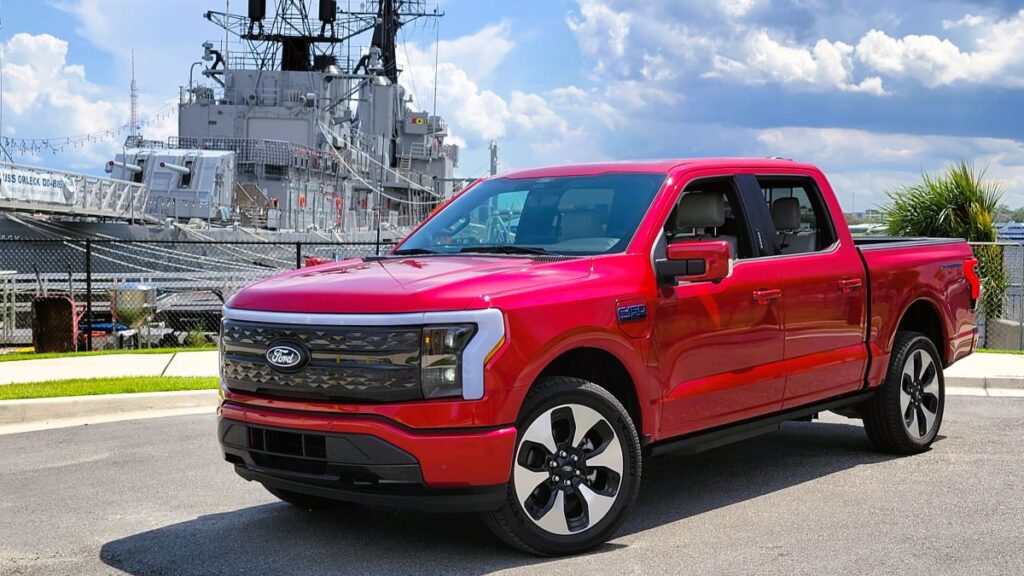
Looking at our 2025 Ford F-150 Lightning Platinum edition, there’s almost no visual difference between it and the 2022 I tested with 5.5-foot-long beds. But a closer look shows one change – a gloss black grille – accenting the all-aluminum body atop steel frame.
There are stacked LED headlights, a glowing light bar flowing over and alongside them, and Ford emblem on that grille. This EV’s bumper is smoother than the gas version’s, with tow hooks framing a lower inlet to cool batteries and brakes. There’s a chest-high hood and rounded fenders with an F-150 badge atop the driver’s-side charging port hatch. Slim running boards tuck in at the sills. They deployed every time I walked by the truck with key fob in pocket.
It’s got big, power-folding side mirrors next to side windows with a dip so you can see down to the pavement. Familiar F-150 slab sides remain. Out back, big zig-zag LED taillights connected by a cross-tailgate light bar over a step bumper. The pickup’s flat-faced silver and black alloy wheels are designed to slip through the wind and are shod in street-biased 22-inch General Grabber rubber.

Taken to a classic car cruise or two during my weekend drives, it got lots of looks, especially when parked next to a classic pickup.
Platinum Level Interior Is Practical
The interior, with top-line Platinum-level options, looks like other F-150s except for a 15.5-inch central touchscreen also seen in Ford’s Mustang Mach-E EV. Running boards and grab handles on A-pillars make it easy to get into this dark gray-over-white leather interior accented with glossy veined silver woodgrain and chrome.

Platinum trims the hard plastic dash in padded leatherette with double stitching. Those leather seats get heat, cooling and massage. They are comfortable and mostly supportive, if a bit flat. There’s a power tilt/telescoping steering wheel with audio, BlueCruise, voice command and information screen buttons.
The 12-inch digital gauge cluster offers speed and driver safety system status, plus EV stuff like range, battery charge and power use/recharge. Center stage is a configurable display with power usage vs. miles driven, as well as audio, navigation and more. When the Lightning’s semi-autonomous BlueCruise highway driving system activates, the power gauge transforms into a “Hands-Free” icon. Audio choice, outside temperature and compass information line the bottom of the driver’s guage cluster screen.
That central touchscreen eliminates most physical buttons but does have a physical volume control, which transforms into fan speed adjust at the tap of an icon. At first it feels like too many moves, but you get used to it. The huge map has a slim swipe-able menu strip to access audio, phone, miles/range and more. There are also touchscreen controls for dual-zone temperature controls, plus heated/cooled seats.

To activate the massage feature you have to tap the lumbar support on the seat bottom – that activates the massage and lumbar control icon on the center screen. You tap it on, then select the kind of massage and speed you want. A few more real buttons wouldn’t hurt.
That said, screen buttons access some main menus, like a Home Screen with buttons to access all functions including expanded range/charge, drive modes, 1-pedal driving, locking e-differential, Smart Hitch, and OnBoard Scale. You can tap on external cameras in a tight parking spot. And you can find EV charging stations nearby, although once, I got a “Chargers Unavailable” pop-up. I then tapped on the screen and dozens popped up.

There’s SYNC 4A with cloud-connected navigation and wireless Apple CarPlay, Android Auto and SYNC AppLink. There’s Alexa, self-park, valet and driver assistance access. But somewhat hidden left of the steering wheel is a control panel for power-opening frunk and tailgate, and power-adjust pedals.
The center console is a Swiss Army knife of usefulness with an inductive phone charger and two USB plugs, plus a chunky gearshift that drops into the center console so the center armrest can unfold into a desk for laptop work when parked. See the video at the top of this post for a demo. There’s power (12- and 120-volt) plugs nearby, plus an upper and lower glovebox.

F-150 Lightning Can Power Remote Worksites
There’s all the room you’d expect in the back bench seat, a long moonroof extending over those passengers, with a power rear window. That bench easily handles three adults’ leg and head room, with heat for those seated outboard, plus a/c vents and more USB ports. There’s storage bins under the flip-up 60/40 split seat bottoms.
In back, the 5.5-foot bed is easily accessible via power tailgate. It’s got a fold-out step, handle and tie-down hooks, able to store up to 2,000 pounds of cargo – about 1,000 less than the gas version. There’s three outlets with up to 7.2 kilowatts to power tools, or to use Lightning to power your home for up to three days – with an optional Vehicle to Home (V2H) accessory kit.

With no gas engine up front, the power hood reveals a usable 14.1-cu. ft. frunk that handles 400 pounds of payload. There’s four electrical outlets and two USB chargers, plus a drainable under-floor compartment for ice and drinks. I got tired of folks asking where my engine was – which brings us to the important part – what moves you, and it.
Our Lightning Platinum has inboard fixed magnet AC motors on each axle – with a 131 kWh extended-range battery and a total of 580-hp, plus a whopping 775 lb.-ft. of torque. The Lightning’s four-wheel-drive allocates power to the end that needs it. The 2025 Lightning now charges at a maximum of 500 amps, a boost from the previous 450 amps, which is good for a peak charging speed of roughly 190 kW.
Ford says our Platinum’s extended-range battery has up to 300 miles range, and a 8,600-pound towing limit. Starting out with a 90% battery charge, and an indicated 257 miles of range, we drove in Normal mode with max regenerative braking engaged — effectively 1-pedal driving that goes to maximum regen the second you back off throttle.
Related: More F-150 Lightning Coverage
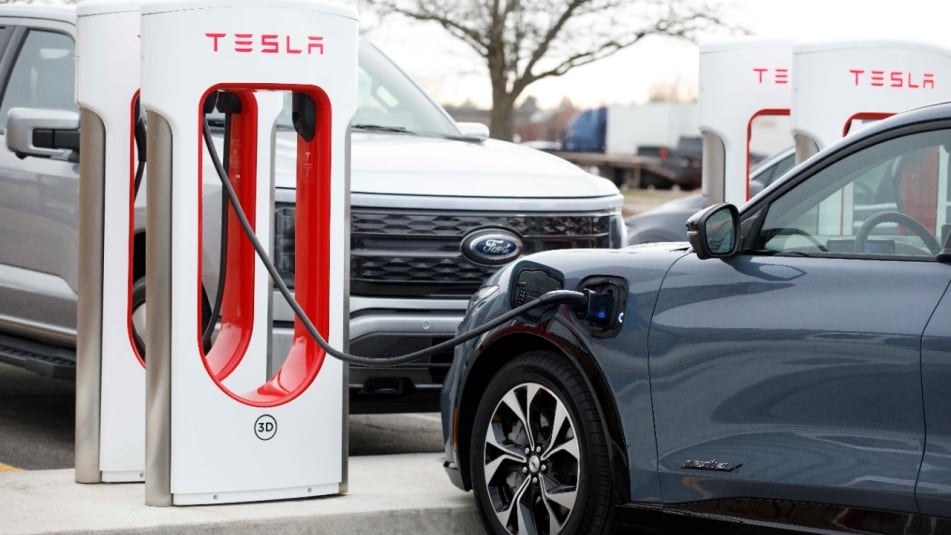
Ford Will Offer Complementary Mach-E, F-150 Lightning NACS Supercharger Adapters
EV Rider’s 2023 Top 10; What’s Ahead In 2024
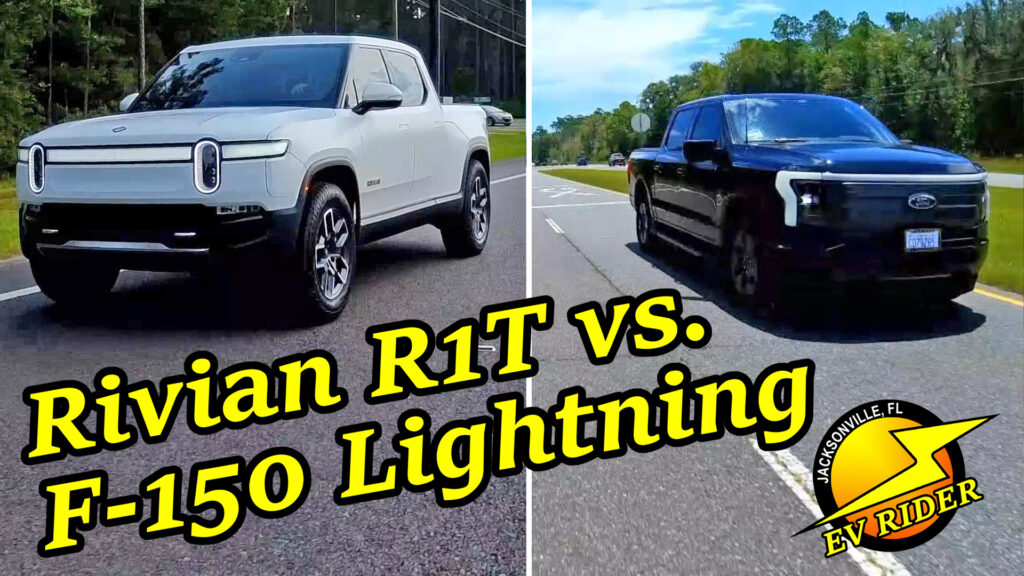
Showdown: Ford F-150 Lightning Vs. Rivian R1T
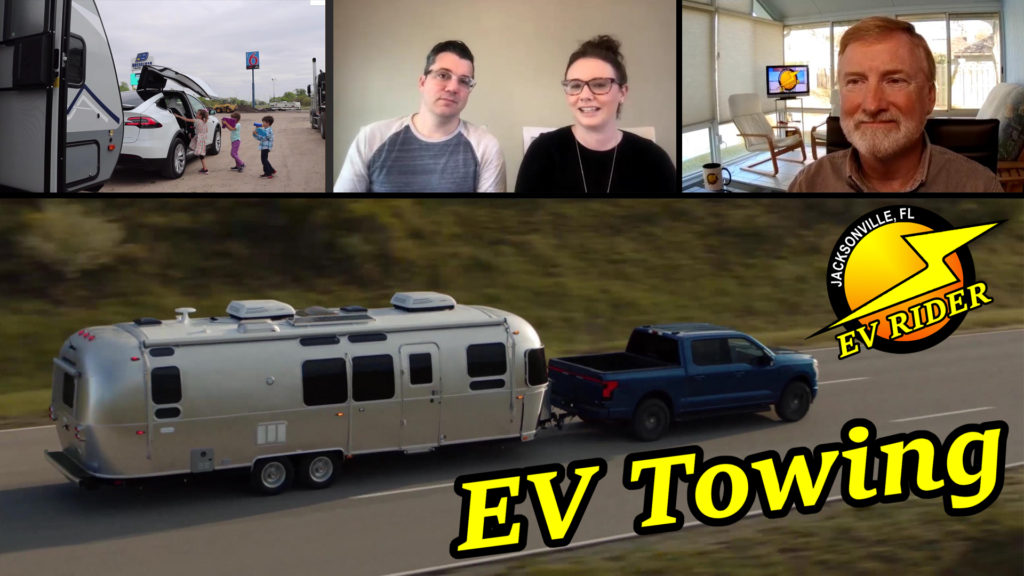
Will Wave Of New Tow-Worthy EV Pickups Need To Unhitch To Charge?
When we recharged 130.5-miles later, we tallied that we’d done at just over six miles better than the estimated miles-left display. The max regen brake setting on our 2,300-mile-old test truck seemed to help, adding a bit back on the “miles-remaining” display in Normal mode, or least holding off the drop. And the truck talks back – we got “100 percent energy return” on the display many times, showing that 1-pedal driving was putting power back into the battery.

Ford says Level two charging — 240 volts — means a full charge from nothing takes 13 hours, and we saw an indicated 320 miles range after one overnight topping off. A Level three charger – 480 volts – will take 38 minutes to go from 10% to 80% in ideal conditions, Ford says. But the slower DC charger we used when we plugged in took 41 minutes to get from 47% to 90%. That took us from 133 miles to 264 miles range, and cost $29. Good news – we had the adapter to use a Tesla Supercharger that massively expands the number of locations across America to get DC fast charges.
Lightning Performance Excels
Now the fun part – whether in Normal or Sport drive mode, our truck belied its 6,000-plus pound weight with instant torque the millisecond you tap the pedal. Throttle tip-in is sometimes abrupt, but passengers were amazed at even part-throttle acceleration.

Launched in Normal mode, our EV truck hit 60 mph in 3.9 seconds. Choose Sport – Off Road and Tow/Haul drive modes also available – and we had a bit of front wheelspin, the nose lifting a bit as it hit 60 mph in 3.4 seconds – in a 3-ton pickup! Outside of some EV powertrain sound that you can engage – a gentle-but-cool growling under acceleration – all we heard was a hint of tire and wind noise. Despite that urge, our Lightning was well-mannered as it launched, with passing power whenever needed, acceleration nudging you into your seat.
Let’s compare that to the test I did last year in a now-defunct website in a 2024 Lightning – 4.2 seconds to 60 mph in Normal mode, and 3.8 seconds in Sport, with a bit more front wheelspin, quickly controlled. But just so you know, Sport mode fun saw us lose three miles of indicated range after three quick launches in a ½-mile test route. And the more weight you tow/haul, the less your range will be, say pundits.

F-150 Lightning Handles Well Despite Weight
The Lightning weighs just over 6,100 lbs. vs. a gas-powered SuperCrew’s 5,540, despite an aluminum-intensive body thanks to those heavy batteries. It rides on an independent double-wishbone front suspension, with independent semi-trailing arms in back and heavy-duty gas pressurized twin-tube shocks all-round. The resulting ride was much nicer than most unladen trucks, almost plush, easily handling holes and speed bumps with a slight-but-controlled after-bounce.
The low center of gravity and all-wheel-drive helped in handling, as the front and rear motors allocated drive as needed in curves. We had understeer, but not much body roll if we pushed it in corners. Power steering had a firm, somewhat artificial feel in Sport mode – a bit lighter in boost in Normal. In fact, between the EV motor thrum, seamlessly smooth passing power, tighter steering feel and composed handling, Sport mode was the one to drive in – acceleration, passing, steering feel all very nice. And while the regen brakes had a bit of an initial grab, as do some, the 1-pedal throttle was what I loved to use – I could gauge where it would come to a full stop most of the time. When we did use the left pedal, it had a solid bite high on the pedal and gave us decent stops with some nose dive from 60 mph, and no fade after repeated use.

For off-road, there’s 8.4 inches of ground clearance as well as metal skid plates and waterproof shielding on the batteries. We only played in a sandy, grassy lot and found good traction, plus a comfortable ride with no harshness through dips.
For safety, it has lane-departure with very insistent lane-keep assist — I turned it off. Adaptive cruise control has full stop-and-go ability. And Blue Cruise’s autonomous magic – only on interstates and some state highways – stays in lane and away from others, other than a bit of wander sometimes. Sensors make sure you keep eyes open or it will ping repeatedly with a stern display, then tap brakes to wake you up. At odd moments on interstates, it just turned off, then back on. I liked auto-lane change — tap the stalk and it neatly does it.
A base 2025 Lightning Pro starts at $54,780 – our Platinum Extended Range was $84,995 with lots standard except for: $495 for Rapid red paint, $400 running boards, $600, $595 bed spray and $175 spare, for a final $87,260 minus delivery.
Bottom line: This a real truck that offers reasonable range on a full charge -although less than an ICE F-150 with a full tank. The Lightning is VERY quick, well-mannered and sure-footed. It even makes a nice sound on throttle.

2025 Ford F-150 Lightning Platinum Specifications
Vehicle type – full-size 4-door, 5-passenger four-wheel-drive full electric pickup
Base price – $84,995 ($90,780 as tested)
Engine type – 131 kWh battery pack and dual AC motors
Horsepower (net) – 580 hp total
Torque – 775 lb-ft. total
Wheelbase – 145.5 inches
Overall length – 232.7 inches
Overall width – 96 inches w/mirrors
Height – 78.3 inches
Ground clearance: 8.4 inches
Front headroom – 40.8 inches
Front leg room – 43.9 inches
Rear headroom – 40.4 inches
Rear legroom – 43.6 inches
Frunk volume – 14.1 cu.ft.
Cargo bed – 5.5-foot-long/ 52.8 cu. ft. volume
Payload/towing – 2,000 lbs./up to 8,600 pounds
Weight – 6,100 lbs.